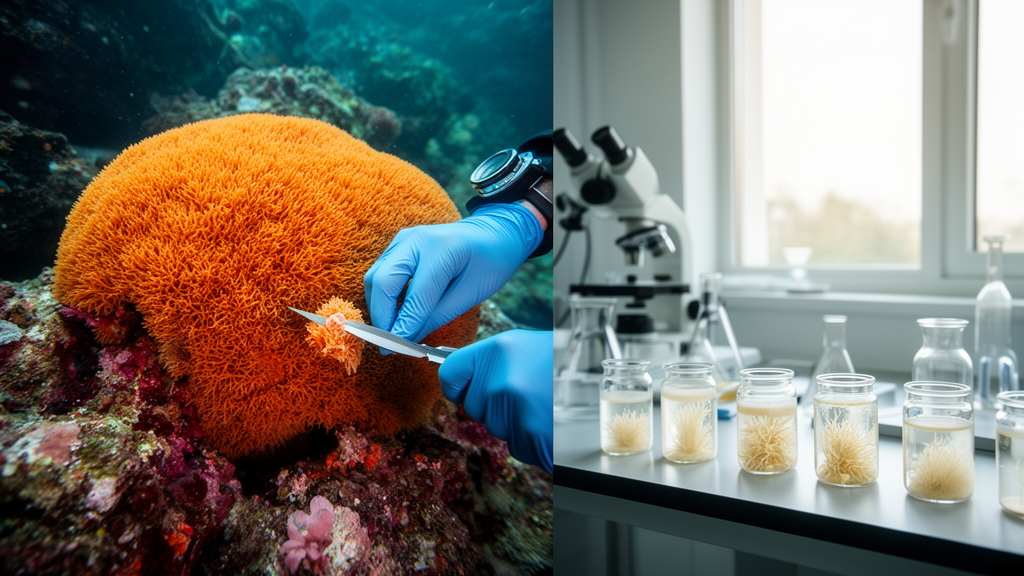
A fungus pulled from the tissues of a marine sponge collected off Vietnam has yielded a small library of biologically active molecules, several of which show measurable antimicrobial and cancer-cell-killing properties in laboratory assays. The organism, a strain of Aspergillus versicolor designated QT21, was isolated from the sponge Spheciospongia sp. gathered at a depth of eight meters around Con Co Island in Quang Tri Province. When researchers cultured the fungus and chemically dissected its extracts, they recovered twelve distinct secondary metabolites spanning sterols, a naphthalenone, a simple phenol, cyclic dipeptides, an acetylated tryptamine derivative, and two common nucleosides. One of those compounds, a fungal metabolite known as isosclerone, had never previously been reported from the species A. versicolor, making its detection a first for this widely studied microorganism.
The work, published in the journal Applied Biological Chemistry, began with a deliberately unglamorous procedure. Half a gram of sponge tissue was crushed, homogenized in sterile seawater, briefly heat-treated, diluted, and spread onto agar plates. After a week of incubation at 28 degrees Celsius, a single fungal colony was picked out and purified. Identification rested on two complementary lines of evidence: classical morphology, including the characteristic biseriate conidiogenous structures and spherical, smooth-walled conidia typical of Aspergillus, and molecular barcoding of the 18S rRNA and ITS gene regions. The 18S rRNA sequence matched the A. versicolor type strain with 99.64 percent identity, while the ITS sequence showed a perfect 100 percent match, and phylogenetic trees built by both Neighbor-Joining and Maximum Likelihood methods placed QT21 squarely within the A. versicolor clade. The gene sequences have been deposited in GenBank under accession numbers PZ164095 and PZ790593.
Scaling up the chemistry required patience and considerable glassware. The fungus was grown in fifty flasks on solid potato dextrose agar medium for ten days, and the resulting cultures were exhaustively extracted, first with ethyl acetate and then with methanol under ultrasonic treatment. The ethyl acetate extraction yielded 10.0 grams of crude material and the methanol extraction a much larger 90.0 grams. These extracts were then fractionated through a gauntlet of chromatographic techniques, including medium-performance liquid chromatography, silica gel columns, Sephadex LH-20 size-exclusion separation, and preparative thin-layer chromatography, until twelve pure compounds emerged in yields ranging from roughly 2.5 to 5 milligrams each. Structures were assigned using one- and two-dimensional nuclear magnetic resonance spectroscopy on 500 and 600 MHz instruments, cross-checked against published reference data.
Four of the twelve molecules are closely related ergostane-type sterols, and their subtle structural differences turned out to matter. Compounds 1 and 2 both carry a 5α,6α-epoxide ring and hydroxyl groups at positions 3 and 7, but they differ in the location of a single double bond within the steroid nucleus: between carbons 8 and 14 in compound 1, and between carbons 8 and 9 in compound 2. Compound 5 is ergosterol, the classic fungal sterol, while compound 6 resembles it but bears an additional hydroxyl group at carbon 7. The remaining isolates included isosclerone, the phenol orcinol, three cyclic dipeptides built from proline, glycine, alanine, tyrosine, and tryptophan residues, N-acetyltryptamine, and the nucleosides uridine and adenosine.
To probe biological activity, the team tested all twelve compounds against a panel of seven reference microorganisms: three Gram-positive bacteria, Enterococcus faecalis, Staphylococcus aureus, and Bacillus cereus; three Gram-negative bacteria, Escherichia coli, Pseudomonas aeruginosa, and Salmonella enterica; and the yeast Candida albicans. Assays were run in 96-well microtiter plates with ciprofloxacin and cycloheximide as positive controls for bacteria and yeast respectively. The pattern that emerged was strikingly lopsided. Most compounds showed selective activity against Gram-positive bacteria and yeast, while none of the isolated metabolites displayed significant activity against the Gram-negative strains, with minimum inhibitory concentrations at or above 256 micrograms per milliliter. The authors attribute this asymmetry to the outer membrane of Gram-negative bacteria, whose lipopolysaccharide-rich architecture acts as a permeability barrier that blocks many small molecules from reaching their targets.
Ergosterol, compound 5, proved to be the antimicrobial standout. It inhibited E. faecalis with a minimum inhibitory concentration of 32 micrograms per milliliter, and B. cereus and C. albicans at 64 micrograms per milliliter each. Compound 2 showed moderate inhibition of the same three organisms, with MIC values of 64 micrograms per milliliter against E. faecalis and 128 micrograms per milliliter against B. cereus and C. albicans. Compound 4, orcinol, was active only against E. faecalis at 128 micrograms per milliliter, and isosclerone showed weak inhibition of E. faecalis and B. cereus at 256 micrograms per milliliter.
The cytotoxic screen told a complementary story. Using the MTT assay against three human cancer cell lines, A549 lung carcinoma, MCF7 breast cancer, and HepG2 hepatocellular carcinoma, with ellipticine as the positive control, the researchers found that compounds 1 and 2 were the most potent. Compound 1 inhibited all three lines, with IC50 values of 14.67, 16.31, and 13.07 micrograms per milliliter for A549, MCF7, and HepG2 respectively. Compound 2 was even more potent but selective, killing A549 and MCF7 cells with IC50 values of 11.34 and 10.91 micrograms per milliliter while showing no cytotoxic effect on HepG2 cells even at 100 micrograms per milliliter. Compounds 4 and 5 were weaker, with IC50 values ranging from 43.72 to 51.35 and from 70.40 to 83.02 micrograms per milliliter respectively, and the remaining compounds, 3 and 6 through 12, were inactive against every line tested.
Because compounds 1, 2, 5, and 6 share a common sterol framework, the authors used them to sketch preliminary structure-activity relationships. The single difference in double-bond position between compounds 1 and 2 was accompanied by markedly different biology: compound 2 outperformed compound 1 against E. faecalis, B. cereus, and C. albicans, and showed stronger but more selective cytotoxicity. Comparing compounds 5 and 6 suggested that retaining unsaturation at carbon 7 favors antimicrobial activity, whereas converting that double bond to a 7β-hydroxyl group attenuates it, with compound 6 showing an MIC of 256 micrograms per milliliter against E. faecalis and no appreciable cytotoxicity. The authors are careful to frame these as associations rather than definitive causal relationships, noting that hydrophobicity, molecular conformation, and membrane interactions may all contribute, and that validation will require a larger panel of systematically modified sterol analogues.
The broader context gives the findings their significance. Marine-derived fungi have attracted intense interest because adaptation to high salinity, pressure, and nutrient limitation drives unusual metabolic pathways, and recent studies have reported more than 300 new natural products from marine Aspergillus strains, many with cytotoxic, antibacterial, antiviral, or anti-inflammatory effects in laboratory settings. A. versicolor itself is among the most chemically prolific species in the genus, with previous investigations documenting hundreds of metabolites including peptides, diketopiperazines, alkaloids, xanthones, terpenes, and anthraquinones. Yet metabolite profiles differ substantially between strains, particularly across ecological environments, which is why the authors argue that individual marine isolates still merit dedicated chemical study.
Important caveats temper the excitement. Every result reported here comes from in vitro assays: microdilution tests against reference microbial strains and MTT assays on cancer cell lines in triplicate, with IC50 values calculated from absorbance measurements. None of the compounds has been tested in animals or humans, and the authors explicitly note that further studies are needed to elucidate the mechanisms and biological significance of the observed cytotoxic effects. The milligram-scale yields also mean that any serious development effort would require far larger production or synthesis. What the study delivers is a well-documented strain-specific chemical inventory, a first report of isosclerone from A. versicolor, and a set of testable hypotheses about how small structural changes in fungal sterols reshape biological activity, a reminder that even well-trodden microbial species can still hide chemical surprises in the right ecological corner.
Subject of Research: Secondary metabolites isolated from the marine sponge-derived fungus Aspergillus versicolor and their antimicrobial and cytotoxic activities
Article Title: Isolation, identification, and characterization of antimicrobial and cytotoxic secondary metabolites from the marine sponge-derived fungus Aspergillus versicolor
Article References: Anh, N. M., Huyen, V. T. T., Linh, N. T., Van, T. T. T., Huong, D. T. M., Cuong, P. V., Minh, L. T. H., & Dat, T. T. H. (2026). Isolation, identification, and characterization of antimicrobial and cytotoxic secondary metabolites from the marine sponge-derived fungus Aspergillus versicolor. Applied Biological Chemistry, 69(1), Article 73. https://doi.org/10.1186/s13765-026-01142-w
Image Credits: AI Generated
DOI: 10.1186/s13765-026-01142-w
Keywords: Aspergillus versicolor, marine fungi, natural products, secondary metabolites, antimicrobial activity, cytotoxicity, ergosterol, isosclerone, marine sponge, structure-activity relationships, MIC, MTT assay
Cite Scienmag News
Roger Howard. (October 28, 2026). Sponge-Dwelling Fungus Yields Twelve Metabolites with Antimicrobial and Cytotoxic Activity. Scienmag. https://scienmag.com/sponge-dwelling-fungus-yields-twelve-metabolites-with-antimicrobial-and-cytotoxic-activity/
Roger Howard. "Sponge-Dwelling Fungus Yields Twelve Metabolites with Antimicrobial and Cytotoxic Activity." Scienmag, 28 October 2026, https://scienmag.com/sponge-dwelling-fungus-yields-twelve-metabolites-with-antimicrobial-and-cytotoxic-activity/. Accessed 29 October 2026.
Roger Howard. "Sponge-Dwelling Fungus Yields Twelve Metabolites with Antimicrobial and Cytotoxic Activity." Scienmag. October 28, 2026. https://scienmag.com/sponge-dwelling-fungus-yields-twelve-metabolites-with-antimicrobial-and-cytotoxic-activity/