


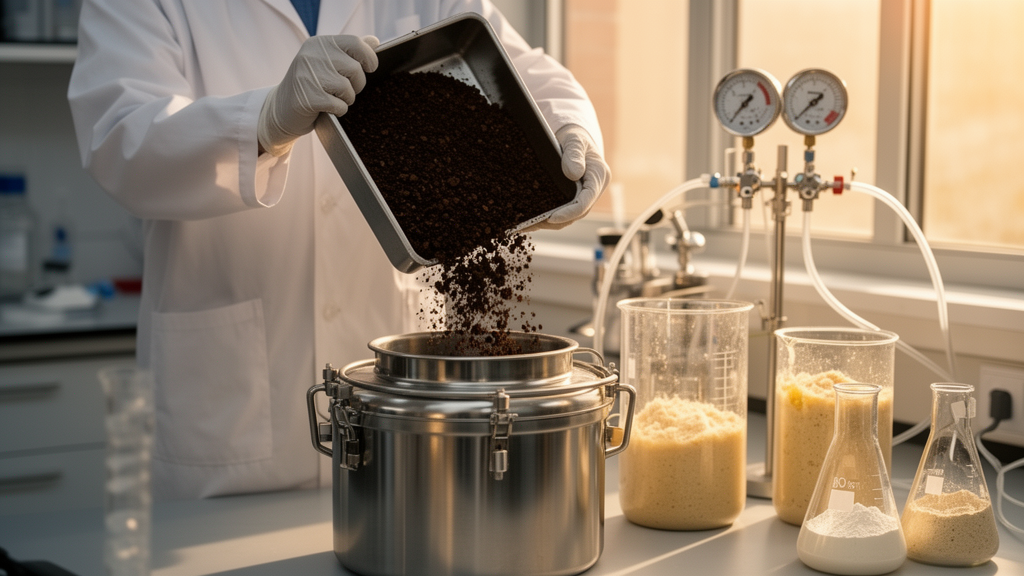
Spent coffee grounds contain substantial organic matter, but much of it is not readily accessible for microbial cultivation. A research team at The Catholic University of Korea in Bucheon, Republic of Korea, has now shown that this byproduct can be converted into single-cell protein through the bacterium Corynebacterium glutamicum, and that the resulting biomass can serve as a substrate for L-lactate and acetate production by lactic acid bacteria and bifidobacteria. The study, published in Frontiers in Sustainable Food Systems, describes a two-stage strategy in which coffee waste is first fermented to release usable nutrients, then converted into microbial biomass, and finally used to drive organic acid formation by the two bacterial groups.
The researchers subjected spent coffee grounds to solid-state fermentation and tested extracts produced under different fermentation schedules. They selected an extract generated by 15 days of once-daily stirring followed by 30 days of static incubation and evaluated it as a nutrient source for growing C. glutamicum. At a concentration of 5% (w/v), the fermented spent coffee grounds extract supported the recovery of 4.91 grams of single-cell protein per liter. For comparison, the same organism yielded 4.76 grams per liter in minimal medium and 4.85 grams per liter in complex medium, placing the coffee-waste-derived biomass on par with conventional laboratory culture formulations.
Chemical characterization showed that the biomass carried a comparable carbohydrate profile regardless of whether C. glutamicum had been grown on the fermented coffee extract or on complex medium. Both preparations contained acid-hydrolyzable rhamnose, arabinose/galactose, mannose, and glucose, together with alkali-extractable glycogen. The team then assessed whether the biomass could support lactic acid bacteria and bifidobacteria, measuring L-lactate and acetate as the fermentation outputs.
The response was strain-dependent. Individual lactic acid bacteria and bifidobacteria strains varied in how much L-lactate and acetate they produced when supplied with the two single-cell protein preparations. The most notable result emerged from a mixed culture containing 22 strains. Under this condition, acetate production reached 1.83 milligrams per milliliter with single-cell protein derived from complex medium and 2.28 milligrams per milliliter with single-cell protein derived from the fermented coffee grounds extract. Both values were significantly higher than the acetate measured under a glucose-containing condition, and acetate production was significantly higher with the coffee-extract-derived biomass than with the complex-medium-derived biomass.
The authors frame these findings as proof of concept for integrating spent coffee grounds valorization with C. glutamicum single-cell protein production, and as demonstrating that the resulting biomass supports subsequent organic acid formation by lactic acid bacteria and bifidobacteria. The experiments were conducted in laboratory cultures, and the 22-strain mixed community does not represent the complexity of the human gut microbiome or an industrial fermentation vessel. Acetate and L-lactate production were measured as metabolic outputs under defined conditions; the results do not establish health benefits, and the strain-dependent responses indicate that any application would depend on which bacteria are paired with the protein substrate.
Subject of Research: Production of Corynebacterium glutamicum single-cell protein from fermented spent coffee grounds extract as a substrate for bacterial L-lactate and acetate production
Article Title: Corynebacterium glutamicum single-cell protein produced with fermented spent coffee grounds extract supports L-lactate and acetate production by lactic acid bacteria and bifidobacteria
Article References: Park, S., Kim, T., Lee, S., & Kim, P. (2026). Corynebacterium glutamicum single-cell protein produced with fermented spent coffee grounds extract supports L-lactate and acetate production by lactic acid bacteria and bifidobacteria. Frontiers in Sustainable Food Systems, 10, Article 1961024. https://doi.org/10.3389/fsufs.2026.1961024
Image Credits: AI Generated
DOI: 10.3389/fsufs.2026.1961024
Keywords: spent coffee grounds, single-cell protein, Corynebacterium glutamicum, solid-state fermentation, lactic acid bacteria, bifidobacteria, L-lactate, acetate, food waste valorization, sustainable food processing, Corynebacterium, glutamicum
Cite Scienmag News
Morgan Morrow. (October 26, 2026). Spent Coffee Grounds Converted Into Microbial Protein for Bacterial Fermentation. Scienmag. https://scienmag.com/spent-coffee-grounds-converted-into-microbial-protein-for-bacterial-fermentation/
Morgan Morrow. "Spent Coffee Grounds Converted Into Microbial Protein for Bacterial Fermentation." Scienmag, 26 October 2026, https://scienmag.com/spent-coffee-grounds-converted-into-microbial-protein-for-bacterial-fermentation/. Accessed 26 October 2026.
Morgan Morrow. "Spent Coffee Grounds Converted Into Microbial Protein for Bacterial Fermentation." Scienmag. October 26, 2026. https://scienmag.com/spent-coffee-grounds-converted-into-microbial-protein-for-bacterial-fermentation/


