


Editor’s note: The following press release is being jointly issued by the University of Maryland and Brookhaven National Laboratory.

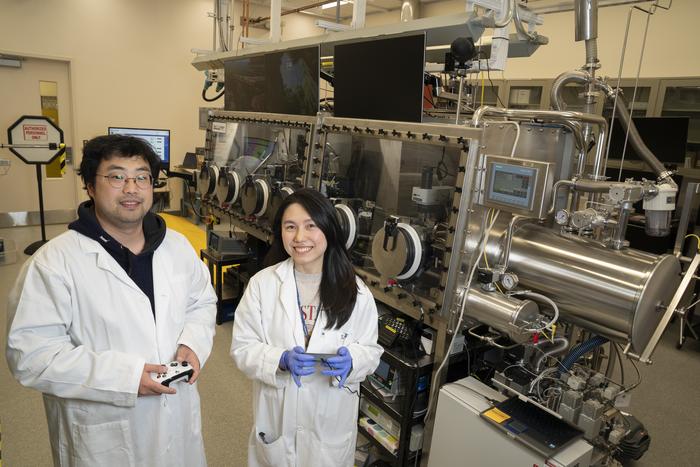
Credit: Jessica Rotkiewicz/Brookhaven National Laboratory
Editor’s note: The following press release is being jointly issued by the University of Maryland and Brookhaven National Laboratory.
COLLEGE PARK, Md. and UPTON, N.Y. — Advanced information processing technologies offer greener telecommunications and strong data security for millions, a study led by University of Maryland (UMD) researchers revealed.
A new device that can process information using a small amount of light could enable energy-efficient and secure communications. Work led by You Zhou, an assistant professor in UMD’s Department of Materials Science and Engineering (MSE), in collaboration with researchers at the U.S. Department of Energy’s (DOE) Brookhaven National Laboratory, was published today in the journal Nature Photonics.
Optical switches, the devices responsible for sending information via telephone signals, rely on light as a transmission medium and on electricity as a processing tool, requiring an extra set of energy to interpret the data. A new alternative engineered by Zhou uses only light to power a full transmission, which could improve speed and energy efficiency for telecommunications and computation platforms.
Early tests of this technology have shown significant energy improvements. While conventional optical switches require between 10 to 100 femtojoules to enable a communication transmission, Zhou’s device consumes one hundred times less energy, which is only one tenth to one femtojoule. Building a prototype that enables information processing using small amounts of light, via a material’s property known as “non-linear response,” paved the way for new opportunities in his research group.
“Achieving strong non-linearity was unexpected, which opened a new direction that we were not previously exploring: quantum communications,” said Zhou.
To build the device, Zhou used the Quantum Material Press (QPress) at the Center for Functional Nanomaterials (CFN), a DOE Office of Science user facility at Brookhaven Lab that offers free access to world-class equipment for scientists conducting open research. The QPress is an automated tool for synthesizing quantum materials with layers as thin as a single atom.
“We have been collaborating with Zhou’s group for several years. They are one of the earliest adopters of our QPress modules, which include an exfoliator, cataloger, and stacker,” said co-author Suji Park, a staff scientist in the Electronic Nanomaterials Group at CFN. “Specifically, we have provided high-quality exfoliated flakes tailored to their requests, and we worked together closely to optimize the exfoliation conditions for their materials. This partnership has significantly enhanced their sample fabrication process.”
Next up, Zhou’s research team aims to increase energy efficiency down to the smallest amount of electromagnetic energy, a main challenge in enabling the so-called quantum communications, which offer a promising alternative for data security.
In the wake of rising cyberattacks, building sophisticated protection against hackers has grown scientific interest. Data transmitted over conventional communication channels can be read and copied without leaving a trace, which cost thousands of breaches for 350 million users last year, according to a recent Statista report.
Quantum communications, on the other hand, offer a promising alternative as they encode the information using light, which cannot be intercepted without altering its quantum state. Zhou’s method to improve materials’ nonlinearity is a step closer to enabling those technologies.
This study was supported by the DOE Office of Science and the National Science Foundation.
Brookhaven National Laboratory is supported by the Office of Science of the U.S. Department of Energy. The Office of Science is the single largest supporter of basic research in the physical sciences in the United States and is working to address some of the most pressing challenges of our time. For more information, visit science.energy.gov.
Follow @BrookhavenLab on social media. Find us on Instagram, LinkedIn, X, and Facebook.
Cite Scienmag News
Bethany Barker. (May 14, 2024). Speedy, secure, sustainable — that’s the future of telecom. Scienmag. https://scienmag.com/speedy-secure-sustainable-thats-the-future-of-telecom/
Bethany Barker. "Speedy, secure, sustainable — that’s the future of telecom." Scienmag, 14 May 2024, https://scienmag.com/speedy-secure-sustainable-thats-the-future-of-telecom/. Accessed 3 September 2026.
Bethany Barker. "Speedy, secure, sustainable — that’s the future of telecom." Scienmag. May 14, 2024. https://scienmag.com/speedy-secure-sustainable-thats-the-future-of-telecom/

