


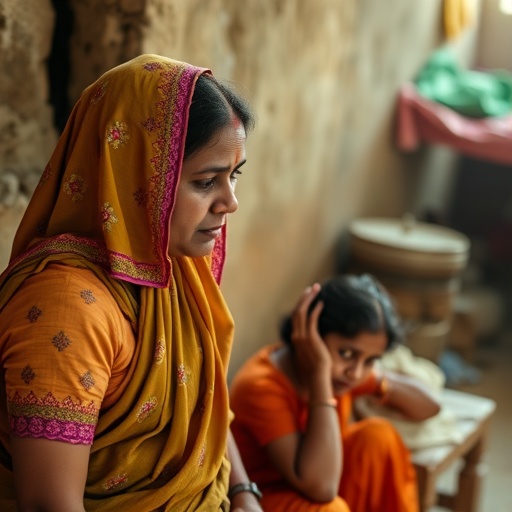
In rural India, the birth of a firstborn son can alter far more than a family’s hopes for the future. It can reshape household relationships, influence decisions about contraception, and even affect the mental health of the women living under the same roof. A new study from the University of Illinois Urbana-Champaign finds that the psychological benefits of a firstborn boy are particularly pronounced among mothers-in-law, whose risk of depression or anxiety was approximately 15% lower when their daughter-in-law’s first child was male. The finding offers a detailed view of how gender preferences operate inside extended families, showing that the consequences of son preference are distributed unevenly across generations.
The research focuses on a social structure common in parts of India, where a married woman often moves into her husband’s family home. In these multigenerational households, the mother-in-law may exercise substantial authority over domestic decisions, including whether and when a younger woman uses contraception. Sons are widely viewed as carriers of the family lineage and as sources of support for parents in old age. Daughters, by contrast, are often expected to marry into another household. These expectations create intense pressure on women to produce a male child, even when families say they want to limit the number of births. The pressure is not simply an individual preference; it is embedded in economic insecurity, inheritance customs, gender roles, and ideas about family continuity.
The study, published in the Journal of Development Economics, examined married women of reproductive age and their co-residing mothers-in-law in Jaunpur district in Uttar Pradesh. Researchers collected information about household demographics and socioeconomic conditions, then assessed mental health using a screening instrument designed to identify symptoms associated with depression and anxiety. When a household included more than one daughter-in-law, the researchers included the youngest woman in their analysis. This design allowed the team to compare the experiences of two generations of women who shared the same household environment but occupied different positions within its hierarchy. It also made it possible to investigate whether the sex of the first child was associated with different outcomes for the mother-in-law and daughter-in-law.
The most striking result appeared among mothers-in-law. Those whose daughter-in-law had a firstborn son showed, on average, a 15% lower risk of screening positive for depression or anxiety than mothers-in-law whose daughter-in-law’s first child was a daughter. The researchers said the magnitude was comparable to effects reported in studies of policies that improve economic security for older women, such as inheritance reforms or pension programs. Technically, the result does not mean that every mother-in-law became mentally healthier after the birth of a boy, nor does it establish that the child’s sex alone caused the change. Rather, it indicates a strong statistical association within a setting where the birth of a grandson may reduce uncertainty about lineage, future support, and the family’s perceived success in meeting social expectations.
For daughters-in-law considered as a single group, the researchers did not detect an overall mental-health effect associated with having a firstborn son. A more detailed analysis, however, revealed an important age pattern. Among older women, the risk of adverse mental-health consequences increased when their first child was not a boy. This heterogeneity is consistent with the idea that reproductive timing changes the meaning of childbirth. A younger woman may still be expected to have another pregnancy, leaving the family with the possibility of eventually having a son. For an older woman approaching the end of her reproductive years, the birth of a daughter may be interpreted as a failure to fulfill a powerful household expectation, while the birth of a son can bring immediate relief.
The different responses of the two generations illuminate the psychological mechanics of family power. For a mother-in-law, a grandson may provide reassurance at almost any age because it represents the continuation of the family line and a potential source of support in later life. For a daughter-in-law, the pressure can intensify as opportunities for another pregnancy narrow. In that situation, the sex of a first child may influence not only how she feels about herself but also how she is treated by other members of the household. The study therefore moves beyond the idea that son preference is a simple desire for male children. It presents son preference as a system of incentives and anxieties that can change behavior, distribute authority, and affect emotional well-being across generations.
The researchers also identified consequences extending beyond mental-health screening scores. When a daughter-in-law had a firstborn son, her mother-in-law was more likely to approve of her using family planning or birth control. The pattern is consistent with a household logic in which the family’s desired fertility outcome is considered achieved once a boy has been born. Before that point, contraception may be viewed as a threat to the possibility of a future son. Afterward, the same practice may be accepted as a way to prevent additional births. This dynamic helps explain why women’s access to family planning cannot always be understood as an individual decision between a woman and a health provider. In multigenerational households, approval from an older female relative may determine whether contraception is available, tolerated, or socially safe to use.
Mental-health improvements among mothers-in-law were also associated with greater support for younger women’s daily lives. In particular, mothers-in-law—especially those living with younger daughters-in-law—were more likely to help with childcare and support the younger woman’s participation in paid work when a firstborn son was present. That assistance can have measurable economic consequences. Childcare support may reduce the time and financial costs of employment, making it easier for a daughter-in-law to enter or remain in the labor force. In this way, a deeply unequal gender norm can generate an apparently positive economic outcome for some women, but only after a condition has been met: the arrival of a male child. The result underscores the complicated way social norms can simultaneously restrict women’s autonomy and shape opportunities within the household.
The study found no clear evidence that men’s behavior explained these patterns, although the researchers noted that husbands and other male household members may often work as migrant laborers and remain away from home for months. Their absence can leave mothers-in-law as the de facto authorities over domestic matters. That possibility is important for interpreting interventions. Programs that focus only on husbands or couples may miss the person who actually controls access to contraception, childcare, and permission to work. The findings suggest that mothers-in-law should be included in efforts to improve women’s health, but not simply treated as obstacles. They are themselves responding to economic insecurity and social expectations that reward the birth of sons. Addressing those pressures may require stronger old-age support, equal inheritance rights, reliable healthcare, and community programs that challenge assumptions about daughters’ and sons’ value.
Son preference is not unique to India; comparable expectations have been documented across parts of Southeast Asia and Africa. Yet the researchers emphasize that social norms, although persistent, are not immovable. Community discussions can expose mistaken beliefs about what other families want, while direct engagement can encourage relatives to reconsider practices that appear universal but are not. Indian government programs have already experimented with community-level activities that bring women and their mothers-in-law into conversations about family planning. Building on the new evidence, the Illinois team is developing an intervention intended to change household dynamics around son preference and improve women’s well-being. The broader lesson is that the emotional and economic effects of childbirth cannot be separated from the family systems surrounding women. A firstborn son may lower distress for one generation, increase pressure for another, and unlock support that should not depend on a child’s sex. Understanding those connections could help public-health programs replace conditional acceptance with reproductive autonomy for all women.
Web References: University of Illinois Urbana-Champaign; Journal of Development Economics article: https://www.sciencedirect.com/science/article/pii/S0304387826001501?via%3Dihub
References: Anukriti, S., Herrera-Almanza, C., Hossain, S., and Karra, M. “Son preference, intergenerational household dynamics, and women’s mental health in India.” Journal of Development Economics. DOI: 10.1016/j.jdeveco.2026.103867
Cite Scienmag News
Glenn Wilkins. (August 25, 2026). Son preference takes a toll on rural Indian women’s mental health. Scienmag. https://scienmag.com/son-preference-takes-a-toll-on-rural-indian-womens-mental-health/
Glenn Wilkins. "Son preference takes a toll on rural Indian women’s mental health." Scienmag, 25 August 2026, https://scienmag.com/son-preference-takes-a-toll-on-rural-indian-womens-mental-health/. Accessed 3 September 2026.
Glenn Wilkins. "Son preference takes a toll on rural Indian women’s mental health." Scienmag. August 25, 2026. https://scienmag.com/son-preference-takes-a-toll-on-rural-indian-womens-mental-health/


