


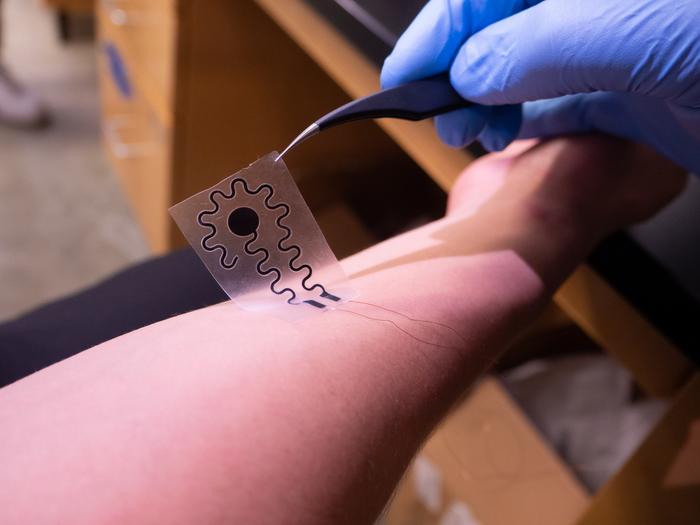
A team of researchers led by the University of California San Diego has developed a soft, stretchy electronic device capable of simulating the feeling of pressure or vibration when worn on the skin. This device, reported in a paper published in Science Robotics, represents a step towards creating haptic technologies that can reproduce a more varied and realistic range of touch sensations.

Credit: Liezel Labios/UC San Diego Jacobs School of Engineering
A team of researchers led by the University of California San Diego has developed a soft, stretchy electronic device capable of simulating the feeling of pressure or vibration when worn on the skin. This device, reported in a paper published in Science Robotics, represents a step towards creating haptic technologies that can reproduce a more varied and realistic range of touch sensations.
The device consists of a soft, stretchable electrode attached to a silicone patch. It can be worn like a sticker on either the fingertip or forearm. The electrode, in direct contact with the skin, is connected to an external power source via wires. By sending a mild electrical current through the skin, the device can produce sensations of either pressure or vibration depending on the signal’s frequency.
“Our goal is to create a wearable system that can deliver a wide gamut of touch sensations using electrical signals—without causing pain for the wearer,” said study co-first author Rachel Blau, a nano engineering postdoctoral researcher at the UC San Diego Jacobs School of Engineering.
Existing technologies that recreate a sense of touch through electrical stimulation often induce pain due to the use of rigid metal electrodes, which do not conform well to the skin. The air gaps between these electrodes and the skin can result in painful electrical currents.
To address these issues, Blau and a team of researchers led by Darren Lipomi, a professor in the Aiiso Yufeng Li Family Department of Chemical and Nano Engineering at UC San Diego, developed a soft, stretchy electrode that seamlessly conforms to the skin.
The electrode is made of a new polymer material constructed from the building blocks of two existing polymers: a conductive, rigid polymer known as PEDOT:PSS, and a soft, stretchy polymer known as PPEGMEA. “By optimizing the ratio of these [polymer building blocks], we molecularly engineered a material that is both conductive and stretchable,” said Blau.
The polymer electrode is laser-cut into a spring-shaped, concentric design and attached to a silicone substrate. “This design enhances the electrode’s stretchability and ensures that the electrical current targets a specific location on the skin, thus providing localized stimulation to prevent any pain,” said Abdulhameed Abdal, a Ph.D. student in the Department of Mechanical and Aerospace Engineering at UC San Diego and the study’s other co-first author. Abdal and Blau worked on the synthesis and fabrication of the electrode with UC San Diego nano engineering undergraduate students Yi Qie, Anthony Navarro and Jason Chin.
In tests, the electrode device was worn on the forearm by 10 participants. In collaboration with behavioral scientists and psychologists at the University of Amsterdam, the researchers first identified the lowest level of electrical current detectable. They then adjusted the frequency of the electrical stimulation, allowing participants to experience sensations categorized as either pressure or vibration.
“We found that by increasing the frequency, participants felt more vibration rather than pressure,” said Abdal. “This is interesting because biophysically, it was never known exactly how current is perceived by the skin.”
The new insights could pave the way for the development of advanced haptic devices for applications such as virtual reality, medical prosthetics and wearable technology.
Paper: “Conductive Block Copolymer Elastomers and Psychophysical Thresholding for Accurate Haptic Effects.” Co-authors include Alexander X. Chen, Tarek Rafeedi, Robert Ramji, Taewoo Kim, Laura L. Becerra, Samuel Edmunds, Samantha M. Russman, Shadi A. Dayeh and David P. Fenning, UC San Diego; and Nicholas Root and Romke Rouw, University of Amsterdam.
This work was supported by the National Science Foundation Disability and Rehabilitation Engineering program (CBET-2223566). This work was performed in part at the San Diego Nanotechnology Infrastructure (SDNI) at UC San Diego, a member of the National Nanotechnology Coordinated Infrastructure, which is supported by the National Science Foundation (grant ECCS-1542148).
Journal
Science Robotics
Article Title
Conductive Block Copolymer Elastomers and Psychophysical Thresholding for Accurate Haptic Effects
Article Publication Date
12-Jun-2024
Cite Scienmag News
Denise Maddox. (June 28, 2024). Soft, stretchy electrode simulates touch sensations using electrical signals. Scienmag. https://scienmag.com/soft-stretchy-electrode-simulates-touch-sensations-using-electrical-signals/
Denise Maddox. "Soft, stretchy electrode simulates touch sensations using electrical signals." Scienmag, 28 June 2024, https://scienmag.com/soft-stretchy-electrode-simulates-touch-sensations-using-electrical-signals/. Accessed 3 September 2026.
Denise Maddox. "Soft, stretchy electrode simulates touch sensations using electrical signals." Scienmag. June 28, 2024. https://scienmag.com/soft-stretchy-electrode-simulates-touch-sensations-using-electrical-signals/

