


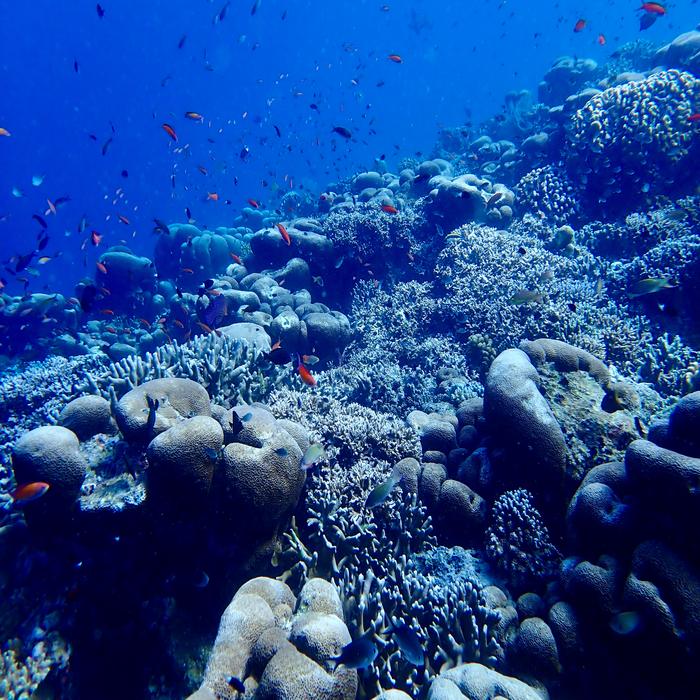
The Coral Triangle, also known as the Indo-Australian Archipelago, is renowned for having the greatest marine biodiversity on our planet. Despite its importance, the detailed evolutionary history of this biodiversity hotspot has remained largely a mystery. An international research team has now shed light on this history, reconstructing how biodiversity in the region has developed over the past 40 million years.
This study, co-led by Dr Skye Yunshu TIAN from the University of Bonn, who conducted the major part of the research at The University of Hong Kong (HKU), along with Professor Moriaki YASUHARA from HKU School of Biological Sciences, the Swire Institute of Marine Science (SWIMS) and Institute for Climate and Carbon Neutrality (ICCN), as well as Dr Fabien L. CONDAMINE of Centre National de la Recherche Scientifique (CNRS), has now been published in the journal Nature.
The researchers began their investigation by examining sediment samples from the Indo-Australian Archipelago in the laboratory and identifying the fossils they contained. “We wanted to understand how the marine biodiversity of the Indo-Australian Archipelago evolved and persisted, and what factors were responsible for the disproportionately high diversity in the tropics,” said first author Skye Tian.
Their findings revealed that the archipelago had shown an increase in diversification since the early Miocene, around 20 million years ago. Approximately 2.6 million years ago, the number of species approached a plateau. Interestingly, there were no major extinction events during the entire study period. “The increase in diversity was primarily driven by the habitat factor, as tectonic collisions (movements of Earth’s plates) in Southeast Asia created extensive areas of shallow marine habitats,” Skye noted.
Around 14 million years ago, the region’s thermal stress, or excessive heat, began to moderate. “This moderation was crucial for the development of the hotspot,” Skye continued. “During the Eocene (56 to 34 million years ago), excessively high tropical temperatures in warm climate zones hindered the increase in diversity. The cooling after that allowed for a more favourable environment for biodiversity to flourish.” However, this rich biodiversity could be at risk. “Our palaeobiological results suggest that we could quickly lose the fantastic diversity of the tropical hotspot if the ongoing anthropogenic warming intensifies.” Skye added.
Professor Moriaki Yasuhara further elaborated: “This reconstruction of the long-term history of the Coral Triangle diversity hotspot enables us to better understand how diversity hotspot moved from ‘Tethys (ancient Mediterranian region)’ region to the present place of the Coral Triangle and developed there. These are what we didn’t know too clearly before. And also our results tells us why Coral Triangle diversity is much higher than that of the Caribbean Sea, that is probably because the Coral Triangle didn’t experience large extinction event by luck.”
About the Journal Paper: Skye Yunshu Tian, Moriaki Yasuhara, Fabien L. Condamine, Huai-Hsuan M. Huang, Allan Gil S. Fernando, Yolanda M. Aguilar, Hita Pandita, Toshiaki Irizuki, Hokuto Iwatani, Caren P. Shin, Willem Renema & Tomoki Kase: Cenozoic history of the tropical marine biodiversity hotspot, Nature.
The Journal Paper can be accessed from here:
For media enquiries, please contact Ms Casey To, Assistant Manager (Communications) (tel: 3917 4948; email: caseyto@hku.hk) / Ms Cindy Chan, Assistant Director of Communications of HKU Faculty of Science (tel: 39175286; email: cindycst@hku.hk ).

Credit: The University of Hong Kong
The Coral Triangle, also known as the Indo-Australian Archipelago, is renowned for having the greatest marine biodiversity on our planet. Despite its importance, the detailed evolutionary history of this biodiversity hotspot has remained largely a mystery. An international research team has now shed light on this history, reconstructing how biodiversity in the region has developed over the past 40 million years.
This study, co-led by Dr Skye Yunshu TIAN from the University of Bonn, who conducted the major part of the research at The University of Hong Kong (HKU), along with Professor Moriaki YASUHARA from HKU School of Biological Sciences, the Swire Institute of Marine Science (SWIMS) and Institute for Climate and Carbon Neutrality (ICCN), as well as Dr Fabien L. CONDAMINE of Centre National de la Recherche Scientifique (CNRS), has now been published in the journal Nature.
The researchers began their investigation by examining sediment samples from the Indo-Australian Archipelago in the laboratory and identifying the fossils they contained. “We wanted to understand how the marine biodiversity of the Indo-Australian Archipelago evolved and persisted, and what factors were responsible for the disproportionately high diversity in the tropics,” said first author Skye Tian.
Their findings revealed that the archipelago had shown an increase in diversification since the early Miocene, around 20 million years ago. Approximately 2.6 million years ago, the number of species approached a plateau. Interestingly, there were no major extinction events during the entire study period. “The increase in diversity was primarily driven by the habitat factor, as tectonic collisions (movements of Earth’s plates) in Southeast Asia created extensive areas of shallow marine habitats,” Skye noted.
Around 14 million years ago, the region’s thermal stress, or excessive heat, began to moderate. “This moderation was crucial for the development of the hotspot,” Skye continued. “During the Eocene (56 to 34 million years ago), excessively high tropical temperatures in warm climate zones hindered the increase in diversity. The cooling after that allowed for a more favourable environment for biodiversity to flourish.” However, this rich biodiversity could be at risk. “Our palaeobiological results suggest that we could quickly lose the fantastic diversity of the tropical hotspot if the ongoing anthropogenic warming intensifies.” Skye added.
Professor Moriaki Yasuhara further elaborated: “This reconstruction of the long-term history of the Coral Triangle diversity hotspot enables us to better understand how diversity hotspot moved from ‘Tethys (ancient Mediterranian region)’ region to the present place of the Coral Triangle and developed there. These are what we didn’t know too clearly before. And also our results tells us why Coral Triangle diversity is much higher than that of the Caribbean Sea, that is probably because the Coral Triangle didn’t experience large extinction event by luck.”
About the Journal Paper: Skye Yunshu Tian, Moriaki Yasuhara, Fabien L. Condamine, Huai-Hsuan M. Huang, Allan Gil S. Fernando, Yolanda M. Aguilar, Hita Pandita, Toshiaki Irizuki, Hokuto Iwatani, Caren P. Shin, Willem Renema & Tomoki Kase: Cenozoic history of the tropical marine biodiversity hotspot, Nature.
The Journal Paper can be accessed from here:
For media enquiries, please contact Ms Casey To, Assistant Manager (Communications) (tel: 3917 4948; email: caseyto@hku.hk) / Ms Cindy Chan, Assistant Director of Communications of HKU Faculty of Science (tel: 39175286; email: cindycst@hku.hk ).
Journal
Nature
Article Title
Cenozoic history of the tropical marine biodiversity hotspot
Cite Scienmag News
Margaret Porter. (June 28, 2024). HKU ecologists reconstruct the history of biodiversity in the indo-australian archipelago and its rise as a hotspot. Scienmag. https://scienmag.com/hku-ecologists-reconstruct-the-history-of-biodiversity-in-the-indo-australian-archipelago-and-its-rise-as-a-hotspot/
Margaret Porter. "HKU ecologists reconstruct the history of biodiversity in the indo-australian archipelago and its rise as a hotspot." Scienmag, 28 June 2024, https://scienmag.com/hku-ecologists-reconstruct-the-history-of-biodiversity-in-the-indo-australian-archipelago-and-its-rise-as-a-hotspot/. Accessed 12 September 2026.
Margaret Porter. "HKU ecologists reconstruct the history of biodiversity in the indo-australian archipelago and its rise as a hotspot." Scienmag. June 28, 2024. https://scienmag.com/hku-ecologists-reconstruct-the-history-of-biodiversity-in-the-indo-australian-archipelago-and-its-rise-as-a-hotspot/

