

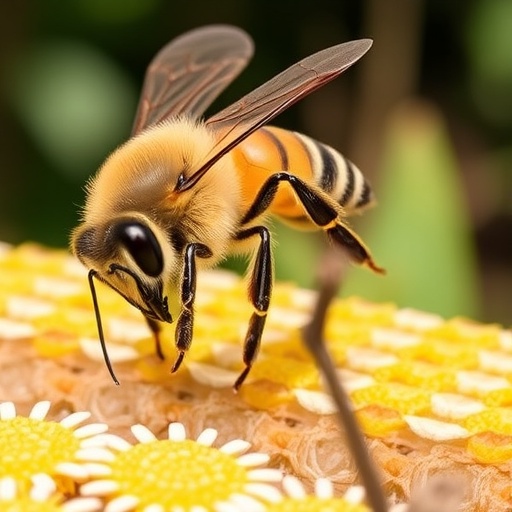
In the sun-drenched landscapes of Southern California, a remarkable discovery has emerged in the battle against one of the most devastating threats to global agriculture: the Varroa mite infestation in honeybee populations. Honeybees, crucial pollinators responsible for the fertilization of countless crops worldwide, have been under siege, with commercial colonies collapsing at alarming rates due to these parasitic mites. Yet, nestled within this challenging environment is a unique hybrid honeybee population exhibiting an extraordinary resilience to Varroa mites, offering a beacon of hope for apiculturists and ecological scientists alike.
Nationwide reports paint a grim picture: in 2025 alone, U.S. beekeepers suffered losses of managed honeybee colonies reaching up to 62%, a scenario threatening the stability of food supply chains reliant on pollination services. The collapse is multifactorial, driven by chemical pesticides, climate instabilities, loss of foraging habitats, and particularly the parasitic Varroa destructor. This mite not only inflicts physical damage by consuming the bees’ vital fat body tissue—a multifunctional organ analogous to the human liver and immune systems—but also vectors lethal viruses directly into the bees’ circulatory systems, exacerbating mortality.
The fat body of honeybees regulates metabolism, detoxification, and immune responses, making its impairment catastrophic for individual health and colony survival. Though conventional responses predominantly rely on chemical miticides, these treatments face diminishing returns due to resistance development and risks of contaminating bee products. A pressing demand exists for alternative strategies that incorporate natural resistance into bee management.
A pioneering study conducted at the University of California, Riverside, and published in Scientific Reports elucidates the natural adaptation mechanisms in a population of hybrid honeybees endemic to Southern California. The research team undertook a rigorous longitudinal analysis of 236 colonies from 2019 to 2022, comparing locally raised queen colonies with commercially bred counterparts. The findings were striking: the Californian hybrids harbored approximately 68% fewer Varroa mites, and their infestation levels rarely surpassed thresholds that necessitate chemical intervention.
Unlike sterile commercial breeds, this hybrid population is genetically complex, reflecting admixture from at least four distinct honeybee lineages—African, Eastern European, Middle Eastern, and Western European—each contributing traits potentially advantageous in mite resistance. These bees primarily originate from feral colonies thriving in wild tree hives, environments where natural selection pressures favor survival traits often absent or diluted in controlled breeding programs.
To unravel the underpinnings of resistance, researchers delved into larval stage behavior and physiology, focusing on the critical window when Varroa mites invade brood cells to reproduce. Laboratory assays demonstrated a marked reduction in mite attraction to seven-day-old larvae from hybrid colonies compared to larval stages of commercial bees. This developmental phase specificity indicates that resistance might stem from intrinsic biological or chemical cues produced by the larvae, deterring mite infestation.
Lead author Genesis Chong-Echavez emphasized the significance of discovering resistance at such an early developmental stage, suggesting that the mechanism transcends observable adult behaviors and may reside in the genetic or biochemical makeup encoded within the hybrid bees themselves. This revelation opens new avenues for breeding programs aimed at enhancing mite resistance through selective propagation of these inherent traits.
Beyond its immediate regional implications, this research holds transformative potential for global apiculture. Honeybees are indispensable for pollinating a vast assortment of crops whose economic value reaches into the tens of billions of dollars worldwide. Mitigating Varroa mite impact by harnessing naturally resistant bee genetics could reduce dependency on chemicals, enhancing environmental sustainability and food security.
Co-author and entomologist Boris Baer highlighted the essential role of beekeeper observations in guiding scientific inquiry. The collaboration underscores the importance of integrating empirical knowledge from field practitioners with advanced research methodologies to address complex ecological challenges effectively.
However, the researchers caution that these hybrid bees are not entirely free from Varroa infestation and that current management practices remain necessary. The goal moving forward is to decipher the precise genetic, behavioral, and chemical signals enabling lowered mite attraction and reproduction in these hybrids. Such understanding could catalyze the development of novel, integrated pest management strategies that prioritize biological resilience.
Future research will focus on mapping the genomic determinants responsible for resistance and exploring larval signaling pathways—chemical attractants or repellents influencing Varroa mite behavior. Similarly, examining the microbiome of resistant bees might reveal symbiotic interactions conferring immunity or detoxification advantages.
This promising discovery arrives at a critical juncture when pollinator populations worldwide are in alarming decline. The hope is that nature’s own evolutionary experiments, exemplified by these Southern Californian hybrid honeybees, might furnish the blueprints required to foster resilient bee populations capable of withstanding emerging environmental pressures. Such breakthroughs could redefine beekeeping, agricultural sustainability, and ecological preservation.
As pollinators face unprecedented threats from anthropogenic influences, climate change, and invasive species, this study offers a compelling narrative of adaptation and survival. It points to an urgent, yet hopeful message: solutions may already exist in natural populations, awaiting recognition and understanding through meticulous scientific inquiry.
Subject of Research:
Varroa mite resistance in a hybrid population of honeybees (Apis mellifera) in Southern California, focusing on genetic, developmental, and behavioral mechanisms of mite suppression.
Article Title:
Varroa mite resistance in a hybrid honey bee (Apis mellifera) population in Southern California
News Publication Date:
27 March 2026
Web References:
https://www.nature.com/articles/s41598-026-45759-9
http://dx.doi.org/10.1038/s41598-026-45759-9
Image Credits:
Boris Baer / University of California, Riverside
Keywords:
Honeybees, Varroa mite, parasite resistance, hybrid honeybee, Apis mellifera, pollinator health, larval development, pest management, entomology, genetic diversity, chemical signaling, beekeeping sustainability, agricultural ecology


