


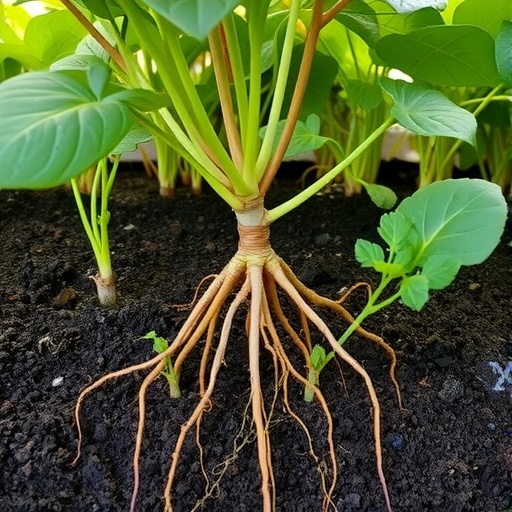
Plants, unlike animals, are rooted to their environment and incapable of relocating to escape adverse conditions such as heat. Their survival is intricately linked to rapid physiological adjustments that allow them to cope with rising temperatures. Root growth stands out as a crucial adaptation strategy: by elongating and exploring deeper soil layers, roots can access vital water and nutrients essential for the plant’s continued development. However, the molecular underpinnings that enable plants to perceive temperature shifts and modulate growth accordingly have largely remained a mystery—until now.
Groundbreaking research out of the Salk Institute has unveiled a fascinating mechanism within plants that acts as an internal “thermostat,” directly linking temperature sensing to growth regulation through a sophisticated interplay of proteins associated with the plant hormone auxin. Auxin, a cornerstone of plant development, orchestrates diverse processes ranging from cell elongation to the formation of roots and shoots. While previous studies emphasized the hormone’s levels as drivers of growth at varying temperatures, this new work shifts the paradigm. It identifies the Auxin Response Factor transcription factors (ARFs), previously known only as gene expression regulators, as direct sensors of temperature changes, thus adding a new dimension to our understanding of plant thermosensitivity.
What emerged from this research is a model in which ARFs accumulate in inactive, clustered forms within the cytoplasm of plant cells when temperatures are low. These protein aggregates serve as a readily mobilizable reservoir, conserving ARFs in a dormant state. As environmental temperatures rise, the physicochemical properties of the ARFs shift—the proteins become increasingly soluble and dissociate from their clusters. Freed from these aggregates, the ARFs translocate into the nucleus where they activate gene networks responsible for promoting root growth. This dynamic redistribution, rather than de novo protein synthesis, enables plants to mount an immediate response to fluctuating temperatures—an elegant and energy-efficient solution to rapid environmental adaptation.
The discovery resolves a longstanding paradox in plant biology. Historically, elevated temperatures have been correlated with increased auxin levels and enhanced root growth. Paradoxically, excessively high auxin concentrations are known to inhibit root elongation. The identification of ARFs as thermal sensors explains how plants circumvent the potentially inhibitory effects of high auxin by modifying the activity and localization of ARFs in response to temperature, rather than merely altering hormone concentration. This nuanced control mechanism ensures that auxin signaling remains “just right”—precisely calibrated for optimal growth in a given thermal environment.
This research exemplifies a remarkable coalescence of protein biochemistry, molecular genetics, and environmental physiology. By characterizing the temperature-dependent solubility properties of ARFs, the researchers revealed that thermal cues directly influence the biophysical state of these transcription factors—shifting them between inactive aggregated reservoirs and active, soluble forms. This intrinsic thermostability within ARFs forms the molecular basis of the plant’s internal thermostat, linking environmental variability to gene expression programs. In practical terms, it enables plants to rapidly adjust root development without the metabolic cost and temporal delay of producing new proteins from scratch.
At a broader scale, such thermosensory adaptations have profound implications for agricultural sustainability. Climate change forecasts predict more frequent and intense heatwaves, threatening crop yields globally. Understanding the molecular architecture through which plants perceive and respond to temperature paves the way for engineering crops with enhanced resilience. By manipulating ARF thermostability or modulating their temperature-triggered solubility dynamics, scientists could develop cultivars capable of maintaining root growth–and thus efficient water and nutrient uptake–under elevated temperature conditions. This innovation holds promise for securing food production in hotter, drier climates.
This work also exemplifies the strength of international scientific collaboration. The Salk Institute team, led by Dr. Lucia Strader, coordinated efforts with Dr. Jorge Casal’s lab at the University of Buenos Aires. Despite distinct experimental approaches, both groups converged on the theme of plant temperature sensing, advancing the field concurrently and synergistically. Such cooperative models not only optimize resource use but foster scientific culture that transcends geographic and institutional boundaries, accelerating discovery.
The insights presented in this study redefine established concepts of hormone-driven growth regulation by positioning ARFs as primary thermal sensors embedded within the auxin signaling cascade. The temperature-dependent phase behavior of ARFs—their reversible clustering and dispersal—effectively translates external thermal conditions into quantifiable intracellular signals, thereby modulating developmental outcomes. This biophysical phenomenon of protein phase separation connected to environmental sensing is an emerging theme across biology, and its revelation in plants opens exciting new avenues for research across kingdoms.
From a methodological perspective, the study employed sophisticated biochemical assays, live-cell imaging, and gene expression analyses to characterize ARF behavior under varying temperatures. Structural investigation of ARF domains revealed the molecular determinants governing their phase partitioning and solubility. These findings underscore the importance of protein structure-function relationships in environmental responsiveness, demonstrating that plants harness intrinsic physicochemical properties of regulatory proteins to overcome challenges posed by fluctuating temperatures.
While auxin levels have long been considered proxies for growth potential, this research delineates a subtler regulatory layer. The presence of a pre-existing pool of ARFs poised for activation provides a rapid response mechanism that decouples immediate regulatory outputs from slower hormone biosynthesis pathways. This layered control enhances phenotypic plasticity by ensuring that growth modulation can occur on timescales aligned with environmental fluctuations, from minutes to hours.
Furthermore, the discovery invites speculation into whether similar temperature-sensing reservoirs exist for other plant hormones or signaling pathways, suggesting a broader paradigm where phase-separated protein assemblies act as environmental sensors within cells. This possibility sets the stage for a new understanding of plant biology wherein dynamic intracellular condensates serve as key nodes for integrating multifactorial stimuli.
The identification of ARF thermostability as a molecular switch enhances our comprehension of the origins of growth plasticity and environmental integration in plants. It advances the conceptual framework for hormone-mediated development, demonstrating that thermosensory capacity is not solely a factor of hormone concentration but also of protein state and context. This knowledge enriches our biological toolkit and could inspire innovative strategies in synthetic biology aimed at optimizing plant growth resilience.
In summary, the innovation presented by Strader and colleagues shifts the frontier of plant environmental sensing, revealing an inherent cellular thermostat mechanism that balances growth with changing temperatures through protein reservoir dynamics. As humanity faces escalating climatic challenges, decoding such molecular strategies is indispensable for safeguarding agricultural productivity and understanding the fundamental principles of life on Earth.
News Publication Date: 27-Mar-2026
Web References:
- Original study: https://www.nature.com/articles/s41467-026-71012-y
- Complementary study by Jorge Casal’s lab: https://www.nature.com/articles/s41467-026-71011-z
Cite Scienmag News
Alan Morgan. (April 8, 2026). How Do Plant Roots Adapt to Unpredictable Temperature Changes? Scienmag. https://scienmag.com/how-do-plant-roots-adapt-to-unpredictable-temperature-changes/
Alan Morgan. "How Do Plant Roots Adapt to Unpredictable Temperature Changes?" Scienmag, 8 April 2026, https://scienmag.com/how-do-plant-roots-adapt-to-unpredictable-temperature-changes/. Accessed 3 September 2026.
Alan Morgan. "How Do Plant Roots Adapt to Unpredictable Temperature Changes?" Scienmag. April 8, 2026. https://scienmag.com/how-do-plant-roots-adapt-to-unpredictable-temperature-changes/


