


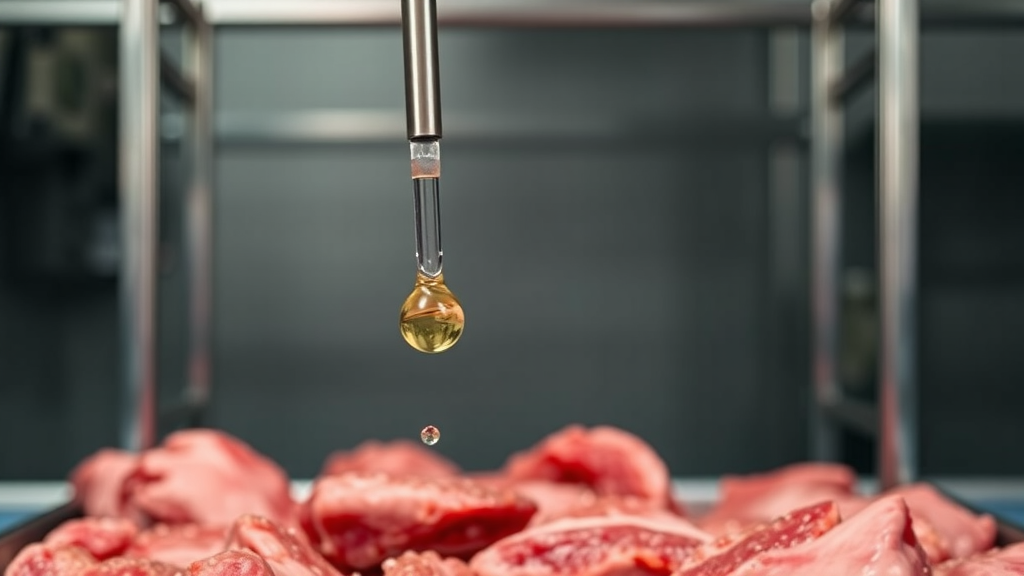
Cultured meat has long promised a future in which real muscle tissue is grown in bioreactors rather than harvested from slaughtered animals, yet the industry has been quietly haunted by an uncomfortable paradox. The cell culture medium that nourishes growing meat cells almost universally depends on fetal bovine serum, or FBS, a substance harvested from the blood of unborn calves at slaughterhouses. Now, a team of researchers at Chung-Ang University in the Republic of Korea has demonstrated a practical route out of this contradiction, showing that serum recovered from adult slaughter livestock can be optimized to fully replace FBS in cultured meat production, while cutting the total cost of culture medium by 62.6 percent.
The study, published in Applied Microbiology and Biotechnology, set out to answer a question that has been asked repeatedly in the cultured meat community but seldom resolved with such systematic rigor: can sera from adult cattle, pigs, and chickens, collected as a byproduct of ordinary meat processing, support the demanding growth requirements of muscle cells destined for cultured meat? The answer, according to the research led by Da-Young Lee and corresponding author Sun Jin Hur, is a qualified but emphatic yes, provided the sera are carefully characterized and supplemented.
The investigators began by collecting blood from cattle, pigs, and chickens under protocols approved by the Animal Experiment Ethics Committee of Chung-Ang University, with approvals numbered 202401030030 and 202301020084. All animal procedures were conducted in accordance with relevant institutional and national guidelines. Because livestock serum would be derived from animals already processed for food, the approach sidesteps the most persistent ethical objection to FBS, namely its fetal origin, while also promising a supply chain that is more abundant, more traceable, and potentially far cheaper than the fetal serum market.
The first stage of the work involved comprehensive biochemical and physicochemical profiling of the sera. The researchers measured parameters that matter deeply to cell biologists: osmolality, pH, protein content, and the biochemical composition that determines whether a serum can sustain living cells. All of the livestock sera tested met sterility requirements, a crucial threshold for any candidate medium component destined for food production. Notably, however, some of the livestock sera showed deviations in physicochemical parameters relative to FBS, deviations that would later inform the optimization strategy. This finding matters because serum is not a simple solution but a complex biological cocktail of growth factors, hormones, attachment factors, carrier proteins, and lipids, and even modest differences in composition can ripple through cell behavior in culture.
With the sera characterized, the team turned to the functional heart of the study: proliferation and differentiation assays using bovine satellite cells, the muscle stem cells responsible for postnatal muscle growth and regeneration. These cells are the workhorses of cultured meat, because they are the ones that must divide vigorously to build biomass and then differentiate and fuse into the multinucleated muscle fibers that give meat its texture and protein content. The results were strikingly species-dependent. Bovine and porcine sera consistently supported robust proliferation, myogenic differentiation, and long-term expansion of the satellite cells. Chicken serum, by contrast, failed to deliver the same performance, unable to sustain the growth trajectory that bovine and porcine sera achieved. For a field that has mostly treated serum as interchangeable, this species-specific divergence is a meaningful data point, suggesting that donor species compatibility should be a central design criterion in serum substitution.
Perhaps the most demanding test was long-term serial passaging. In industrial cultured meat bioprocessing, cells cannot simply be grown once and harvested; they must be expanded repeatedly, through many rounds of passaging, to generate the enormous cell numbers required to fill bioreactors at commercial scale. Serum that supports a few days of growth is of limited value if the cells senesce or lose their myogenic potential after several passages. The optimized bovine- and porcine-based substitutes supported stable proliferation during serial passaging, indicating that the cells retained their proliferative capacity and functional identity over extended culture. This stability is precisely the property that distinguishes a laboratory curiosity from a scalable industrial input.
The optimization itself represents the technical centerpiece of the work. Raw livestock serum, while competent, did not fully match FBS in every respect, so the researchers enhanced the final formulations with targeted supplements. Two additives proved particularly effective: lipid-rich albumin and insulin-transferrin-selenium, the latter supplied at a concentration of 25 micrograms per milliliter. The logic of these supplements is grounded in cell physiology. Albumin serves as a carrier protein for fatty acids and other lipids, which muscle cells require in substantial quantities for membrane synthesis and energy metabolism but which adult serum can deliver inconsistently. Insulin provides anabolic signaling that drives glucose and amino acid uptake, transferrin supplies iron in a controlled and bioavailable form, and selenium acts as an antioxidant cofactor that protects cells from oxidative stress during rapid proliferation. Together, these supplements significantly enhanced cellular performance, closing the gap between livestock serum and FBS to the point of full functional replacement.
The economic implications may prove as consequential as the biological ones. Fetal bovine serum is one of the most expensive components of cell culture medium, with prices driven by limited supply, batch-to-batch variability, and demand from pharmaceutical and research markets that far exceed anything the cultured meat industry can command. Cost analysis conducted by the Chung-Ang University team revealed that replacing FBS with the optimized livestock-derived serum formulations reduced total medium cost by 62.6 percent. Given that medium costs are widely regarded as the single largest barrier to price parity between cultured meat and conventional meat, a reduction of this magnitude in a core medium ingredient represents a substantial step toward commercial viability. The fact that the raw material, adult livestock serum, is an abundant byproduct of existing slaughter operations adds a circular economy dimension, transforming a low-value waste stream into a high-value input.
The study does not claim that every obstacle has been cleared. The researchers note that while all sera met sterility requirements, the deviations in physicochemical parameters among some livestock sera underscore the need for standardization, since cultured meat production at scale will demand consistent, reproducible serum quality from batch to batch. The poor performance of chicken serum also illustrates that a single universal substitute may not exist, and that serum selection may need to be matched to cell line and process. Regulatory pathways for food-grade serum of slaughter origin will likewise require attention as the technology moves toward commercial deployment. Nevertheless, the demonstration that bovine and porcine sera can fully replace FBS, sustain serial passaging, and do so at dramatically reduced cost addresses the three most cited weaknesses of FBS at once: ethics, scalability, and price.
Funded through the Korea Institute of Planning and Evaluation for Technology in Food, Agriculture and Forestry via the High Value-added Food Technology Development Program under the Ministry of Agriculture, Food and Rural Affairs, the work reflects a growing national commitment to cell-based food technology. For an industry that has struggled to reconcile its sustainability narrative with its dependence on fetal calf blood, optimized slaughter livestock serum offers a resolution that is effective, scalable, and ethically aligned. If subsequent scale-up studies confirm these results in suspension culture and bioreactor settings, the humble byproduct of the slaughterhouse floor may become one of the key ingredients that finally allows cultured meat to grow up.
Subject of Research: Optimization of slaughter livestock serum as a fetal bovine serum substitute for bovine satellite cell culture in cultured meat production
Article Title: Optimization of slaughter livestock serum as an alternative to fetal bovine serum in cultured meat application
Article References: Lee, D.-Y., Mariano, E., Park, J. W., Namkung, S., Choi, S. Y., Lee, W. J., Shin, Y. W., Bok, C. H., & Hur, S. J. (2026). Optimization of slaughter livestock serum as an alternative to fetal bovine serum in cultured meat application. Applied Microbiology and Biotechnology. https://doi.org/10.1007/s00253-026-14017-3
Image Credits: AI Generated
DOI: 10.1007/s00253-026-14017-3
Keywords: cultured meat, fetal bovine serum, livestock serum, cell culture, bovine satellite cells, myogenic differentiation, serum substitutes, bioprocessing, cell proliferation, medium cost reduction, food biotechnology, sustainable food production
Cite Scienmag News
Drew Townsend. (September 22, 2026). Slaughterhouse Serum Could Slash Cultured Meat Costs by Over 60 Percent. Scienmag. https://scienmag.com/slaughterhouse-serum-could-slash-cultured-meat-costs-by-over-60-percent/
Drew Townsend. "Slaughterhouse Serum Could Slash Cultured Meat Costs by Over 60 Percent." Scienmag, 22 September 2026, https://scienmag.com/slaughterhouse-serum-could-slash-cultured-meat-costs-by-over-60-percent/. Accessed 5 October 2026.
Drew Townsend. "Slaughterhouse Serum Could Slash Cultured Meat Costs by Over 60 Percent." Scienmag. September 22, 2026. https://scienmag.com/slaughterhouse-serum-could-slash-cultured-meat-costs-by-over-60-percent/


