


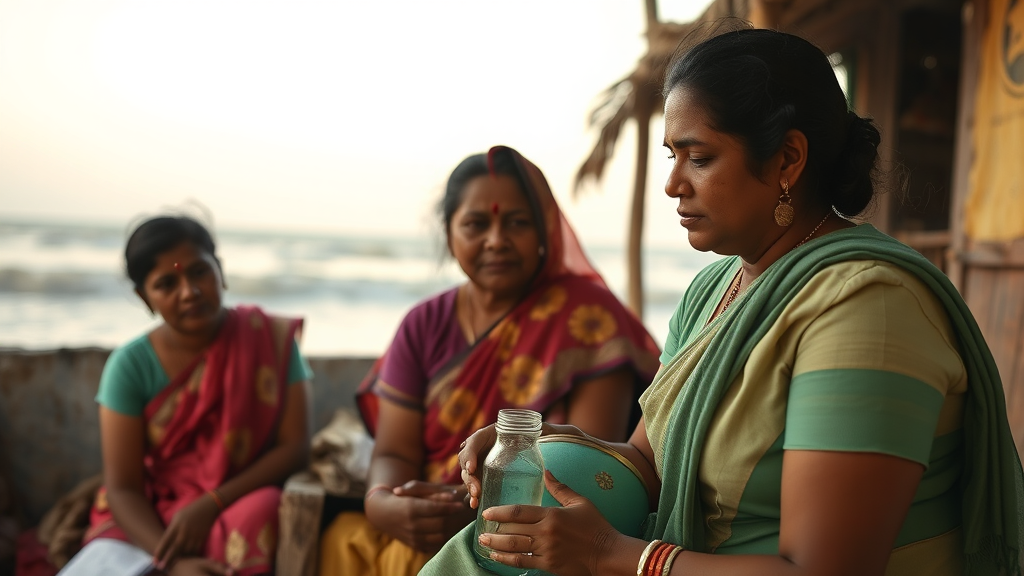
In the fishing hamlets of Alappad, a narrow coastal strip in Kerala, India, the daily architecture of family life is quietly being rewritten. A new qualitative study published in Discover Social Science and Health documents how married women in households affected by alcoholism step into roles that traditional family structures never assigned to them, becoming the de facto leaders of their homes. The research, led by U. Harikrishnan of Amrita Vishwa Vidyapeetham together with colleagues in New Delhi and Ireland, offers a granular, ground-level view of how chronic alcohol misuse by husbands destabilizes conventional divisions of labour and authority, and how women respond not by collapsing under the weight of that disruption but by reorganizing family functioning around themselves.
The study set out with a specific aim: to investigate how wives operate as leaders in alcohol-affected households in the Alappad coastal region. Rather than measuring drinking prevalence or economic loss in numerical terms, the researchers chose a multi-method qualitative design that privileges lived experience. Twenty married women from households impacted by alcoholism participated in the research. Participation in in-depth interviews was determined through data saturation, the methodological principle that recruitment continues until new interviews stop yielding new themes, while convenience sampling was used to assemble participants for a focus group discussion. This dual approach allowed the team to capture both the intimate, individual texture of each woman’s situation and the shared, collective patterns that emerged when women spoke together.
Data collection relied on semi-structured interview guides and focus group questions covering five interlocking domains: marital relationships, family roles, decision-making, emotional experiences, and coping mechanisms. The semi-structured format is a deliberate methodological choice in qualitative research; it provides enough consistency across interviews to allow systematic comparison, while leaving space for participants to raise concerns the researchers had not anticipated. The gathered material was then examined through thematic analysis conducted in accordance with Naeem’s methodology, a structured procedure for coding qualitative data, grouping codes into candidate themes, and refining those themes until they form a coherent account of the phenomenon under study.
The in-depth interviews produced a set of themes that trace an arc from disruption to reorganization. The first and most fundamental theme was the disruption of family roles brought on by alcohol addiction. When a husband’s drinking becomes chronic, the responsibilities he was expected to carry, providing income, making major household decisions, representing the family in the community, do not simply disappear. They migrate. The interviews showed women absorbing financial management, childcare, negotiations with creditors and neighbours, and the emotional labour of holding a household together, often while managing the unpredictable behaviour that accompanies alcohol dependence.
From that disruption, the researchers identified a second theme: the shift into functional leadership. This concept is central to the study’s contribution. Functional leadership, in this context, does not mean formal authority or ceremonial headship of the family. It means the practical, day-to-day stewardship of the household, deciding how scarce money is spent, when children go to school, how conflicts are defused, and how the family presents itself to the outside world. The women in the study had not campaigned for this role; it was thrust upon them by circumstance. Yet over time, the interviews suggest, they came to operate as the effective centres of household decision-making, even when the formal structure of the family continued to recognize the husband as its nominal head.
The third theme, managing societal expectations and gender norms, reveals the tightrope these women walk. In Kerala’s coastal communities, as in many patriarchal settings, the ideal of the male breadwinner and the subordinate wife remains culturally powerful. Women who take over household leadership must do so without openly claiming the authority they exercise, because an overt challenge to gender norms invites social judgment. The study found that women negotiated this tension constantly, performing deference in public while exercising control in private, and absorbing stigma both for their husbands’ drinking and for any visible departure from expected feminine roles. The focus group discussion sharpened this picture, surfacing themes of the breakdown of traditional male family roles, the normalization of women’s functional leadership, and the negotiation of gender norms and social judgment.
Emotionally, the burden is not carried alone, and this is where the focus group data proved especially revealing. The discussion yielded themes of shared emotional burden and collective coping, and of collective resilience and empowerment. When women who live through similar circumstances come together, the researchers found, individual suffering becomes a shared experience that can be named, compared, and managed collectively. Coping strategies described across the study ranged from practical adaptation, restructuring household routines to accommodate a husband’s drinking, to emotional strategies that protect children from the worst effects of the situation. The interviews also captured a theme of rethinking authority and family structure, suggesting that prolonged exposure to alcohol-related disruption leads some women to fundamentally reconsider what a family is and who should hold power within it.
The methodological rigour of the study is worth noting for readers assessing how much weight these findings can bear. The combination of data saturation for interview recruitment and convenience sampling for the focus group is a pragmatic hybrid: saturation ensures that the interview corpus is thematically complete, while the focus group adds a deliberative setting in which participants can react to one another’s accounts, often surfacing norms and shared understandings that one-on-one interviews miss. Thematic analysis following Naeem’s procedure provides a transparent, replicable pathway from raw transcripts to reported themes. The study received ethical approval from the Institutional Human Ethics Committee of Amrita Vishwa Vidyapeetham under reference number IHEC/2025/151, and all participants gave informed consent, were assured of confidentiality, and retained the right to withdraw at any time without consequence. The authors declare no competing interests and received no financial support for the research.
What makes the findings resonate beyond Alappad is their conceptual implication: alcoholism is often studied as an individual clinical condition, but this study reframes it as a force that reorganizes entire family systems and, in doing so, quietly rewrites gender relations. The women described here are not passive victims of a husband’s addiction, nor are they simply surviving it. They are functioning as leaders, absorbing responsibilities, negotiating social expectations, and building networks of collective coping that sustain their households over years. The normalization of women’s functional leadership that the focus group identified suggests a durable shift, one that persists even as the underlying alcohol problem remains unresolved.
The authors conclude that the study emphasizes how gender roles and family structures are altered in alcohol-affected families, and they draw direct practical implications from that conclusion. The results highlight the need for psychological support for women carrying these hidden leadership burdens, for family-centred therapies that treat the household rather than only the individual drinker as the unit of intervention, and for greater formal acknowledgement of women’s resilience and leadership in families affected by alcohol. In coastal Kerala, as in alcohol-affected communities worldwide, the research suggests that effective policy must recognize the women who are already holding families together, and support them in roles they never chose but have come to master.
Subject of Research: Women's functional leadership and family role reorganization in alcohol-affected households in coastal Kerala
Article Title: Women as functional leaders in alcohol affected families in coastal Kerala
Article References: Harikrishnan, U., Nair, D. R., Sania, P. S., Fathima, A., Namitha, M. R., Nath, A. S., Athira, R., John, A. E., Ali, A., & Savarimalai, R. (2026). Women as functional leaders in alcohol affected families in coastal Kerala. Discover Social Science and Health. https://doi.org/10.1007/s44155-026-00462-y
Image Credits: AI Generated
DOI: 10.1007/s44155-026-00462-y
Keywords: alcoholism, functional leadership, women, family dynamics, coping, resilience, Kerala, qualitative study, gender norms, household decision-making, Alappad, family-centred interventions
Cite Scienmag News
Courtney Benton. (September 22, 2026). When Alcohol Reshapes the Household: Women Emerge as Functional Leaders in Coastal Kerala. Scienmag. https://scienmag.com/when-alcohol-reshapes-the-household-women-emerge-as-functional-leaders-in-coastal-kerala/
Courtney Benton. "When Alcohol Reshapes the Household: Women Emerge as Functional Leaders in Coastal Kerala." Scienmag, 22 September 2026, https://scienmag.com/when-alcohol-reshapes-the-household-women-emerge-as-functional-leaders-in-coastal-kerala/. Accessed 5 October 2026.
Courtney Benton. "When Alcohol Reshapes the Household: Women Emerge as Functional Leaders in Coastal Kerala." Scienmag. September 22, 2026. https://scienmag.com/when-alcohol-reshapes-the-household-women-emerge-as-functional-leaders-in-coastal-kerala/


