


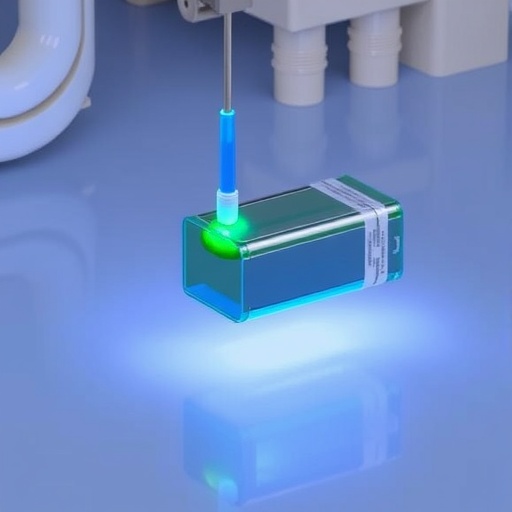
In a groundbreaking advancement poised to redefine the future of energy storage, Professor Young-Jun Kim and his team at the Sungkyunkwan Advanced Institute of Nano Technology (SAINT) of SKKU have unveiled a pioneering “Dry Electrode” technology. This innovation represents a seismic leap in battery manufacturing, promising to dramatically enhance energy density while simultaneously streamlining production processes. By eliminating the use of liquid solvents traditionally employed in electrode fabrication, this method stands as a beacon for eco-friendly and cost-effective battery development. The implications of this breakthrough reach well beyond academic circles, potentially reshaping the global battery market landscape and offering significant environmental benefits.
Traditional lithium-ion battery production hinges on the use of toxic and volatile organic solvents to bind electrode materials, necessitating complex drying steps that consume vast amounts of energy. The dry electrode process circumvents these limitations by compacting solid raw materials directly into electrode films without solvents. This radical departure from the wet coating paradigm not only reduces carbon footprints but also shortens manufacturing time, cutting operational costs and boosting throughput. The significance of such innovation is underscored by the heightened industry attention, with major players like Tesla actively exploring solvent-free processes to secure competitive advantages in next-generation battery technologies.
One of the major technical barriers that has hampered dry electrode adoption has been the challenge of achieving uniform mixing of active materials and conductive agents, critical for ensuring product consistency and high electrochemical performance. To surmount this hurdle, Professor Kim’s team engineered a novel “One-body” composite material, wherein energy-storing active particles and conductive additives are intricately integrated within a unified architecture. This composite structure facilitates homogeneous dispersion and intimate contact between components, markedly improving electron transport pathways while maintaining mechanical robustness. The resultant electrodes exhibit unprecedented areal loading capacities without sacrificing stability or charge-discharge kinetics.
Achieving scalability in dry electrode production has equally been a daunting obstacle. The team’s method leverages advanced material design coupled with precise processing techniques to enable mass manufacture of high-quality electrodes. Collaborative simulation studies conducted with Professor Yong-Min Lee’s group at Yonsei University provided rigorous validation of the material’s electrochemical behavior and mechanical properties under operational stress. These computational insights confirmed the electrode’s ability to maintain structural integrity and electrochemical functionality throughout repeated cycling, establishing the foundation for robust industrial application.
The environmental footprint of battery manufacturing stands to benefit enormously from this innovation. Eliminating toxic solvents eradicates the risks of hazardous emissions and reduces the demand for energy-intensive drying ovens, one of the largest contributors to factory greenhouse gas output. This solvent-free methodology aligns with global decarbonization goals, providing a scalable pathway to greener energy storage solutions. Beyond ecological advantages, the process simplifies factory logistics by obviating the need for solvent recycling infrastructure, thereby decreasing capital expenditures and operational complexity.
Professor Kim highlights that dry electrode technology transcends mere environmental gains; it represents a transformative leap in battery engineering that amplifies performance, quality consistency, and safety profiles. The dry process minimizes internal defects such as cracks and delamination often observed in conventionally wet-coated electrodes, which degrade cycle life and reliability. Furthermore, the “One-body” material design enhances electronic conductivity and ionic diffusion within the electrode matrix, supporting rapid charge-discharge capabilities critical for emerging fast-charging applications.
In parallel to their academic endeavors, the research team is vigorously pursuing commercialization pathways. Through Corenergy Solution, a startup incubated within their laboratory ecosystem, they plan to establish a dedicated “Battery Electrode Foundry” focused on dry electrode fabrication. This enterprise aims to catalyze technological diffusion across the domestic battery sector, collaborating with industry veterans formerly affiliated with giants such as Samsung SDI and LG Energy Solution. Their vision encompasses advancing electrode design tools and cell assembly protocols attuned for solvent-free manufacturing environments, fortifying regional battery supply chains and technological sovereignty.
The team’s work received substantial support from the Nano-Material Technology Development Program under the National Research Foundation of Korea. Their dry cathode research was published in the prestigious Joule journal, where it garnered attention for its scientific rigor and practical relevance. Complementary findings on dry anode technology appeared in Carbon Energy, reinforcing the academic and industrial significance of their contributions. These publications mark a critical milestone, catalyzing further research and investment in dry electrode innovations globally.
The paradigm shift introduced by this technology could accelerate adoption of solid-state batteries, widely regarded as the holy grail of energy storage due to their superior energy densities and safety profiles. Dry electrodes inherently complement solid-state architectures by simplifying interface engineering and mitigating solvent-related degradation mechanisms. Consequently, this advancement not only strengthens conventional lithium-ion chemistries but also paves the way for next-generation battery modalities, including sodium-ion and beyond.
Addressing the commercialization challenge, the integration of cutting-edge material science with pragmatic manufacturing design embodies a model for successful translation of lab discoveries into market-ready technologies. The fusion of multi-disciplinary expertise, spanning chemistry, materials engineering, and computational modeling, underpins the robustness of their solution. This collaborative approach epitomizes the future of battery innovation ecosystems, where academic ingenuity and industrial pragmatism converge to meet escalating energy demands sustainably.
Looking forward, the team envisions continuous refinement of material formulations and process parameters to unlock even higher energy densities and faster charging rates. They also intend to expand the application scope of dry electrodes beyond electric vehicles and portable electronics, targeting grid-scale storage and renewable energy integration. By championing solvent-free, scalable, and high-performance battery electrodes, this initiative signals a transformative chapter in the global quest for sustainable energy solutions.
In summary, Professor Young-Jun Kim’s pioneering dry electrode technology signifies a paradigm shift in energy storage manufacturing. By harmonizing environmental stewardship with superior battery performance and cost efficiency, this innovation stands to disrupt the global battery industry and accelerate the transition to electrified mobility and green grids. As research navigates from laboratory validation to commercial reality through Corenergy Solution’s foundry initiatives, the ripple effects promise to redefine how batteries are conceived, built, and deployed worldwide.
News Publication Date: 2026
Web References:
http://dx.doi.org/10.1016/j.joule.2026.102392
References:
Y. Kwon, J. K. Koo, C. Ha, J. M. Sheem, Y. Suh, and Y.-J. Kim, “Dry-Processed Graphite Electrodes Enabling Ultra-High Areal Capacity and Stable Fast-Charging Performance,” Carbon Energy 8 (2026): e70163
Keywords
Dry Electrode Technology, Lithium-ion Batteries, Energy Density, Solvent-Free Manufacturing, Battery Innovation, Electrode Materials, Battery Production, Eco-Friendly Batteries, Battery Commercialization, High-Loading Electrodes, Solid-State Batteries, Fast Charging
Cite Scienmag News
Denise Maddox. (April 29, 2026). SKKU Advances Battery Manufacturing Using Density Dry Electrode Technology, Aims for Foundry Commercialization. Scienmag. https://scienmag.com/skku-advances-battery-manufacturing-using-density-dry-electrode-technology-aims-for-foundry-commercialization/
Denise Maddox. "SKKU Advances Battery Manufacturing Using Density Dry Electrode Technology, Aims for Foundry Commercialization." Scienmag, 29 April 2026, https://scienmag.com/skku-advances-battery-manufacturing-using-density-dry-electrode-technology-aims-for-foundry-commercialization/. Accessed 5 September 2026.
Denise Maddox. "SKKU Advances Battery Manufacturing Using Density Dry Electrode Technology, Aims for Foundry Commercialization." Scienmag. April 29, 2026. https://scienmag.com/skku-advances-battery-manufacturing-using-density-dry-electrode-technology-aims-for-foundry-commercialization/


