


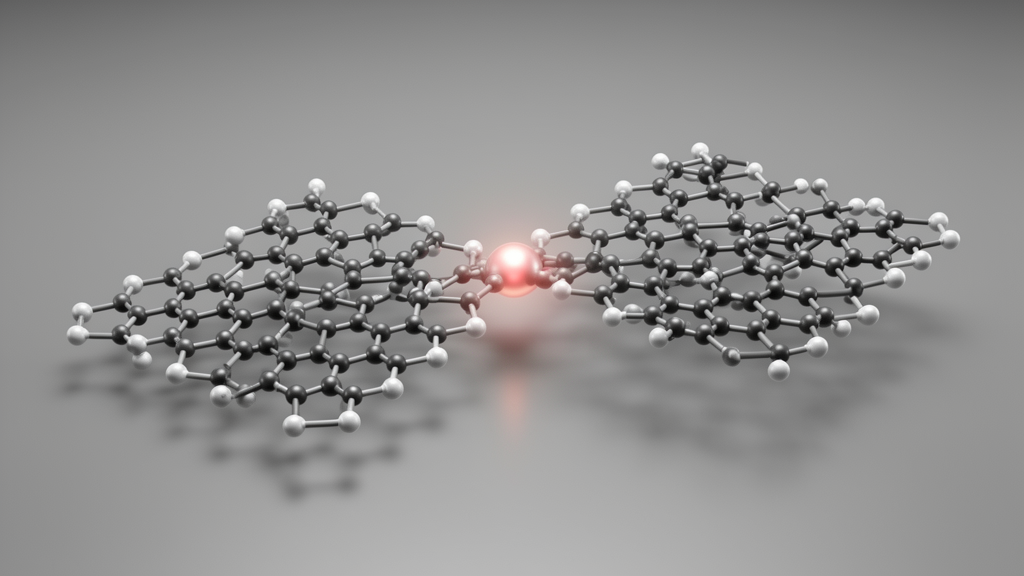
Flat molecules are easy to make, but some of the most valuable structures in modern chemistry refuse to stay flat. In electronics, drug design, and materials science, three-dimensional frameworks often outperform their planar cousins because their geometry locks functional groups into precise orientations that flat molecules simply cannot adopt. Now, chemists at The University of Osaka have reported a reaction that performs what many would have considered a near-impossible feat: they use a single carbon atom as a universal connector to weld two flat molecules into one rigid, three-dimensional structure, forming four new carbon–carbon bonds around a single central atom in the process.
The study, scheduled for publication in Nature, describes a rhodium-catalyzed transformation that the researchers call spirofusion. The products are spirocycles, structures in which two rings share exactly one atom. Because the two ring systems meet at a single point and sit at right angles to one another, the resulting frameworks resemble two playing cards slotted together into a cross. That orthogonal arrangement makes spirocyclic compounds unusually rigid and conformationally stable, properties that have already made them prized components in solar cells and other organic electronic materials. The difficulty has always been in building them: the shared central carbon must simultaneously form four separate carbon–carbon bonds, something conventional synthetic methods struggle to achieve in a controlled way.
Lead author Hayato Fujimoto explains the core challenge. A lone carbon atom would be the ideal glue for the job, because a single carbon can form four bonds at one point, but free carbon atoms are extremely unstable and cannot simply be released into a reaction mixture. Previous approaches to carbon-atom insertion relied on substitutes that could only join molecules through their carbon–carbon double bonds, which limited the kinds of flat starting materials that could be used. The Osaka team wanted to go further and work with carbon–carbon single bonds, the most common and least reactive connections in organic chemistry.
The solution rests on two components working in concert. The first is a rhodium catalyst, a metal complex capable of cleaving carbon–carbon single bonds in a class of flat molecules called biphenylenes. Biphenylenes are strained, butterfly-shaped hydrocarbons in which two benzene rings are fused in a way that weakens one particular carbon–carbon bond, making it susceptible to oxidative addition onto the rhodium center. When the catalyst snips this bond, it opens a reactive gap in the middle of the flat molecule. The second component is a reagent the researchers call PINC, which functions as a packaged carbon atom. PINC holds a single carbon atom in a stable, handleable form and delivers it to the rhodium complex at exactly the right moment.
Once the carbon atom is transferred, it lands in the gap created by bond cleavage and becomes the shared center of the new spirocyclic framework. The arithmetic of the transformation is striking: one carbon–carbon single bond is broken, and four new carbon–carbon bonds are formed around the delivered atom, converting two planar molecules into a single rigid 3D architecture in one operation. The reaction is catalytic in rhodium, meaning the metal is regenerated and continues to process more substrate, which is essential for any practical synthetic method.
Verifying that the central atom really came from the PINC reagent was a key part of the study. The researchers labeled PINC with a traceable form of carbon and then analyzed the products. The labeled carbon ended up exclusively at the heart of the new spirocyclic molecules, confirming the atom-transfer mechanism and ruling out alternative pathways in which the central carbon might have come from the starting materials. This kind of isotopic tracing is a standard but crucial test for claims of atom transfer, and the clean result gives strong support to the proposed mechanism.
Practicality was another concern the team addressed directly. Many impressive reactions reported in the literature work only on milligram scales under glovebox conditions, which limits their usefulness to other chemists. The Osaka method, by contrast, was demonstrated on a gram scale using a standard benchtop setup, meaning ordinary synthetic laboratories could adopt it without specialized equipment. That scalability, combined with the simplicity of the starting materials, positions the reaction as a genuine tool rather than a laboratory curiosity.
Perhaps the most powerful feature of the new chemistry is its flexibility. Senior author Mamoru Tobisu notes that what excites the team most is the ability to control the outcome by temperature. By adjusting the reaction conditions, the researchers can join either two identical biphenylene molecules, producing symmetric spirocycles, or two different ones, producing unsymmetric frameworks. This temperature-dependent selectivity opens access to a diverse range of 3D structures that would otherwise be very difficult to synthesize, since unsymmetric spirocycles typically require lengthy multistep routes with modest yields.
The reaction also proved tolerant of a variety of chemical groups attached to the starting molecules, an important quality for any method intended for real-world molecular design, where functional groups carry the properties that make a molecule useful. Even more notably, the team showed that the carbon-atom transfer can pair a biphenylene with a molecule containing a carbon–carbon double bond, extending the reaction beyond the single-bond cleavage chemistry and further broadening the structural space it can reach. In effect, the single carbon atom acts as a versatile stitching point that can connect different types of unsaturated flat molecules into the same rigid 3D motif.
The broader significance lies in what the method makes accessible. Turning simple, flat starting materials into complex three-dimensional architectures in a single step removes a long-standing bottleneck in the design of functional molecules. Spirocyclic frameworks are already valued in organic electronics and solar cell materials, where their rigidity helps control how molecules pack together and how charge moves through a material. With a reliable, catalytic, gram-scale route to these structures now available, chemists can explore spirocycle-based designs that were previously too difficult to prepare, potentially accelerating the development of new electronic materials and other functional molecules built from the ground up, one carbon atom at a time.
Subject of Research: Rhodium-catalyzed carbon-atom transfer enabling spirofusion of carbon–carbon single bonds into 3D spirocycles
Article Title: One atom, four bonds: a single carbon stitches flat molecules into 3D structures
Article References: One atom, four bonds: a single carbon stitches flat molecules into 3D structures. (n.d.). Original publication
Image Credits: AI Generated
DOI: Not provided
Keywords: spirocycles, rhodium catalysis, carbon atom transfer, biphenylene, C–C bond cleavage, PINC reagent, University of Osaka, Nature, organic synthesis, 3D molecular frameworks, electronic materials, solar cells
Cite Scienmag News
Bethany Barker. (October 14, 2026). Single carbon atom joins flat molecules into rigid 3D spirocycles. Scienmag. https://scienmag.com/single-carbon-atom-joins-flat-molecules-into-rigid-3d-spirocycles/
Bethany Barker. "Single carbon atom joins flat molecules into rigid 3D spirocycles." Scienmag, 14 October 2026, https://scienmag.com/single-carbon-atom-joins-flat-molecules-into-rigid-3d-spirocycles/. Accessed 14 October 2026.
Bethany Barker. "Single carbon atom joins flat molecules into rigid 3D spirocycles." Scienmag. October 14, 2026. https://scienmag.com/single-carbon-atom-joins-flat-molecules-into-rigid-3d-spirocycles/


