


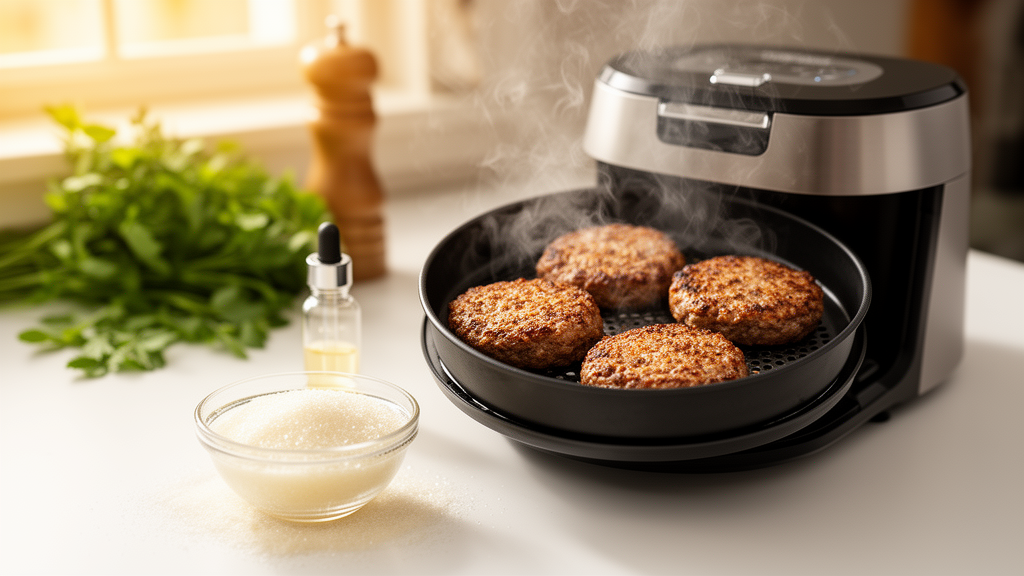
Air fryers have become the darling of health-conscious cooks, promising crispy, golden results with a fraction of the oil used in deep frying. But even the cleanest hot-air circulation cannot escape a fundamental problem of cooking meat at high temperatures: the Maillard reaction, the same browning chemistry that makes a burger taste delicious, also churns out hazardous compounds. Chief among these are heterocyclic aromatic amines, or HAs, potent mutagens classified as possible human carcinogens by the International Agency for Research on Cancer, and advanced glycation end products, or AGEs, a family of compounds increasingly implicated in diabetes, atherosclerosis, and neurodegenerative disease. Now a team of Chinese food chemists reports that a carefully chosen chemical tweak to a humble shellfish-derived polymer can suppress both classes of contaminants in air-fried beef patties, without wrecking the flavor that makes the patties worth eating in the first place.
The study, published in Food Chemistry: X, set out to resolve a stubborn trade-off that has plagued previous attempts to make fried meat safer. Researchers led by Wei Quan of Changsha had earlier identified chitosan, a linear polysaccharide obtained by deacetylating chitin from crustacean shells, as a remarkably effective inhibitor of heat-induced hazards in meat. Chitosan works because its abundant free amino groups form Schiff bases with reactive carbonyl intermediates, intercepting the molecular building blocks of both HAs and AGEs before they can assemble into their final, dangerous forms. But there was a catch: at the concentrations needed for meaningful inhibition, plain chitosan imparted a pronounced off-flavor to the finished product, a sensory penalty that no amount of safety improvement could justify commercially. The new work asked a deceptively simple question: if you change the chemistry of chitosan, can you change what it attacks, and what it leaves alone?
To answer it, the team compared five structurally distinct chitosans in a real food matrix rather than a simplified model system. Alongside unmodified chitosan, they tested carboxyl-modified chitosan, sulfhydryl-modified chitosan, quaternary ammonium-modified chitosan, and carboxymethyl-modified chitosan. Each modification was chosen for a specific mechanistic hypothesis. Carboxyl groups were expected to chelate pro-oxidant metal ions that drive oxidative steps in the Maillard reaction. Thiol groups, being strongly nucleophilic, were predicted to trap reactive dicarbonyl intermediates such as glyoxal and methylglyoxal through direct nucleophilic addition. Permanent positive charges on the quaternary ammonium derivative were expected to electrostatically disrupt negatively charged Maillard intermediates. Carboxymethylation, prized for water solubility, was suspected of a hidden cost: it masks the very amino groups that make chitosan work.
The experimental design was refreshingly practical. Fresh beef longissimus lumborum was ground, mixed with 0.1 percent by weight of each chitosan derivative as a dry powder, marinated for thirty minutes, and shaped into patties. The patties were then air-fried at 200 degrees Celsius for ten minutes per side, conditions typical of both home cooking and laboratory studies of contaminant formation. After cooking, the researchers extracted and purified the HAs and AGEs from the meat and quantified them using ultra-high-performance liquid chromatography coupled to triple quadrupole mass spectrometry, targeting four representative HAs, namely Harman, Norharman, PhIP, and MeIQx, and the two major AGEs, carboxymethyllysine and carboxyethyllysine.
The results revealed a striking structure-activity relationship. All five treatments significantly reduced both HAs and AGEs compared with untreated controls, but the magnitude and selectivity of inhibition varied dramatically. Unmodified chitosan delivered broad-spectrum suppression, cutting Norharman by 74.8 percent, PhIP by 68.6 percent, and MeIQx by 66.1 percent, with more modest reductions of roughly 22 to 24 percent in the two AGEs. The thiolated derivative, however, emerged as the star performer, achieving the strongest and broadest inhibition: MeIQx fell by 75.0 percent, Harman by 65.1 percent, carboxymethyllysine by 26.9 percent, and carboxyethyllysine by 32.0 percent. Critically, it was the only derivative that simultaneously topped the rankings for both IQ-type HAs and AGEs, suggesting that thiol groups excel at intercepting the reactive intermediates shared by both hazard pathways.
The other derivatives told more selective stories. Carboxyl-modified chitosan was the champion against PhIP, reducing it by 78.4 percent, consistent with the idea that metal chelation preferentially disrupts the oxidative steps crucial to that particular HA’s formation, yet it showed only moderate effects on the beta-carbolines. The quaternary ammonium derivative displayed the opposite pattern, achieving the strongest inhibition of beta-carbolines while performing worst of all against carboxyethyllysine, evidence that electrostatic disruption is a pathway-selective tool rather than a universal weapon. Carboxymethylated chitosan fared worst across the board, and the reason is chemically elegant: substituting the free amino groups with bulky carboxymethyl moieties destroys the Schiff base chemistry that underpins carbonyl scavenging, and no amount of incidental metal-chelating capacity could compensate. The lesson is that direct trapping of reactive carbonyls, not indirect antioxidant activity, is the dominant mechanism controlling these contaminants.
But hazard inhibition is only half the story, and this is where the study breaks new ground. The researchers went on to measure cooking loss, water distribution, color, texture, lipid oxidation, and protein oxidation, and then profiled the volatile aroma compounds using gas chromatography-ion mobility spectrometry, a technique sensitive enough to fingerprint the subtle differences between treatments. The water data showed that chitosan and its thiolated and carboxymethylated forms significantly reduced cooking loss and shifted water from the free to the immobile fraction, a change associated with juicier, more stable meat. The thiolated derivative also proved the most effective protector of proteins, cutting total carbonyl content from 2.25 to 0.93 nanomoles per milligram, likely by scavenging reactive oxygen species and forming protective mixed disulfides with protein thiols.
The flavor analysis delivered the study’s most commercially significant finding. The thiolated chitosan altered the volatile profile least of all treatments: the levels of hexanal, heptanal, octanal, and nonanal, the straight-chain aldehydes responsible for the fatty, grassy, and roasted notes of cooked meat, remained closest to those of the untreated control. The explanation lies in chemical selectivity. Thiol groups react preferentially with the highly reactive dicarbonyl intermediates that serve as HA and AGE precursors, while sparing the less reactive aldehydes that carry the aroma. By contrast, unmodified chitosan and the quaternary ammonium derivative depleted the desirable aldehydes indiscriminately through non-specific Schiff base formation and electrostatic interactions respectively, potentially stripping the patties of their characteristic meaty aroma even as they made them safer.
Multivariate statistics tied the whole picture together. Principal component analysis of the combined hazard and flavor dataset showed that the first two components captured 74.8 percent of the total variance, and the spatial map placed the thiolated derivative closest to the control along flavor dimensions while farthest from the hazard loadings, a quantitative confirmation of its dual advantage. Partial least squares discriminant analysis identified eleven key volatile compounds, predominantly aldehydes, as the primary drivers of differentiation between treatments. Taken together, the data establish a coherent framework: the accessibility and reactivity of nucleophilic groups determine both how well a chitosan derivative blocks heat-induced contaminants and how gently it treats the flavor chemistry of cooking meat.
The authors are careful to note the limits of their work. The proposed mechanisms involving glyoxal and methylglyoxal are inferred from inhibition patterns and supported by separate model-system studies rather than by direct measurement of intermediates in the meat itself, and no human sensory panel has yet confirmed that the flavor differences detected instrumentally translate into perceptible changes for consumers. Future work, they suggest, should include trapping assays, spectroscopic validation, consumer taste tests, and extension to other foods and cooking conditions. Even so, the implications are considerable. A food-grade, biocompatible additive derived from shellfish waste, added at just 0.1 percent, could meaningfully reduce two classes of potentially harmful compounds in one of the world’s most popular cooked foods while leaving its aroma essentially intact. As demand grows for healthier processed meats that do not taste like a compromise, the humble thiol may prove to be the food industry’s most useful new chemical handle.
Subject of Research: Structure-dependent inhibition of heterocyclic amines and advanced glycation end products by chemically modified chitosans in air-fried beef patties
Article Title: Structure-dependent inhibition of heterocyclic amines and advanced glycation end products by chemical modified chitosans in air-fried beef patties: Balancing safety and flavor quality
Article References: Quan, W., Liu, J., Liu, S., Zhou, L., Wu, Z., Lou, A., Liu, Y., Shen, Q., Zeng, M., Chen, J., Xue, C., Yang, D., & Mo, L. (2026). Structure-dependent inhibition of heterocyclic amines and advanced glycation end products by chemical modified chitosans in air-fried beef patties: Balancing safety and flavor quality. Food Chemistry: X, Article 104620. https://doi.org/10.1016/j.fochx.2026.104620
Image Credits: AI Generated
DOI: 10.1016/j.fochx.2026.104620
Keywords: chitosan, heterocyclic amines, advanced glycation end products, air frying, Maillard reaction, food safety, beef patties, thiol modification, flavor chemistry, GC-IMS, food chemistry, meat processing
Cite Scienmag News
Bethany Barker. (October 14, 2026). Thiol-Modified Chitosan Cuts Carcinogens in Air-Fried Beef While Preserving Flavor. Scienmag. https://scienmag.com/thiol-modified-chitosan-cuts-carcinogens-in-air-fried-beef-while-preserving-flavor/
Bethany Barker. "Thiol-Modified Chitosan Cuts Carcinogens in Air-Fried Beef While Preserving Flavor." Scienmag, 14 October 2026, https://scienmag.com/thiol-modified-chitosan-cuts-carcinogens-in-air-fried-beef-while-preserving-flavor/. Accessed 14 October 2026.
Bethany Barker. "Thiol-Modified Chitosan Cuts Carcinogens in Air-Fried Beef While Preserving Flavor." Scienmag. October 14, 2026. https://scienmag.com/thiol-modified-chitosan-cuts-carcinogens-in-air-fried-beef-while-preserving-flavor/


