


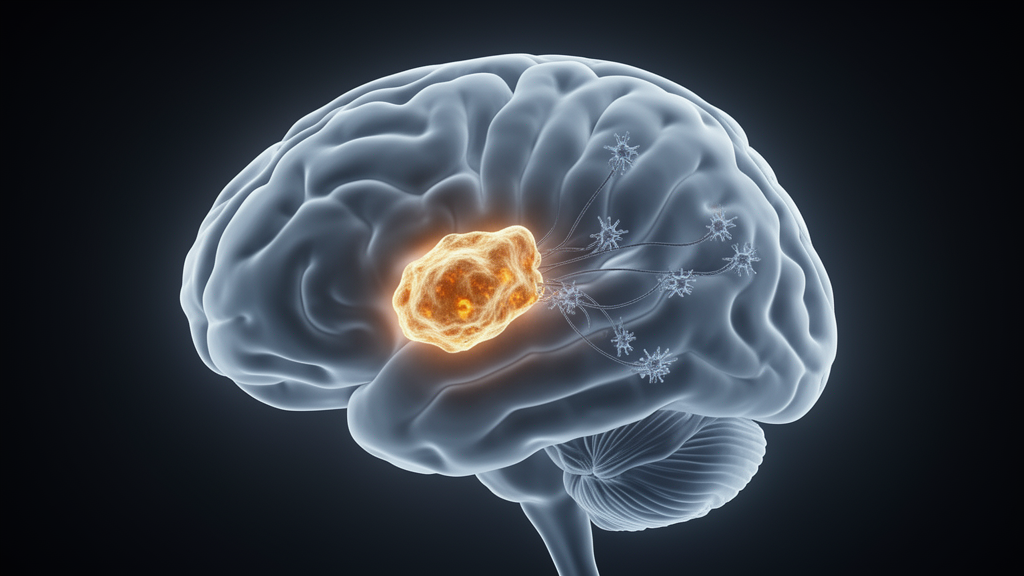
Central neurocytomas have long occupied a comfortable niche in neuro-oncology as the rare brain tumors with a reassuring prognosis. These slow-growing, WHO grade 2 neoplasms arise most often in the fluid-filled ventricles deep within the brain, typically striking young adults in their twenties. Standard textbooks have generally suggested that when surgeons manage a complete removal, patients can expect to be cured. A new 35-year collaboration between Northwestern University and the Mayo Clinic, published in the Journal of Neuro-Oncology, now complicates that picture considerably. In one of the largest and longest-followed cohorts of central neurocytoma patients ever assembled, the researchers found that recurrences were frequent even after what was believed to be a complete gross resection, and that several measurable factors, including a patient’s age at diagnosis and the proliferative activity of the tumor, could predict who was most at risk.
The study reviewed patients diagnosed with tissue-confirmed central neurocytoma between 1990 and 2025 across the two institutions. Fifty-one patients made up the final cohort, with a median age at diagnosis of just 26 years and a remarkable median follow-up of 9.7 years, a duration that few single-institution series of this rare tumor have achieved. That long observational window matters enormously for a tumor that can recur years, even decades, after initial treatment. The researchers calculated recurrence-free survival and overall survival using Kaplan-Meier methods, the standard statistical approach for tracking how many patients remain free of disease over time, and then applied multivariate Cox regression analysis to a pre-planned set of variables to determine which factors independently influenced the risk of the tumor coming back.
The headline survival numbers remain genuinely encouraging. Overall survival for the entire cohort stood at 94 percent at ten years, meaning that despite the tumor’s location in a surgically treacherous part of the brain and its tendency to recur, death from this disease is uncommon. Central neurocytomas sit within or adjacent to the lateral ventricles, the cavities that produce and circulate cerebrospinal fluid, and surgery there carries risks of hydrocephalus, bleeding, and injury to deep brain structures. Yet the long-term mortality data confirm that for most patients, this is a disease to be managed rather than feared, provided that recurrences are caught and treated promptly.
Recurrence, however, proved to be a much more common companion than the field has generally acknowledged. Among patients who did not receive adjuvant radiotherapy after surgery, the five-year recurrence-free survival was 61 percent following gross total resection, the operation in which the surgeon removes all visibly identifiable tumor, versus 46 percent after subtotal resection, where some tumor is deliberately or unavoidably left behind. The difference between the two surgical outcomes did not reach statistical significance in this cohort, with a P value of 0.18, but the absolute numbers are striking. A 39 percent chance of recurrence within five years after a supposedly complete removal contradicts the widely held assumption that gross total resection alone is curative, and it directly challenges previous reports that have portrayed recurrence after complete surgery as an exception rather than a rule.
The multivariate analysis sharpened the picture by isolating four independent predictors of worse recurrence-free survival. Omission of adjuvant radiotherapy carried a hazard ratio of 9.0, meaning patients who did not receive postoperative radiation were nine times more likely to experience recurrence, with a P value of 0.003. Subtotal resection carried a hazard ratio of 5.7, statistically significant at P equals 0.017. Younger age at diagnosis was associated with a hazard ratio of 3.1, significant at P equals 0.002, an intriguing finding suggesting that the biology of these tumors in younger patients may be more aggressive than their histological appearance implies. Finally, a higher Ki-67 proliferation index, a pathologist’s measure of how many tumor cells are actively dividing, carried a hazard ratio of 1.13 per unit increase, significant at P equals 0.017, confirming that the biological activity of the tumor itself, not merely the extent of surgery, shapes the risk of relapse.
The Ki-67 finding deserves particular attention because it connects this study to a long-running debate in neuropathology. Ki-67 is a protein expressed by cells in the active phases of the cell cycle, and the labeling index, the percentage of tumor nuclei that stain positive for it, has been used for decades to distinguish indolent from more aggressive gliomas. For central neurocytomas, earlier work had suggested that tumors with elevated MIB-1 labeling, the antibody used to detect Ki-67, behave more aggressively and deserve the designation of atypical neurocytoma. The new multi-institutional data lend substantial statistical weight to that idea, showing that even within a WHO grade 2 classification, the proliferative index carries real prognostic information that should inform how closely a patient is monitored and whether additional therapy is considered up front.
Perhaps the most clinically actionable result concerns what happens after the first recurrence. Among the 17 patients in the cohort who received salvage radiotherapy, radiation delivered at the time of their first relapse rather than immediately after initial surgery, the five-year recurrence-free survival after that salvage treatment was 83 percent, with a median follow-up of 4.8 years. In other words, holding radiation in reserve until the tumor actually returns produced durable long-term control for the large majority of patients. This strategy, sometimes called deferred or salvage treatment, spares patients the potential toxicities of brain radiotherapy, which can include cognitive effects and injury to surrounding healthy tissue, during the years when they are most likely to be building careers and families. For a tumor diagnosed at a median age of 26, deferring radiation without compromising ultimate control is a meaningful quality-of-life win.
The findings arrive amid a broader re-evaluation of how central neurocytomas should be managed. Recent multicenter studies from Korea and France have reported improved tumor control with adjuvant radiotherapy, and an earlier 35-year experience from the Mayo Clinic itself had generated management recommendations favoring consideration of postoperative radiation in selected cases. The new study builds on that foundation with longer follow-up and a formal multivariate framework, and its results suggest a middle path: patients with favorable features, such as a gross total resection, a low Ki-67 index, and older age at diagnosis, may be safely observed with close surveillance imaging, while those with subtotal resections, high proliferative indices, or young age warrant a serious discussion about adjuvant radiotherapy given the ninefold increase in recurrence risk when it is omitted.
There are important caveats to keep in view. Fifty-one patients, though large for this ultra-rare tumor, is still a modest number, and the comparison between adjuvant radiotherapy and observation was not randomized; treatment decisions were made by clinicians and patients over three and a half decades, raising the possibility of selection bias in who received radiation. The hazard ratios, while statistically significant, come from retrospective data, and the authors themselves note that no new datasets were generated or analyzed beyond the clinical records reviewed. The difference in five-year recurrence-free survival between gross total and subtotal resection without radiotherapy did not reach significance, a reminder that even apparent clinical differences in rare-disease cohorts require cautious interpretation. Still, the consistency of the Ki-67 and age findings with prior literature strengthens the case that they reflect genuine biology rather than statistical noise.
For the young patients who make up the vast majority of those diagnosed with central neurocytoma, the practical message of this study is one of informed vigilance rather than alarm. Survival is excellent, ten-year mortality is low, and even tumors that return can usually be brought back under control with salvage radiotherapy. But the era of assuming that a clean surgical margin equals a cure appears to be over. The study’s authors, led by Yufan Yang of the University of Michigan and Northwestern University’s radiation oncology team together with colleagues at the Mayo Clinic, argue that their cohort represents one of the most comprehensive long-term pictures of this disease available anywhere. As molecular profiling increasingly refines the classification of even rare brain tumors, the proliferative index and the patient’s age at diagnosis are emerging as the numbers that matter most, and clinicians managing these tumors now have firmer statistical ground on which to decide who needs radiation now and who can safely wait.
Subject of Research: Long-term recurrence outcomes and prognostic predictors in central neurocytoma
Article Title: Long term outcomes and predictors of recurrence in central neurocytomas: a 35-year multi-institutional experience
Article References: Long term outcomes and predictors of recurrence in central neurocytomas: a 35-year multi-institutional experience. (n.d.). https://doi.org/10.1007/s11060-026-05825-8
Image Credits: AI Generated
DOI: 10.1007/s11060-026-05825-8
Keywords: central neurocytoma, brain tumor, recurrence, Ki-67, adjuvant radiotherapy, salvage radiotherapy, gross total resection, prognostic markers, neuro-oncology, WHO grade 2, Kaplan-Meier, Cox regression
Cite Scienmag News
Nathaniel Bowman. (October 14, 2026). Rare Brain Tumor Study Reveals Recurrence Is Far More Common Than Assumed. Scienmag. https://scienmag.com/rare-brain-tumor-study-reveals-recurrence-is-far-more-common-than-assumed/
Nathaniel Bowman. "Rare Brain Tumor Study Reveals Recurrence Is Far More Common Than Assumed." Scienmag, 14 October 2026, https://scienmag.com/rare-brain-tumor-study-reveals-recurrence-is-far-more-common-than-assumed/. Accessed 14 October 2026.
Nathaniel Bowman. "Rare Brain Tumor Study Reveals Recurrence Is Far More Common Than Assumed." Scienmag. October 14, 2026. https://scienmag.com/rare-brain-tumor-study-reveals-recurrence-is-far-more-common-than-assumed/


