


A racing heart that starts and stops without warning, known medically as paroxysmal supraventricular tachycardia or PSVT, strikes an estimated 35 out of every 100,000 people each year, with women and older adults affected most often. For most patients the episode is frightening but hemodynamically stable, and the first-line response in emergency departments, ambulances, and rural clinics is often not a drug at all but a controlled bout of straining. A new systematic review, conducted according to the PRISMA 2020 reporting guidelines and registered with PROSPERO, has now pulled together a decade of randomized evidence to answer a deceptively simple question: which way of resetting the heartbeat works best, and how much of that success depends on exactly how the technique is performed?
The answer, synthesized from eleven studies encompassing roughly 2,071 patients across seven randomized controlled trials, one retrospective cohort study, and three systematic reviews or meta-analyses, points firmly toward a modified version of a maneuver many readers already know. The standard Valsalva maneuver asks a patient to generate pressure by straining, typically blowing into a syringe, which stimulates baroreceptors and transiently slows conduction through the atrioventricular node, the electrical bottleneck that sustains the reentry circuit driving most PSVT episodes. In real-world practice, however, the standard technique converts fewer than one in five patients, largely because achieving sufficient and consistent intrathoracic pressure is surprisingly difficult and patient cooperation varies widely. Evidence even suggests that repeated or suboptimal attempts may impair baroreflex responses or cause hemodynamic instability.
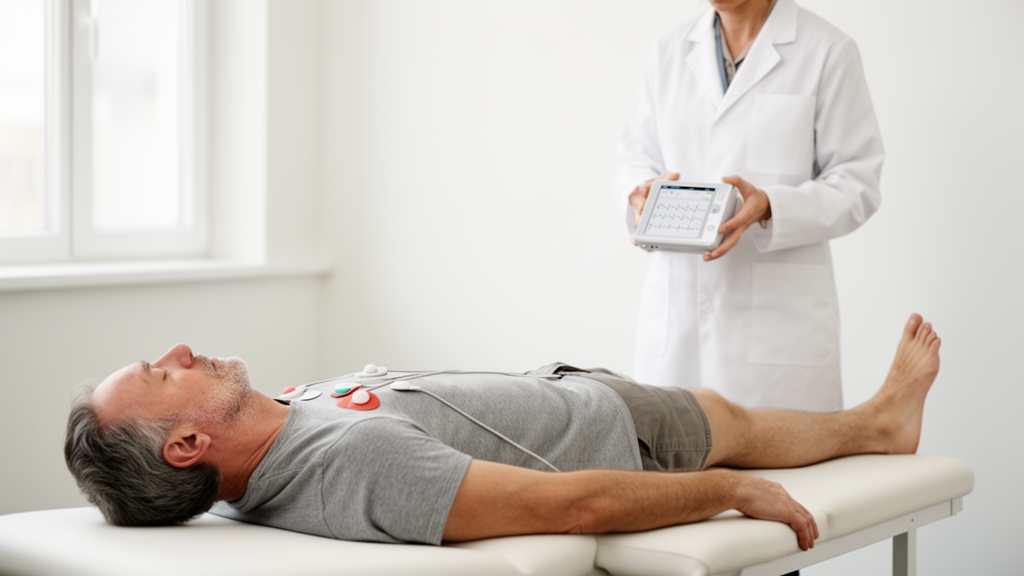
The modified Valsalva maneuver, introduced by the landmark REVERT trial, adds a crucial postural flourish: immediately after the strain phase, the patient is repositioned supine with the legs passively elevated. This repositioning enhances venous return to the heart during the relaxation phase, amplifying the baroreceptor stimulus that briefly inhibits atrioventricular nodal conduction and allows the sinus rhythm to reassert itself. In the REVERT trial of 428 emergency department patients, this simple addition converted 43 percent of episodes on a single attempt compared with 17 percent for the standard technique, an odds ratio of 3.7 with a confidence interval of 2.3 to 5.8 and a p-value below 0.0001. The review’s authors highlight that an effect of this magnitude exceeds typical differences seen between acute cardiac interventions, suggesting the postural modification is physiologically meaningful rather than incrementally marginal.
Subsequent trials have replicated the pattern across markedly different settings. One randomized comparison with continuous electrocardiographic monitoring reported immediate conversion rates of 43.7 percent for the modified maneuver, 24.2 percent for the standard version, and just 9.1 percent for carotid sinus massage, the older alternative that involves pressing on the neck’s baroreceptor-rich arteries, with only the difference between the modified maneuver and massage reaching statistical significance. Another trial of 361 inpatients found 47.8 percent success with the modified approach versus 15.4 percent with the standard one, rising to 62.2 percent and 19.8 percent respectively when up to three attempts were permitted. A meta-analysis pooling 2,527 patients calculated a risk ratio of 2.05 for first-attempt success and 1.80 for overall success, both statistically robust, with moderate heterogeneity of 66 percent reflecting inevitable differences in how the protocol was executed. One smaller trial of 62 patients found lower absolute success rates and no significant difference, a reminder that protocol variability and sample characteristics matter.
Perhaps just as important as efficacy is what the review found about safety. Across all eleven studies, the modified maneuver produced only mild and transient adverse events, with no serious complications reported. The REVERT trial noted minor events in 6 percent of modified-maneuver cases versus 4 percent for the standard technique, a difference that did not reach statistical significance, including brief ventricular escape rhythms and self-limited pauses in heartbeat. The pooled meta-analysis of 17 trials confirmed no significant difference in adverse events between the two techniques, with a risk ratio of 1.07 and the most commonly reported symptoms being flushing, palpitations, and headache. Carotid sinus massage, by contrast, carries greater risks of bradycardia and cerebral hypoperfusion in older patients or those with carotid artery disease, requires precise anatomical knowledge, and the review concludes it is no longer a competitive first-line option given both its lower success rates and its more demanding skill requirements.
The maneuver’s advantages extend to reducing pharmacological reliance. When the modified technique succeeded, far fewer patients needed intravenous drugs: in the REVERT trial, adenosine was administered to 15 percent of modified-maneuver patients compared with 45 percent in the standard arm. One trial reported that 57.1 percent of modified-maneuver patients required drug therapy compared with 89.3 percent of standard-technique patients, while a structured prehospital protocol reported adenosine use of just 12.9 percent. This matters because the principal pharmacological alternative, adenosine, converts more than 85 percent of episodes but does so with a burst of distressing and transient symptoms, including chest pain, flushing, and dyspnea, which can feel alarming even when they are self-limiting. Calcium channel blockers such as verapamil offer comparable efficacy, 74.4 percent versus 81.8 percent for adenosine in one systematic review, but carry hypotension risk in borderline patients, and their relative effectiveness shifts with heart rate, with adenosine less reliable below 166 beats per minute and verapamil less reliable above 186.
Dosage detail also emerged from the sole cohort study, included as an acknowledged deviation from the review’s pre-specified eligibility criteria because it supplied unique comparative data on weight-based adenosine dosing unavailable in any randomized trial. Among 76 emergency department patients with confirmed reentrant tachycardia, doses of at least 0.1 milligrams per kilogram converted 92.7 percent of episodes compared with 59.6 percent at lower doses, with mild adverse events in 8.3 percent versus 3.9 percent, a difference that was not statistically significant. Meanwhile, a hybrid protocol tested in a multicenter trial of 118 patients combined the modified maneuver with low-dose adenosine and achieved 86.1 percent overall success, higher than either the maneuver alone at 42.1 percent or adenosine alone at 75 percent, though the review’s authors caution this should be interpreted as evidence for a distinct combined strategy rather than for the standalone maneuver.
Subgroup findings add nuance. One multicenter trial found higher success in patients with short RP intervals on the electrocardiogram, typically linked to atrioventricular nodal reentrant tachycardia, at 70 percent versus 20 percent in long RP cases, supporting rhythm-stratified use of the technique. Patient acceptability appears comparable between maneuver variants, with one trial reporting similar comfort ratings of 3.67 and 3.54 on a five-point Likert scale. The review’s formal scope was restricted to adults, and it explicitly notes that observations about children, in whom vagal maneuvers are generally less effective at roughly 47 percent with standard techniques, and about pregnant women, in whom non-pharmacological strategies are preferred to minimize fetal exposure, fall outside its eligibility criteria and were not part of the formal synthesis.
The review’s authors are candid about limitations. Substantial clinical and methodological heterogeneity, including variation in strain pressure targets, strain duration, leg elevation angle, the number of permitted attempts, care settings, and the timing of outcome assessment, precluded formal meta-analysis, so findings were synthesized narratively. No GRADE certainty assessment was performed, the registered protocol was formally published only after the literature search had begun due to an administrative oversight, eight full-text articles could not be retrieved, special populations were underrepresented, and the possibility of publication bias cannot be excluded given the predominance of positive findings favoring the modified technique. Crucially, no included study directly compared the modified maneuver head-to-head against adenosine or calcium channel blockers in a randomized design, so conclusions about superiority over drugs rest on indirect inference from separate evidence streams, and results from smaller single-center trials should be treated as hypothesis-generating.
Even so, the convergence across trials of varied design and population lends the central conclusion considerable weight, reinforced by physiological plausibility: enhanced venous return during the Valsalva relaxation phase is a coherent mechanism for the observed benefit. For emergency nurses and paramedics, the implications are concrete. The modified maneuver requires no equipment beyond a syringe for standardized pressure generation, a bed or stretcher for repositioning, and training in correct execution, and paramedic-led implementation has already proven feasible in ambulance settings. Because early success correlates with reduced drug use and lower healthcare costs, embedding the technique into nursing curricula and prehospital protocols offers a low-risk change to frontline arrhythmia management, particularly in rural and resource-limited settings where drugs and monitoring may be scarce and where nurse-led care is already the first, and often only, line of defense against a suddenly racing heart.
Subject of Research: Comparative effectiveness and safety of vagal maneuvers versus pharmacological cardioversion in adults with stable paroxysmal supraventricular tachycardia
Article Title: Vagal maneuvers and pharmacological cardioversion in stable PSVT: A systematic review with implications for emergency nursing practice
Article References: González-García, M., Carrillo-Franco, L., Morales-Luque, C., Rocha, I., Dawid-Milner, M. S., & López-González, M. V. (2026). Vagal maneuvers and pharmacological cardioversion in stable PSVT: A systematic review with implications for emergency nursing practice. iScience, 29(11), Article 117869. https://doi.org/10.1016/j.isci.2026.117869
Image Credits: AI Generated
DOI: 10.1016/j.isci.2026.117869
Keywords: PSVT, Valsalva maneuver, cardioversion, adenosine, emergency nursing, arrhythmia, systematic review, prehospital care, REVERT trial, vagal techniques, carotid sinus massage, Vagal
Cite Scienmag News
Denise Maddox. (October 23, 2026). Simple Breathing Trick With Leg Lift Doubles Heart Rhythm Reset Success, Review Finds. Scienmag. https://scienmag.com/simple-breathing-trick-with-leg-lift-doubles-heart-rhythm-reset-success-review-finds/
Denise Maddox. "Simple Breathing Trick With Leg Lift Doubles Heart Rhythm Reset Success, Review Finds." Scienmag, 23 October 2026, https://scienmag.com/simple-breathing-trick-with-leg-lift-doubles-heart-rhythm-reset-success-review-finds/. Accessed 23 October 2026.
Denise Maddox. "Simple Breathing Trick With Leg Lift Doubles Heart Rhythm Reset Success, Review Finds." Scienmag. October 23, 2026. https://scienmag.com/simple-breathing-trick-with-leg-lift-doubles-heart-rhythm-reset-success-review-finds/


