


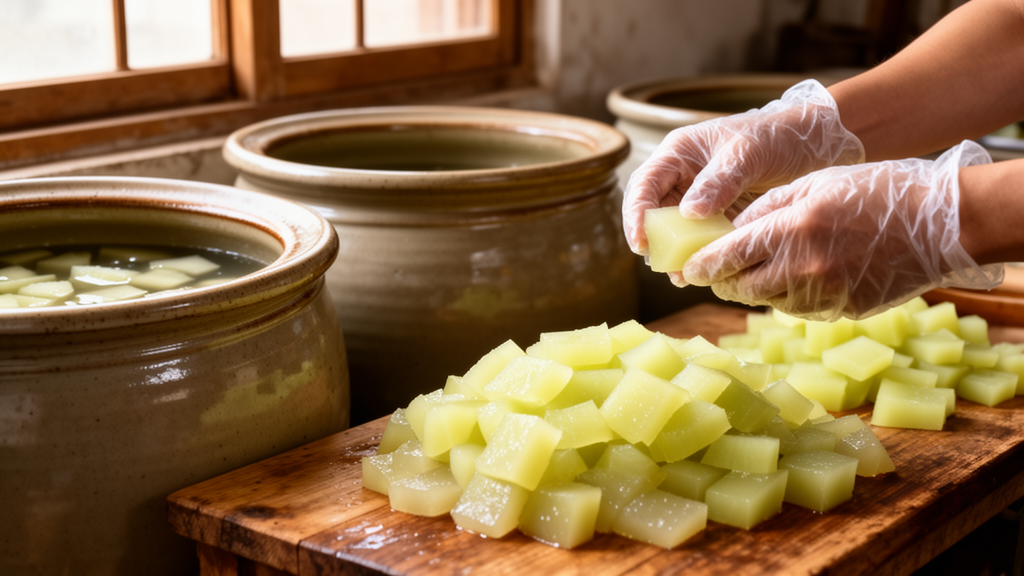
The signature crunch of Fuling Zhacai, the salted stem mustard produced in Chongqing's Fuling District, collapses almost entirely during its traditional three-stage pickling process, and a new laboratory study has mapped precisely how that happens. Their central finding is stark: hardness fell by roughly 93.6 percent and chewiness by about 88.9 percent between the fresh tuber and the finished product, driven mainly by the enzymatic dismantling of pectin and cellulose, compounded by mechanical pressing that physically tears the cell wall apart. The texture profile measurements told an unambiguous story.
Fresh stem mustard registered a hardness of 163.70 newtons and a chewiness of 136.35 millijoules, measured with a texture analyzer using a 2 millimeter cylindrical probe at 55 percent compression. After the first pickling stage, in which 3 percent salt is added for about five days before pressing, hardness had already plunged to 26.83 newtons. It stayed near that level through the second, 10-day stage at 5 percent salt, at 25.03 newtons, then dropped further to 10.47 newtons after the third and longest stage, a 90-day fermentation at 8 percent salt that both develops flavor and, at its high salt concentration, inhibits microbial growth to allow extended storage.
Chewiness followed a similar trajectory, falling to 15.02 millijoules by the end. The most dramatic single loss occurred in that earliest stage, which the researchers identify as the critical window for intervention. Physicochemical measurements supplied the environmental backdrop for this decline.
Moisture content fell from 93.94 grams per 100 grams in fresh samples to 79.66 grams per 100 grams at the end of pickling, a consequence the authors attribute to a salting-out effect: as salt penetrates the tissue, damaged cell walls release water and the tissue dehydrates. Total acid, the hallmark of lactic acid fermentation, climbed from 1.32 grams per kilogram to 5.12 grams per kilogram as microbial growth and metabolism accelerated in the later stages, converting more sugars into organic acids. Nitrite, a critical safety parameter for pickled vegetables, declined steadily and ended at just 1.83 milligrams per kilogram, far below the 20 milligrams per kilogram benchmark cited in the study, reflecting the denitrifying and nitrate-reducing activity of fermentative microorganisms reported in earlier work on Zhacai and cowpea pickles.
In fresh tubers, the carbonate-soluble fraction dominated at 102.85 milligrams per gram, with chelate-soluble pectin at 49.15 and only 7.65 milligrams per gram of the water-soluble form, a pattern indicating an intact, well-crosslinked wall. As pickling proceeded, the alcohol-insoluble residue and the insoluble pectin fractions declined continuously while water-soluble pectin rose, a chemical signature of cell wall disassembly. Carbonate-soluble pectin is covalently anchored into the wall's polysaccharide network, so its loss thins and weakens the wall and loosens cell connections.
Chelate-soluble pectin, held in the middle lamella by calcium bridges, glues neighboring cells together; its decline loosens intercellular adhesion. The researchers suggest that salt ions in the brine disrupt those ionic bonds while the enzyme pectin methylesterase promotes conversion of the chelate-soluble form into the weakly bound, water-soluble type, which attaches to the wall only through non-covalent, non-ionic interactions. The enzyme measurements explained how this conversion was catalyzed.
Activities of pectin methylesterase, polygalacturonase and beta-galactosidase all followed the same pattern: a sharp early rise followed by a decline across the later two stages. The authors propose that the pressing step physically disrupts cell architecture, releasing enzymes from their compartments, while the increasing salt concentration later creates osmotic stress that damages catalytic sites and compromises enzymatic function, a phenomenon also observed in salt-stressed tomato. Each enzyme has a distinct role.
Pectin methylesterase strips methyl-ester bonds from galacturonic acid residues, lowering the degree of esterification and making pectin vulnerable to attack. Polygalacturonase then cleaves the exposed galacturonic acid backbone, reducing cell rigidity; its early peak in the first-stage sample coincided with a supply of low-esterified substrate created by the methylesterase. Beta-galactosidase trims galactosyl side chains, weakening interactions between pectin molecules.
The team also notes that microbes such as Providencia vermicola and Galactomyces geotrichum, reported in earlier studies, can secrete their own plant cell wall-degrading enzymes during fermentation and contribute to vegetable softening. Cellulose, the structural polysaccharide that forms microfibers and supports tissue rigidity, degraded in parallel. Cellulose content was highest in fresh samples and fell steadily as pickling advanced, and cellulase activity peaked at the end of the first stage before declining.
The authors link this early cellulase boost to the initial salt concentration and its later suppression to the accumulating acidity of the fermenting brine, a pattern previously seen in dry-salted spaghetti squash and fermented chopped peppers. Similar cellulose degradation has been documented in pickled radish, where both microbial exogenous enzymes and liberated endogenous enzymes appear to contribute under saline conditions. Correlation and clustering analyses drew the threads together.
Hierarchical clustering showed the first and second pickling stages grouping together with the third stage joining them, while fresh samples formed an entirely separate branch, evidence of progressively divergent cell wall metabolism as pickling proceeded. The authors attribute this divergence to the relatively short duration of the first two stages, where quality changes were driven mainly by salt penetration and wall-degrading enzymes, whereas the third stage is characterized predominantly by lactic acid bacteria fermentation. Pickling time correlated negatively with moisture, carbonate-soluble pectin, chelate-soluble pectin and cellulose, and positively with water-soluble pectin and wall-degrading enzyme activities.
Hardness and chewiness correlated positively with the insoluble wall fractions and moisture but negatively with water-soluble pectin, indicating that cell wall composition and moisture content play a dominant role in determining Zhacai texture. Intriguingly, no significant correlation emerged between the texture parameters and cell wall-degrading enzyme activity directly, a result also reported for white kiwifruit. The authors interpret this as evidence that softening is a cumulative, multi-factor effect: enzyme activities rose and then fell while hardness declined continuously, and the synergy among different endogenous enzymes weakens the relationship between any single enzyme and the texture indicators, with high salt further suppressing enzymatic contribution in later stages.
Enzyme activities did correlate significantly with the cell wall fractions, with beta-galactosidase and polygalacturonase showing the most prominent associations, and total acid was negatively correlated with the activities of those two enzymes, suggesting that accumulating organic acids help modulate the rate of wall disassembly in later pickling. Fourier-transform infrared spectroscopy added a molecular view. Spectra of the pectin fractions showed characteristic polysaccharide bands, and the degree of esterification, calculated from the ratio of esterified to total carboxyl band areas, fell continuously through pickling.
In the water-soluble fraction it dropped from 63.03 percent in fresh tissue to 39.40 percent in the final product, and in the chelate-soluble fraction from 55.45 percent to 33.31 percent. This progressive de-esterification triggers the breakdown of water-insoluble pectin into water-soluble components, loosening the wall. Peak shifts near 1012 per centimeter indicated changes in pyranoside bonds during pickling.
Overall, however, the authors report no dramatic changes in pectin components or cellulose structure across the process, with only several pectin-associated functional groups, such as the C–O–O band of water-soluble pectin near 1407 per centimeter, changing at the late stage, implying alterations in pectin monosaccharide composition. Transmission electron microscopy made the damage visible at the subcellular scale. Fresh cells showed an intact, continuous wall of uniform thickness, a smooth membrane pressed against the wall, orderly mitochondria with dense cristae and a dominant central vacuole.
By the first pickling stage, walls had become unevenly thickened and folded in places, the middle lamella had loosened and delaminated, and plasmolysis had ruptured membranes, scattering fragmented organelles through the cytoplasm. These defects worsened through the second and third stages, culminating in severely distorted walls with heterogeneous thickness and pervasive organelle debris. The authors also observed occasional wall thickening, which they attribute to the pressing step: mechanical pressure prompting cell wall components to retain cell fluid can trigger swelling-induced gelation, as previously described in pumpkin cubes.
Because the first pickling stage is where wall-degrading enzymes surge, the authors suggest that inhibiting enzyme activity at this early point offers the best chance of preserving texture, and that alternative, non-mechanical dehydration approaches could reduce the cell wall damage caused by pressing. They caution that their experimental design could not quantitatively separate the contributions of mechanical force and enzymatic hydrolysis, and that exogenous pectinases and cellulases from halophilic lactic acid bacteria during late fermentation may also participate in polysaccharide breakdown. The study examined a single traditional production process, with correlations rather than controlled single-factor experiments, so the interplay among salt stress, enzymatic hydrolysis, microbial metabolism and wall restructuring will require further disentangling.
Subject of Research: Mechanisms of texture softening in Fuling Zhacai during the traditional three-stage pickling process
Article Title: The effect of key physicochemical properties, cell wall polysaccharides, and cell microstructure on the texture of Fuling Zhacai during pickling process
Article References: Zheng, Q., Zhang, Z., Rao, M., Pan, Y., Song, J., & Gao, X. (2026). The effect of key physicochemical properties, cell wall polysaccharides, and cell microstructure on the texture of Fuling Zhacai during pickling process. Food Chemistry: X, 40, Article 104630. https://doi.org/10.1016/j.fochx.2026.104630
Image Credits: AI Generated
DOI: 10.1016/j.fochx.2026.104630
Keywords: Fuling Zhacai, pickling, texture softening, pectin, cellulose, cell wall-degrading enzymes, fermentation, transmission electron microscopy, FT-IR, food science, stem mustard, salt
Cite Scienmag News
Bethany Barker. (October 23, 2026). How China’s Crunchy Pickled Zhacai Loses Its Bite: Enzymes, Salt and Cell Wall Breakdown Tracked Stage by Stage. Scienmag. https://scienmag.com/how-chinas-crunchy-pickled-zhacai-loses-its-bite-enzymes-salt-and-cell-wall-breakdown-tracked-stage-by-stage/
Bethany Barker. "How China’s Crunchy Pickled Zhacai Loses Its Bite: Enzymes, Salt and Cell Wall Breakdown Tracked Stage by Stage." Scienmag, 23 October 2026, https://scienmag.com/how-chinas-crunchy-pickled-zhacai-loses-its-bite-enzymes-salt-and-cell-wall-breakdown-tracked-stage-by-stage/. Accessed 23 October 2026.
Bethany Barker. "How China’s Crunchy Pickled Zhacai Loses Its Bite: Enzymes, Salt and Cell Wall Breakdown Tracked Stage by Stage." Scienmag. October 23, 2026. https://scienmag.com/how-chinas-crunchy-pickled-zhacai-loses-its-bite-enzymes-salt-and-cell-wall-breakdown-tracked-stage-by-stage/


