


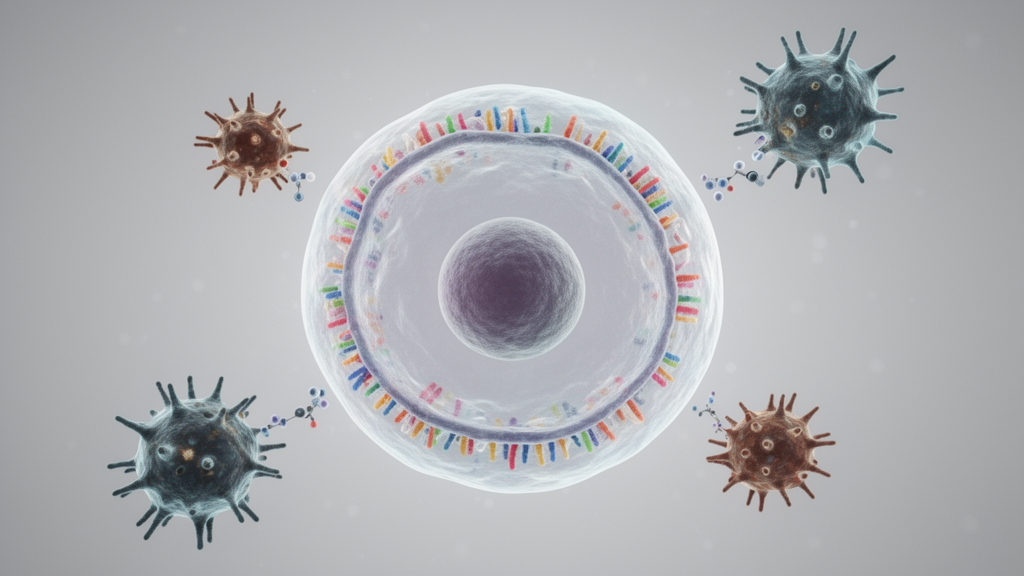
A primer published in PLOS Biology by Andrea L. Graham and David A. Chang van Oordt discusses a new study by Belyi and colleagues that offers an evolutionary explanation for why host and parasite populations remain genetically diverse. The commentary highlights experimental and modeling evidence suggesting that infection outcomes depend strongly on the specific interaction between host and parasite genotypes, rather than on the inherent strength of one partner alone. This context-dependent fitness landscape implies that no single genotype holds a permanent advantage, which helps prevent the erosion of genetic variation that would typically occur through simple directional selection. By synthesizing mathematical modeling with extensive experimental data, the primer outlines mechanisms that may sustain heterogeneity in these biological arms races, providing a framework for understanding persistent variability in natural populations.
Host defense capabilities and parasite attack strategies are notoriously variable, a fact that has long been a key aim for researchers in both evolutionary biology and clinical medicine. In a straightforward scenario, one might expect that universally susceptible host genotypes would be eliminated by parasite-mediated selection, while universally resistant hosts would dominate. However, such a static outcome is rarely observed in nature. Instead, populations often maintain a rich tapestry of genetic diversity. The primer suggests that this persistence is driven by antagonistic coevolution, where hosts and parasites continuously evolve in response to one another. This dynamic process is predicted to generate balancing selection, which fosters persistent genetic diversity at the population scale, although these theoretical expectations are contingent upon other factors such as geographical population structure.
To investigate these dynamics, Belyi and colleagues focused on the interaction between fruit flies (Drosophila melanogaster) and vertically transmitted sigma viruses. They first developed mathematical models to predict how genetic variance for fitness might emerge from coevolution. The simulations indicated that antagonistic coevolution should erode additive genetic variance, which is the variance explained by the main effects of host or parasite genotype alone. Instead, the models predicted that fitness variance would shift into the interaction term, representing the combined effect of specific host and parasite genotype pairings. This theoretical framework set the stage for the experimental validation that followed, aiming to test whether the bulk of genetic variance would indeed reside in these complex interactions.
The experimental component of the study was ambitious in scope, involving a factorial design that crossed nine distinct fly genotypes against ten virus genotypes. This resulted in 90 replicated combinations, allowing for a detailed statistical analysis of genetic variance. For each combination, the researchers measured key fitness-related traits, including viral transmission rates, viral load, and virulence, which was assessed by its negative effects on fly fecundity and hatch rates. The results aligned closely with the simulation predictions, revealing that the bulk of the genetic variance in these traits was explained by the host-by-parasite interaction terms rather than by the main effects of either partner. This finding indicates that the fitness of a genotype is not fixed but depends on the specific genetic context of its interaction.
These findings imply that there is no single fly genotype that is universally resistant to all sigma virus variants, nor is there a single viral genotype that is universally transmissible or virulent across all fly backgrounds. This lack of a dominant genotype is consistent with the balancing selection scenario, where genetic diversity is maintained because the fitness of a genotype depends on the frequency and identity of its interacting partners. The data suggest that even fly genotypes harboring polymorphisms known to severely restrict sigma virus replication did not offer general resistance. Instead, these resistance mechanisms were effective only against a subset of viral genotypes, further entrenching the complexity of the host-parasite interaction and highlighting the limitations of assuming universal resistance or susceptibility.
The study also highlighted the role of sex in these interactions, with effects manifesting primarily within the interaction term. This suggests that female and male hosts experience differential dependence on genotype interactions for their fitness. Such sex-specific dynamics add another layer of complexity to the evolutionary landscape, indicating that the maintenance of genetic diversity may be influenced by factors beyond simple genotype-by-genotype interactions. The authors note that this inherent dynamism, occurring “under the hood” of sustained coexistence, is a key driver of the observed variability in natural populations, suggesting that the biological systems involved are far more intricate than simple linear models might predict.
The authors conclude that because most of the observed genetic variance resides in the interaction term, this variance remains cryptic, effectively masking heritable variation from directional selection. They posit that their results are consistent with negative frequency-dependent selection, a mechanism that promotes diversification by favoring rare variants until they become common. Their mathematical model revealed parameter-dependent persistent cycling, which is consistent with general theory on negative frequency-dependent selection. This suggests that time-lagged selection, as predicted by the Red Queen model of antagonistic coevolution, may underlie the dynamics observed in the fruit fly-sigma virus system, although the specific mechanism remains an open question for further investigation.
However, the primer acknowledges that empirical demonstration of negative frequency-dependent selection is not trivial, especially in natural host-parasite systems. While the interaction term is necessary, it is not sufficient to prove that rare variants have a fitness advantage. A truly state-of-the-art demonstration would require time series data on genotypes and fitness across both microevolutionary and macroevolutionary time scales, or time-shift experiments involving hosts exposed to parasites from the past, present, and future. The authors leave the specific mechanism of balancing selection open, noting that other processes such as heterozygote advantage or spatiotemporal fluctuating selection could also contribute to the persistence of genetic variation, and that further work is needed to unpick what evolutionary processes are underway.
Despite these open questions, the study sets a high bar for linked empirical and theoretical investigation of the evolutionary maintenance of genetic diversity. The tractability of the fruit fly-sigma virus system allows for future research directions, including the exploration of the evolution of known fly resistance alleles in the face of sigma virus diversity. The data collected highlight the critical importance of using multiple genotypes in experiments to identify susceptibility, infectivity, or restriction factors that might be missed in single-genotype studies. This work is likely to inspire new experiments in other systems, potentially revealing how these coevolutionary dynamics apply across diverse organismal groups and time scales, including systems where sex roles and immunological correlates are reversed.
Ultimately, the research underscores the profound complexity of host-parasite interactions and the evolutionary forces that maintain diversity in natural populations. By demonstrating that fitness is a product of specific genotype interactions rather than inherent traits, the study provides a robust framework for understanding the persistence of genetic variation. As researchers continue to explore these dynamics, the insights gained from this work will be crucial for unraveling the mechanisms that drive coevolution and shape the evolutionary trajectories of hosts and parasites, ensuring that the dynamic nature of these biological relationships remains a central focus of evolutionary biology.
Subject of Research: Coevolutionary maintenance of genetic variation in host-parasite systems
Article Title: Dynamism under the hood: Coevolutionary maintenance of variation in hosts and parasites
Article References: Graham, A. L., & Chang van Oordt, D. A. (2026). Dynamism under the hood: Coevolutionary maintenance of variation in hosts and parasites. PLOS Biology, 24(10), e3004045. https://doi.org/10.1371/journal.pbio.3004045
Image Credits: AI Generated
DOI: 10.1371/journal.pbio.3004045
Keywords: coevolution, host-parasite interaction, genetic diversity, Drosophila melanogaster, sigma virus, balancing selection, negative frequency-dependent selection, evolutionary biology, genotype-by-genotype interaction, fitness variance, Dynamism, under
Cite Scienmag News
Kristina Jarvis. (October 23, 2026). Primer: Genotype Interactions Maintain Host and Parasite Diversity. Scienmag. https://scienmag.com/primer-genotype-interactions-maintain-host-and-parasite-diversity/
Kristina Jarvis. "Primer: Genotype Interactions Maintain Host and Parasite Diversity." Scienmag, 23 October 2026, https://scienmag.com/primer-genotype-interactions-maintain-host-and-parasite-diversity/. Accessed 23 October 2026.
Kristina Jarvis. "Primer: Genotype Interactions Maintain Host and Parasite Diversity." Scienmag. October 23, 2026. https://scienmag.com/primer-genotype-interactions-maintain-host-and-parasite-diversity/


