


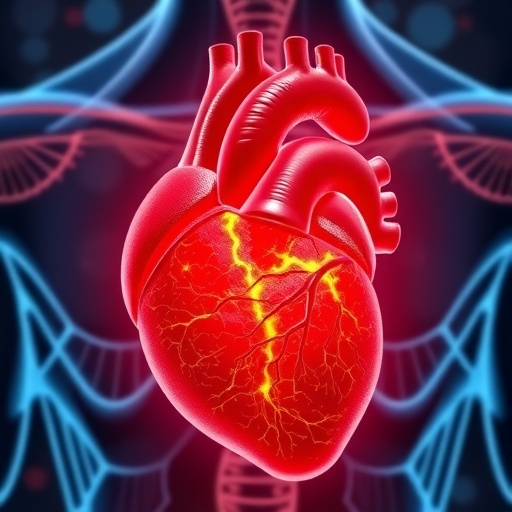
In a groundbreaking study published in Nature Communications, a team of international researchers have unveiled compelling evidence that shared genetic underpinnings significantly influence the risk of major cardiovascular diseases. This landmark research not only sheds new light on the genetic architecture of heart disease but also opens exciting new avenues for precision medicine, fundamentally improving risk prediction and therapeutic strategies for millions worldwide.
Cardiovascular diseases (CVDs) remain the leading cause of mortality globally, imposing a staggering health and economic burden. Despite advances in medical care, the complexity of genetic factors contributing to CVD has long posed challenges to researchers striving to decipher the hereditary components of diseases such as coronary artery disease, stroke, and heart failure. The collaborative effort led by Qiao et al. takes a comprehensive, multi-trait genome-wide association study (GWAS) approach, integrating extensive genetic data sets to capture the shared genetic basis linking various cardiovascular conditions.
Unlike traditional GWAS that focus on single diseases, this study utilizes an advanced statistical framework to jointly analyze genetic data across multiple CVD phenotypes simultaneously. This integrative method enhances the power to detect subtle genetic overlaps that individual studies may overlook. The researchers harnessed large biobank-scale cohorts, combining data from hundreds of thousands of participants of diverse ancestries to construct a high-resolution map of shared genetic loci implicated in cardiovascular pathogenesis.
Their findings unveiled dozens of novel genomic regions harboring variants that contribute to several major cardiovascular diseases. Intriguingly, many of these loci were found to influence key biological pathways related to lipid metabolism, inflammation, vascular integrity, and myocardial function, revealing a complex web of interrelated molecular mechanisms that orchestrate cardiovascular health and disease progression. This pleiotropy—where a single genetic variant affects multiple traits—explains part of the heritable risk shared among distinct disease categories.
The study highlights specific variants near genes previously known for regulating cholesterol levels and immune responses, suggesting that dysregulation of these processes is central to the convergence of CVD risks. Additionally, novel gene clusters influencing endothelial cell behavior and cardiac remodeling were implicated, providing fresh molecular targets that had not been extensively studied in cardiovascular genetics before. These insights represent steps toward unraveling the multifactorial nature of heart disease beyond classical risk factors.
Importantly, the researchers developed a novel polygenic risk score (PRS) integrating these shared genetic signals, significantly improving the predictive accuracy for future cardiovascular events compared to existing models. This enhanced PRS allows for more precise identification of individuals at high genetic risk across multiple cardiovascular conditions, facilitating early intervention strategies that could dramatically alter disease trajectories.
Moreover, the study’s multi-ancestry design addresses a critical gap in genetic research. Much of cardiovascular genomics has traditionally been Eurocentric, limiting the applicability of findings to diverse populations. By incorporating genetic data from varied ethnic groups, Qiao and colleagues ensured that the discovered associations and risk models have broader global relevance, representing a crucial advance toward equity in genomic medicine and cardiovascular healthcare.
Another key innovation in the analysis was the use of functional genomics data to prioritize candidate genes. Integrating transcriptomic and epigenomic datasets allowed the researchers to pinpoint variants with regulatory roles affecting gene expression in relevant tissues such as the heart and blood vessels. This functional context bridges the gap between genetic association and biological mechanism, paving the way for experimental studies to validate therapeutic targets.
As the field looks toward clinical translation, the identification of shared genetic factors emphasizes the interconnectedness of cardiovascular diseases at a molecular level, suggesting that treatments targeting common pathways may yield broad benefits. For example, therapies modulating inflammation or lipid transport proteins could simultaneously mitigate risks for multiple conditions, revolutionizing how clinicians approach cardiovascular disease management.
Furthermore, the study underscores the importance of systems biology frameworks in understanding complex diseases like CVD, where networks of genes and pathways interact dynamically. The power of integrative analytic techniques demonstrated here foreshadows a future where large-scale multi-omic and genetic data are routinely leveraged to uncover disease mechanisms and guide precision interventions.
However, the authors also caution that genetic risk is only one piece of the cardiovascular puzzle. Environmental factors, lifestyle behaviors, and social determinants continue to exert profound influences on disease development and outcomes. Thus, combining genetic insights with comprehensive clinical and population health strategies remains essential for holistic cardiovascular risk reduction.
Despite these caveats, the current findings represent a monumental step forward. By illuminating the shared genetic foundation of major cardiovascular diseases, this research equips the scientific and medical communities with vital knowledge to accelerate the development of novel diagnostics, preventive measures, and therapeutics.
Looking ahead, ongoing efforts to expand the diversity of genetic data resources and to integrate multi-modal biological information will further enrich the understanding of cardiovascular genetics. Longitudinal studies incorporating environmental exposures and genetic risk profiles hold promise for unraveling disease trajectories, enabling truly personalized medicine.
In summary, the study by Qiao and colleagues stands as a landmark achievement in cardiovascular genomics, robustly demonstrating that the risk of major heart diseases is underpinned by extensive shared genetic architecture. This revelation has profound implications for risk prediction, drug discovery, and the future of cardiovascular healthcare on a global scale. It heralds an era where harnessing genetic complexity illuminates new pathways to combat the world’s deadliest diseases.
Cite Scienmag News
Juliet Wilcox. (September 24, 2025). Shared Genetics Elevate Major Cardiovascular Disease Risk. Scienmag. https://scienmag.com/shared-genetics-elevate-major-cardiovascular-disease-risk/
Juliet Wilcox. "Shared Genetics Elevate Major Cardiovascular Disease Risk." Scienmag, 24 September 2025, https://scienmag.com/shared-genetics-elevate-major-cardiovascular-disease-risk/. Accessed 3 September 2026.
Juliet Wilcox. "Shared Genetics Elevate Major Cardiovascular Disease Risk." Scienmag. September 24, 2025. https://scienmag.com/shared-genetics-elevate-major-cardiovascular-disease-risk/


