


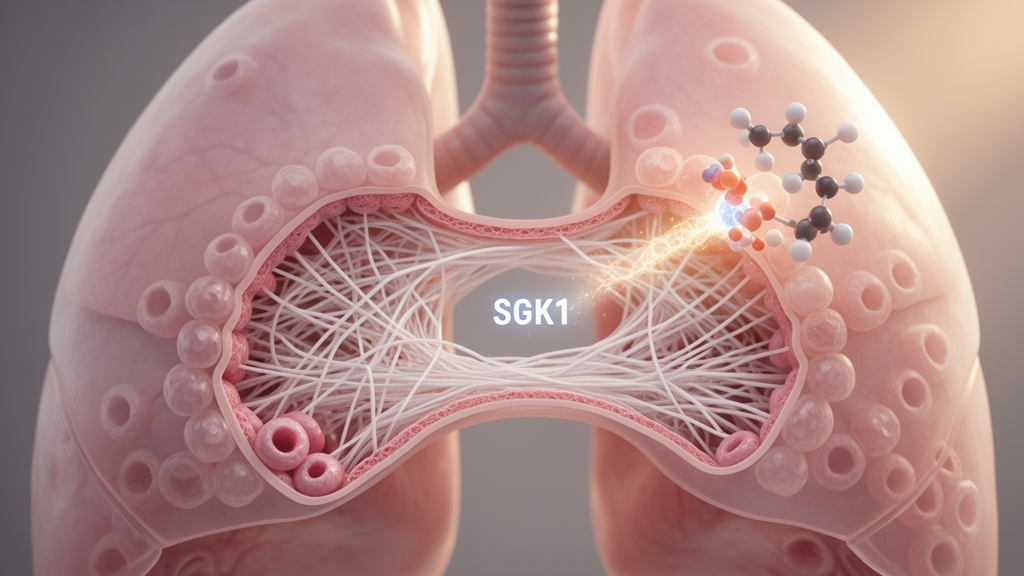
Blocking the stress-responsive kinase SGK1 reduced airway fibrosis and lumen obstruction in a mouse model of bronchiolitis obliterans, while experiments in human small airway epithelial cells linked SGK1 to molecular markers of fibrosis and epithelial-mesenchymal transition. The study combined heterotopic tracheal transplantation in mice with TGF-β1-stimulated human cells and used the investigational SGK1 inhibitor EMD638683. Together, the findings support SGK1 as a mediator of TGF-β1-driven extracellular matrix accumulation and identify it as a potential therapeutic target. The experiments do not establish that SGK1 inhibition can treat established bronchiolitis obliterans in lung-transplant recipients.
Bronchiolitis obliterans is a serious complication of lung transplantation, marked by progressive fibrosis and narrowing of small airways that can ultimately obstruct airflow. One mechanism implicated in its progression is epithelial-mesenchymal transition, in which airway epithelial cells lose traits such as cell polarity, intercellular junctions and basement-membrane attachment while acquiring properties associated with migration and extracellular matrix production. TGF-β1 is a potent inducer of this process and can promote the transdifferentiation of epithelial cells into myofibroblast-like cells, which are major producers of collagen. Inhibition of TGF-β1 signaling has therefore been considered as a possible strategy for reducing bronchiolitis obliterans-associated fibrosis, although the role of individual downstream mediators remained uncertain.
SGK1 is a serine/threonine protein kinase with broad tissue distribution and a low basal expression level under resting conditions. It responds strongly to cellular stress and participates in physiological processes ranging from ion transport to immune-cell function. Its expression is abnormally increased in several fibrotic conditions, including pulmonary fibrosis, diabetic nephropathy, hepatic cirrhosis and cardiac fibrosis. EMD638683 had previously shown effects in experimental cardiac fibrosis, pulmonary arterial hypertension, acute lung injury and colon tumors, but its potential role in bronchiolitis obliterans had not been investigated. The new study therefore tested both the association between SGK1 and fibro-obliterative airway injury and whether blocking SGK1 could alter the disease phenotype.
The investigators first characterized progression in a murine heterotopic tracheal transplantation model. Syngeneic tracheal grafts served as controls, while allogeneic heterotopic transplants were used to generate bronchiolitis obliterans. Grafts were collected on days 7, 14 and 28. Compared with controls, affected grafts showed greater epithelial-cell loss, lumen occlusion, inflammatory-cell infiltration, structural damage and deformation of the tracheal cartilage ring. They also accumulated more collagen and displayed larger areas of staining for collagen type I, or COL1, and fibronectin 1, or FN1, together with less staining for the epithelial marker E-cadherin. The pathological changes became more typical as transplantation time increased. By day 28, differences from controls in epithelial loss, relative collagen content and COL1, FN1 and E-cadherin staining were statistically significant, while lumen occlusion was greater than on day 7.
Transcriptomic analysis indicated that the day-28 model captured a later phase of the process. At this point, 4,139 genes differed between bronchiolitis obliterans and control grafts, including 1,643 upregulated and 2,496 downregulated transcripts. Pathway analysis associated these changes with extracellular matrix organization, graft rejection, T-helper-cell differentiation and extracellular matrix receptor interactions. SGK1 was among the genes increased at day 28, whereas no increase was detected on day 7. Immunohistochemistry independently confirmed greater SGK1 staining in day-28 allografts. Because the fibrotic phenotype was most established at this later time point, the researchers used day-28 grafts for the principal mechanistic analyses and treated the result as evidence of an association between SGK1 upregulation and chronic fibrotic remodeling.
Evidence for the same association emerged from a reanalysis of the public GSE225159 dataset. It compared untreated MRC-5 lung fibroblasts with cells induced by TGF-β1 to become myofibroblasts, with three samples in each group. The induced cells had 8,108 differentially expressed genes relative to untreated cells, with 4,060 upregulated and 4,048 downregulated, and SGK1 was among the upregulated genes. Although the dataset was not derived from people with bronchiolitis obliterans, it extended the observation beyond mouse grafts to another human cellular model of fibrosis. The result showed that SGK1 induction accompanies TGF-β1-driven fibroblast-to-myofibroblast transition; it did not by itself establish that SGK1 causes the transition in patients or in airway tissue.
Administration of EMD638683 before modeling reduced several pathological measures in the mouse transplants. The inhibitor was delivered by oral gavage at 20 milligrams per kilogram per day, while control and untreated bronchiolitis obliterans groups received vehicle. Relative to untreated diseased grafts, treated grafts had significantly less lumen occlusion and smaller SGK1-, COL1- and FN1-positive areas. Inflammatory infiltration and damage to the tracheal cartilage ring were also less severe. Quantitative PCR and western blotting showed lower mRNA and protein levels of SGK1, COL1 and FN1 in treated animals. Histological analyses included seven control mice, 10 untreated bronchiolitis obliterans mice and six inhibitor-treated mice, while molecular analyses included six mice per group. These findings show that systemic SGK1 inhibition was associated with less matrix deposition and airway obstruction in this transplantation model.
The investigators also tested whether treatment could alter disease that had begun to develop. In this experiment, EMD638683 or vehicle began seven days after transplantation. Untreated bronchiolitis obliterans grafts had greater epithelial loss, lumen occlusion and collagen content than controls. Later EMD638683 treatment significantly reduced lumen occlusion and collagen deposition relative to untreated diseased grafts. It also decreased SGK1, COL1 and FN1 expression and partially restored E-cadherin expression, a pattern consistent with reduced epithelial-mesenchymal transition. These outcomes were broadly similar to those observed when treatment began before modeling. The experiment did not test whether mature fibrosis could be reversed, and it did not establish the durability or safety of treatment.
Mechanistic experiments in human small airway epithelial cells connected the tissue effects to TGF-β1 signaling. RNA sequencing identified 1,654 genes whose expression differed between TGF-β1-treated and solvent-treated cells, including 763 increased and 891 decreased transcripts, with SGK1 among those increased. Adding EMD638683 reduced enrichment of the TGF-β signaling, extracellular matrix receptor interaction and PI3K-Akt pathways. It also lowered SGK1, COL1 and FN1 messenger RNA and protein levels. These cellular measurements concerned molecular fibrosis and epithelial-mesenchymal-transition responses; lumen obstruction was not measured in the cell experiments. The observations nevertheless support the interpretation that SGK1 participates in a TGF-β1-driven program of extracellular matrix production rather than merely accompanying fibrosis as an inactive marker.
Genetic perturbation provided a second line of evidence. Small interfering RNA directed against SGK1 lowered SGK1, COL1 and FN1 expression in TGF-β1-treated epithelial cells. It also reduced the mesenchymal marker N-cadherin and the matrix-degrading enzyme MMP9 while increasing E-cadherin, changes consistent with suppression of epithelial-mesenchymal transition. Re-expression of SGK1 reversed these effects, restoring higher COL1 and FN1, greater N-cadherin and MMP9, and lower E-cadherin. Western blotting further associated SGK1 re-expression with more phosphorylated SMAD3, a marker of TGF-β pathway activation. The experiments do not prove that SGK1 directly phosphorylates SMAD3, and systemic EMD638683 treatment does not identify which cell types produced the observed protective effects in vivo or exclude off-target contributions.
The results nominate SGK1 as a regulator of fibrosis in experimental bronchiolitis obliterans and show that inhibiting it can reduce matrix deposition and airway obstruction in the mouse system tested. Several limitations constrain generalization. The transplantation model uses large-airway grafts placed outside the native lung, where they do not participate in normal ventilation, and may not reproduce the small-airway disease seen after lung transplantation. Only male mice were studied. The epithelial experiments used a single immortalized human cell line and did not capture donor variability or interactions with immune and stromal cells, while direct validation in patient-derived bronchiolitis obliterans samples was lacking. The contribution of epithelial cells to collagen-producing myofibroblasts in vivo was not directly determined. Further small-airway models, patient-derived material, cell-specific genetic studies and longer treatment experiments would be needed to determine whether SGK1 inhibition has a useful and safe role in clinical lung-transplant care.
Subject of Research: Preclinical inhibition of SGK1 in TGF-β1-driven airway fibrosis and experimental bronchiolitis obliterans
Article Title: SGK1 mediates TGF-β1-induced epithelial-mesenchymal transition and fibrosis in experimental bronchiolitis obliterans
Article References: Li, H., Zhao, L., Xu, S., Tang, S., Lin, J., Hu, Y., Chen, X., Lu, C., & Chen, D. (2026). SGK1 mediates TGF-β1-induced epithelial-mesenchymal transition and fibrosis in experimental bronchiolitis obliterans. iScience, 29(11), Article 117961. https://doi.org/10.1016/j.isci.2026.117961
Image Credits: AI Generated
DOI: 10.1016/j.isci.2026.117961
Keywords: SGK1, bronchiolitis obliterans, airway fibrosis, lung transplantation, TGF-β1, epithelial-mesenchymal transition, extracellular matrix, EMD638683, mouse models, human airway epithelial cells, mediates, TGF-
Cite Scienmag News
Denise Maddox. (October 20, 2026). SGK1 inhibition eases fibrosis in experimental bronchiolitis obliterans. Scienmag. https://scienmag.com/sgk1-inhibition-eases-fibrosis-in-experimental-bronchiolitis-obliterans/
Denise Maddox. "SGK1 inhibition eases fibrosis in experimental bronchiolitis obliterans." Scienmag, 20 October 2026, https://scienmag.com/sgk1-inhibition-eases-fibrosis-in-experimental-bronchiolitis-obliterans/. Accessed 20 October 2026.
Denise Maddox. "SGK1 inhibition eases fibrosis in experimental bronchiolitis obliterans." Scienmag. October 20, 2026. https://scienmag.com/sgk1-inhibition-eases-fibrosis-in-experimental-bronchiolitis-obliterans/


