


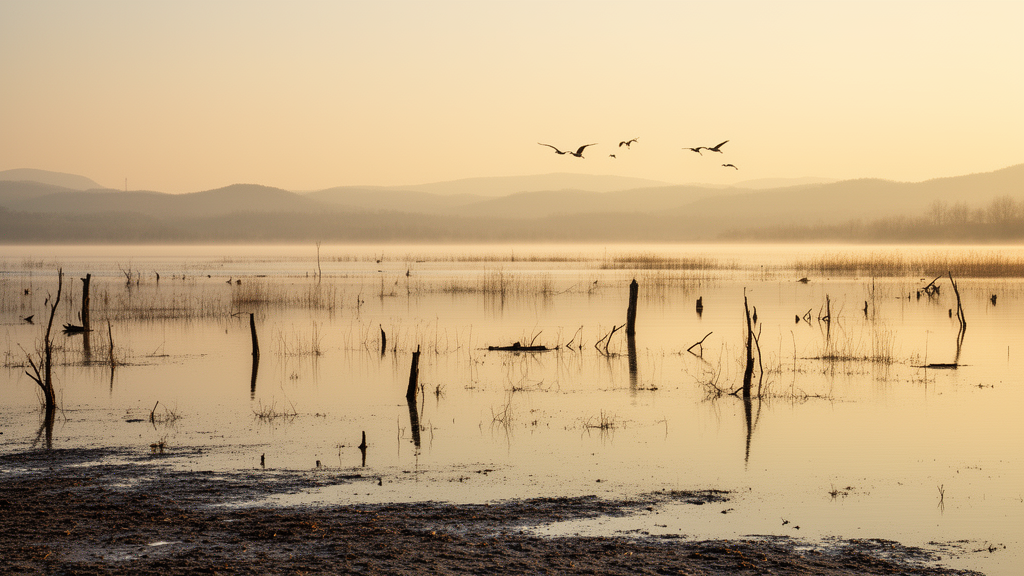
Yet one name is conspicuously absent from the species list: the White-naped Crane, a vulnerable species whose historical counts at this very site once reached 1,020 individuals. The reservoir itself is a giant of north China. Located roughly 13 kilometres north of Miyun District at the junction of the Chao and Bai Rivers, it holds the largest water surface area of any reservoir in the region, approximately 188 square kilometres, with a shoreline stretching some 200 kilometres.
Its ecological importance extends far beyond municipal water supply. Waterbird communities are widely regarded as robust bioindicators of wetland ecosystem health, their species richness and population trends reflecting the condition of the habitats they depend upon. Since September 2015, the Middle Route of the South-to-North Water Diversion Project has been channelling water into Miyun Reservoir, and combined with upstream flood inflows in 2021, the water level rose from around 135 metres to a record 155.3 metres on the Dagu elevation scale.
This elevated level has been deliberately maintained as a standardised long-term water storage regulation regime. Previous studies suggest the consequences have been profound: sustained high water levels appear to have submerged extensive near-shore farmland, tidal flats and riparian shrub wetlands, potentially reducing the shallow-water foraging habitats suited to many waterbird taxa. Published satellite tracking research has indicated decreasing migratory bird site visitation rates, alongside shifts in phytoplankton assemblages, macrophyte communities and reservoir water nitrogen concentrations.
Earlier bird surveys conducted between 2020 and 2022 recorded 324 total avian species across the reservoir and its peripheral tributaries, but these efforts lacked reservoir-wide synchronous waterbird sampling covering full seasonal migration cycles. What was missing was a unified, basin-wide annual waterbird baseline that could serve as a reference point for future ecological modelling. Four seasonal synchronous surveys were implemented at 14 fixed permanent stations covering the full reservoir basin: spring on 10 and 11 April 2023, summer on 24 and 25 July 2023, autumn on 4 September 2023, and late autumn or early winter on 16 October 2023.
The surveyed taxa followed the taxonomy adopted in Waterbird Population Estimates, Fifth Edition, the Ramsar Convention's reference for identifying internationally important wetland bird concentrations. Each sampling station received one standardised survey per season, with a fixed observation duration of 20 to 30 minutes per site, conducted daily between 07:00 and 17:30 hours. Autumn counts in early September captured 14 species and just 1,232 individuals, the lowest tally of the year.
The late autumn or early winter survey in mid-October recorded 14 species and 5,816 individuals. The researchers note that mid-October falls within the north China migratory window, when many waterbird species have not yet settled into stable wintering habitats, meaning this survey phase likely underestimates resident winter waterbird abundance. Station selection followed a three-stage screening process: satellite remote sensing mapping to delineate wetland zones and generate GPS navigation coordinates; consultation with local forestry bureau officials and wildlife experts to identify high-abundance bird hotspots; and prioritisation of road-accessible shorelines, with foot surveys for remote areas.
Observers positioned themselves with sunlight behind their backs and downwind under favourable meteorological conditions. Standard station spacing was set at 3 to 4 kilometres, matching the 2 to 3 kilometre reliable identification distance, with reduced intervals during fog or heavy haze. The reservoir was divided into seven independent survey zones with continuous visual scanning between fixed points to eliminate observation gaps between stations.
Counting birds accurately is notoriously difficult, and the researchers were candid about their limitations. Large mixed bird flocks commonly cause visual counting underestimation, though no exceptionally large aggregations were encountered during the 2023 fieldwork. All censuses were completed by two trained professional observers equipped with high-magnification optical gear, including Swarovski EL10x32SV binoculars and ATS80 telescopes with 20 to 60 times zoom.
While inter-observer and intra-observer duplicate parallel counts were not performed, standardised fixed patrol routes and multi-angle observation minimised the undercount risk. The researchers acknowledge that minor missing records may exist along remote, hard-to-access gully shorelines despite full coverage efforts, a reminder that even the most careful census cannot capture every bird in a basin of 188 million square metres. The most haunting finding is the complete absence of White-naped Cranes across all four seasonal synchronous surveys in 2023, a stark contrast with the historical census documenting 1,020 individuals at Miyun Reservoir in 2013.
The researchers are careful to note that whether this reflects interannual population fluctuations, habitat changes potentially associated with prolonged high-water-level regulation, or other ecological factors cannot be determined from a one-year baseline dataset alone. The dataset's core function is to act as standardised baseline material for follow-up multi-year monitoring and ecological modelling, rather than a quantitative impact evaluation of reservoir water management policies. What makes this dataset genuinely valuable is its positioning as a foundation rather than a verdict.
The researchers explicitly clarify that the 2023 data cannot independently establish causal relationships between long-term high-water regulation and interannual waterbird community variation. Instead, the dataset delivers baseline abundance and distribution data for resident and migratory waterbird assemblages within the reservoir basin, providing the spatial and temporal reference against which future multi-year ecological modelling and comparative analysis can be conducted.
Subject of Research: A baseline waterbird occurrence dataset for Miyun Reservoir, Beijing, China
Article Title: A baseline waterbird occurrence dataset for Miyun Reservoir, Beijing, China
Article References: Sun, W., Wang, Q., Zhao, C., Liu, L., Gu, D., Xu, Z., Meng, F., & Cao, L. (2026). A baseline waterbird occurrence dataset for Miyun Reservoir, Beijing, China. Biodiversity Data Journal, 14, Article e203213. https://doi.org/10.3897/bdj.14.e203213
Image Credits: AI Generated
Keywords: baseline, waterbird, occurrence, dataset, Miyun, Reservoir, Beijing, China, scientific research
Cite Scienmag News
Violet Maxwell. (October 20, 2026). Research report: A baseline waterbird occurrence dataset for Miyun Reservoir, Beijing, China. Scienmag. https://scienmag.com/research-report-a-baseline-waterbird-occurrence-dataset-for-miyun-reservoir-beijing-china/
Violet Maxwell. "Research report: A baseline waterbird occurrence dataset for Miyun Reservoir, Beijing, China." Scienmag, 20 October 2026, https://scienmag.com/research-report-a-baseline-waterbird-occurrence-dataset-for-miyun-reservoir-beijing-china/. Accessed 20 October 2026.
Violet Maxwell. "Research report: A baseline waterbird occurrence dataset for Miyun Reservoir, Beijing, China." Scienmag. October 20, 2026. https://scienmag.com/research-report-a-baseline-waterbird-occurrence-dataset-for-miyun-reservoir-beijing-china/


