


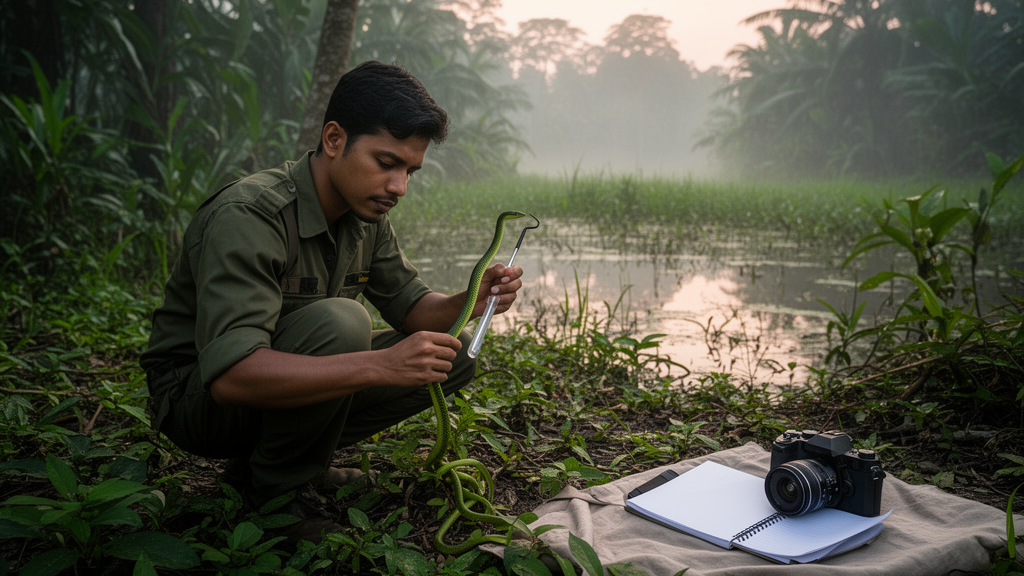
A systematic review of Bangladesh’s snake records confirms the presence of 89 species from 13 families, while identifying three species as regionally extinct under the review’s five-decade documentation criterion. The study also removes 16 species from the national list because of missing specimen evidence or taxonomic revisions, and places 33 additional species on an anticipated list based on their distributions and habitat associations in neighboring countries.
The review examined 227 publications on snakes of Bangladesh published from 1853 through 2024. These comprised 190 research articles, 31 books or book chapters, two conference proceedings and four institutional reports. Earlier country checklists reported differing totals, ranging from 28 species in 1980 to 106 in a 2015 field guide, creating inconsistencies in the documented snake fauna.
To assess occurrence and distribution, the researchers combined the literature with records from the Reptile Database, the IUCN Red List of Threatened Species in Bangladesh, GBIF, iNaturalist, the IUCN portal, and DNA-sequencing data in NCBI. They also searched electronic, print and social media for occurrence information. Social-media records were included only after the associated photographs and locations were checked individually, with Facebook-based groups led by academics and focused on snake rescue, public awareness and conservation prioritized among the sources.
The assembled records were divided into four categories: confirmed, regionally extinct, deleted and expected. A species was classified as confirmed when supported by a specimen-based literature record, research-grade repository data, or photographic documentation with cross-verified identification and locality. Species without documentation or confirmed sightings during the previous five decades were classified as regionally extinct, a designation that reflects the absence of records rather than demonstrated biological extinction. The remaining categories comprised species removed because of misidentification or taxonomic revision and species considered potentially present based on their ecological and geographical ranges.
Three species fell into the review’s regionally extinct category: the marine file snake, Acrochordus granulatus; the Kerala mud snake, Dieurostus dussumieri; and the Indian egg-eating snake, Boiga westermanni. The most recent documented sighting of A. granulatus was in the Sundarbans in 1970. The holotype of D. dussumieri was collected from “Bengal” but was lost or destroyed during World War II, while the holotype of B. westermanni was collected from Rangpur in 1863, with no subsequent confirmed Bangladeshi record documented by the review.
Sixteen species were deleted from the national list. Nine had appeared without specimen-based records or confirmed sightings, including the saw-scaled viper, Echis carinatus, and the mangrove pit viper, Trimeresurus purpureomaculatus. Taxonomic changes also affected several entries. The white-lipped green pit viper, Trimeresurus albolabris, is no longer expected on the Indian subcontinent; the long-nosed vine snake, Ahaetulla nasuta, is considered endemic to Sri Lanka; and a population formerly identified as Dendrelaphis pictus was reassigned to D. proarchos. The former subspecies Rhabdophis subminiatus helleri was elevated to species status as Rhabdophis helleri.
Among the 89 confirmed species, non-venomous snakes represented 70% and venomous species 30%. Colubridae was the largest family, accounting for 35% of confirmed species, followed by Elapidae at 25.8% and Natricidae at 13.5%. Typhlopidae and Homalopsidae each contributed 5.6%, while Pythonidae and Viperidae each represented 3.4%. The venomous assemblage included 23 elapids—10 terrestrial species and 13 marine hydrophiines—and three vipers. Rhabdophis helleri was the only confirmed species classified as both venomous and poisonous.
The researchers mapped species richness by aggregating occurrence data into a 0.02-degree grid within Bangladesh’s administrative boundary and counting unique species in each cell before applying a Gaussian filter. They separately used non-parametric kernel density estimation to create continuous probability surfaces for all confirmed species, non-venomous species and venomous species. The analysis used 1,768 observations for all species, including 1,322 for non-venomous snakes and 443 for venomous snakes.
The mapped estimates indicated the highest species richness in mixed evergreen forests in the Chattogram and Sylhet regions and in the Sundarbans mangroves, with moderate richness in central, northern and northwestern areas. Kernel density estimates placed the greatest probability of occurrence above 0.2 to 0.3 in the southeastern and northeastern mixed evergreen forests; estimates for non-venomous species exceeded 0.3 in those regions, while the northern region had an overall estimate below 0.1. Coastal southeastern Bangladesh showed high estimated potential for marine venomous species. These are occurrence-probability estimates derived from available records, not direct population measurements, and the review’s reliance on heterogeneous literature, repositories, social media and museum data limits precision.
The authors identified the mixed evergreen forests of southeastern and northeastern Bangladesh, the Sundarbans mangroves, east-central deciduous forests and northwestern low-plain wetlands as important habitats for the documented fauna. They also highlighted the vulnerability of these landscapes, including habitat destruction in the eastern forests and pressures from fishing, trawling, vehicle traffic, habitat loss and natural calamities in coastal areas. The taxonomy-focused inventory provides a revised baseline for conservation planning, while the 33 anticipated species remain unconfirmed and require specimen-based or otherwise verified evidence before inclusion among the country’s confirmed fauna.
Subject of Research: Systematic review of snake species diversity, occurrence and distribution patterns in Bangladesh
Article Title: Revisiting the snakes of Bangladesh: a systematic review of species diversity and distribution patterns
Article References: Haidar, I. K. A., Hasan, N., Islam, M. R., Uddin, M. A., Uddin, H., Hasan, M. T., Ullah, M. H., Jahan, N., Biswas, J. K., & Chowdhury, M. A. W. (2025). Revisiting the snakes of Bangladesh: a systematic review of species diversity and distribution patterns. Herpetozoa, 38, 253-269. https://doi.org/10.3897/herpetozoa.38.e163473
Image Credits: AI Generated
DOI: 10.3897/herpetozoa.38.e163473
Keywords: Bangladesh, snake diversity, systematic review, species richness, geographic distribution, taxonomic revision, habitat conservation, venomous snakes, occurrence records, Revisiting, snakes, systematic
Cite Scienmag News
Margaret Porter. (October 20, 2026). Systematic review confirms 89 snake species in Bangladesh and maps regional diversity. Scienmag. https://scienmag.com/systematic-review-confirms-89-snake-species-in-bangladesh-and-maps-regional-diversity/
Margaret Porter. "Systematic review confirms 89 snake species in Bangladesh and maps regional diversity." Scienmag, 20 October 2026, https://scienmag.com/systematic-review-confirms-89-snake-species-in-bangladesh-and-maps-regional-diversity/. Accessed 20 October 2026.
Margaret Porter. "Systematic review confirms 89 snake species in Bangladesh and maps regional diversity." Scienmag. October 20, 2026. https://scienmag.com/systematic-review-confirms-89-snake-species-in-bangladesh-and-maps-regional-diversity/


