


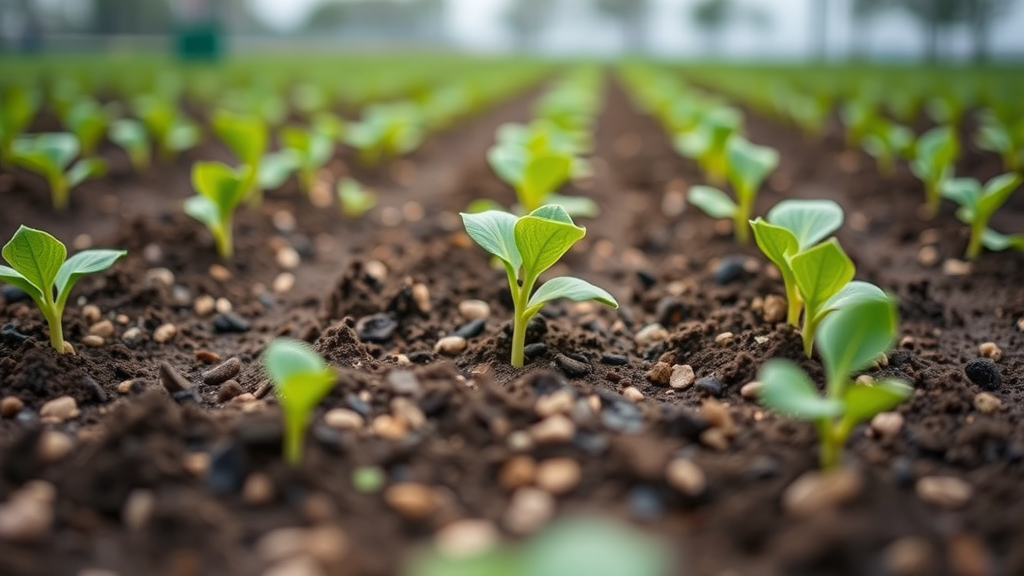
Every spring, farmers around the world entrust billions of seeds to the soil, and every spring a substantial fraction of them fail to deliver a healthy plant. The culprit is rarely the seed itself. It is the ground into which the seed is placed, a medium that can shift from sandy and dry to heavy and waterlogged within the space of a single field, or even a single furrow. A new opinion paper published in the journal Plant and Soil argues that the stubborn problem of uneven crop establishment persists not because farmers lack the technology to see these variations, but because the technologies that sense them have never been properly connected to the machines that sow the crop. The paper, led by Alicia Veiga of the Institut Polytechnique Unilasalle in France, draws on evidence from 109 studies and proposes an integrated framework for what the authors call adaptive sowing: planters that read the seedbed in real time and adjust themselves, seed by seed, to what lies beneath.
The authors use maize as their reference system, and for good reason. Maize is among the most sensitive of the major cereals to the conditions it meets during its first days in the ground. Germination begins when a dry seed absorbs water, swells, and resumes the metabolic activity that was suspended during maturation. That process depends on a narrow band of soil temperature, moisture, and aeration. Classical germination research, stretching back decades, established the concept of cardinal temperatures: below a base threshold, typically around ten degrees Celsius for maize, nothing happens; between the base and an optimum, the rate of germination rises steeply; above the optimum, it falls away again. Hydrothermal time models extend this picture by combining temperature with soil water potential, allowing researchers to predict how quickly a seed will germinate under any given combination of warmth and moisture.
But germination is only the first act. After the radicle emerges and the shoot begins its climb, the seedling must physically negotiate the soil above it. Mechanical resistance from compacted layers can halt the shoot entirely, a phenomenon documented as far back as the 1960s. Oxygen supply matters just as much: in waterlogged or densely packed soil, diffusion of oxygen to the seed can drop so low that germination stalls even when temperature and moisture are otherwise ideal. Soil crusts, which form when rain beats down on freshly tilled ground, can act as a nearly impenetrable lid for a fragile coleoptile. The paper emphasizes that these constraints interact in ways that are inherently spatial. A seed placed fifty millimetres deep in one spot may sit in warm, moist, well-aerated soil; a seed placed at the same depth ten metres away may rest against a compacted clod in a cold, wet pocket. Uniform sowing settings applied across such variability inevitably produce non-uniform emergence.
The agronomic consequences of that non-uniformity are well established and surprisingly large. Studies of maize have shown that a delay of even a few days in the emergence of one plant relative to its neighbours reduces its eventual grain yield substantially, because the later seedling is shaded, outcompeted for nutrients, and developmentally behind for the rest of the season. Modelling work with crop simulation frameworks has demonstrated that canopy gaps and staggered emergence translate directly into lost yield at the field scale. Emergence is, in effect, the moment when field-scale yield potential is partly set, and it is also the moment over which farmers exercise the least control, because the relevant processes happen centimetres below the surface in a matrix they cannot see.
What farmers can see, increasingly, is the soil itself. The paper reviews the current state of proximal soil sensing, the family of technologies that measure soil properties from close range, often from implements moving through the field. Electrical conductivity sensors, mounted on coulters or sledges, map variations in soil texture, moisture, and compaction. Capacitive and frequency-domain sensors estimate volumetric water content on the fly. Visible and near-infrared spectroscopy can estimate organic matter, aggregate stability, and even aggregate size distribution from the spectral signature of the soil, although the authors note that soil moisture strongly distorts these spectra and must be accounted for. Force sensors on depth-gauge wheels and furrow-opening discs reveal mechanical resistance as the planter passes through it. Each of these technologies is mature enough to produce useful data at tractor speed, and several have already been used commercially to delineate management zones for fertilization or seeding rate.
Yet the authors identify a critical mismatch between what these sensors deliver and what a planter actually needs. Management zones, the standard tool of precision agriculture, partition a field into a handful of coarse units, each treated with a single static setting. That approach works reasonably well for fertilization, where the target is a season-long supply of nutrients, but it fails for sowing, where the relevant decisions must be made at the scale of the individual furrow and must respond to conditions that can change within a few metres or even within a single pass. The paper argues that the bottleneck is not sensing but the missing link between sensing and action: there is no established decision-making framework that converts a stream of real-time soil measurements into concrete adjustments of sowing depth, downforce, and furrow-closing pressure.
The conceptual framework the authors propose rests on three pillars. The first is a mechanistic understanding of soil-seed-water interactions during emergence, the domain of germination physiology and soil physics summarized above. The second is proximal sensing, the raw data stream that characterizes the seedbed as the planter encounters it. The third is predictive modelling: models that take sensor readings as inputs and output recommended machine settings before the next seed is placed. These could include hydrothermal germination models, discrete element simulations of seed-soil contact, and emerging machine learning approaches, including physics-informed neural networks and differentiable modelling frameworks that blend physical equations with data-driven learning. Hybrid semi-parametric models, long used in process engineering, offer another route, combining the interpretability of mechanistic soil models with the flexibility of statistical learning.
The machine side of the equation is further along than the modelling side. Modern planters already carry electronically controlled downforce systems that vary hydraulic pressure row by row, depth-control actuators that respond to terrain, and monitoring systems that fuse multiple sensors to track the actual depth at which each seed is placed. Precision seeder research has demonstrated real-time depth control and self-adjusting tillage bodies that respond to measured soil conditions. What is missing, the authors contend, is the intelligence layer that tells these actuators what to do. A planter that knows the soil ahead is wet and heavy should perhaps sow shallower and reduce downforce to avoid smearing a wet furrow; a planter entering a dry, loose ridge should go deeper and press harder to secure seed-soil contact. Today, such decisions are made by the operator’s intuition, if at all.
Getting from concept to practice, the paper is careful to note, will demand progress on several fronts simultaneously. Field validation is essential: sensor-derived recommendations must be tested across seasons, soil types, and climates to confirm that they actually improve emergence uniformity and, ultimately, yield. Sensor integration poses its own challenges, since different instruments measure different properties at different scales and must be fused into a coherent picture of the seedbed. Predictive models must run fast enough to issue a setting change within metres of travel, and they must be robust to the noise and drift that afflict any field instrument. Perhaps most importantly, soil measurements must be translated into agronomic language: a reading of two dS per metre of electrical conductivity means nothing to a planter controller unless a validated rule links it to a sowing depth. The authors frame adaptive sowing as an inherently interdisciplinary challenge, one that requires soil physicists, seed physiologists, sensor engineers, and machinery designers to work from a shared model of the emergence process. If that integration succeeds, the planter of the future will not simply place seeds at a set depth and hope; it will read the ground it is working and give every seed the start it needs.
Subject of Research: An interdisciplinary framework linking real-time soil sensing, seedling emergence physiology, and machine control to enable adaptive precision sowing under heterogeneous soil conditions.
Article Title: When soil heterogeneity meets seedling emergence: the interdisciplinary challenge of adaptive sowing strategies
Article References: Veiga, A., Faucon, M.-P., Houben, D., Dujany, A., De Araujo, H., Tetard, L., & Ugarte, C. (2026). When soil heterogeneity meets seedling emergence: the interdisciplinary challenge of adaptive sowing strategies. Plant and Soil. https://doi.org/10.1007/s11104-026-09102-5
Image Credits: AI Generated
DOI: 10.1007/s11104-026-09102-5
Keywords: precision agriculture, adaptive sowing, seedling emergence, soil heterogeneity, proximal soil sensing, maize, sowing depth, planter downforce, soil-seed-water interactions, predictive modeling, crop establishment, seedbed variability
Cite Scienmag News
Alan Morgan. (September 20, 2026). Sensors and Seeds: New Framework Aims to End Uneven Crop Emergence. Scienmag. https://scienmag.com/sensors-and-seeds-new-framework-aims-to-end-uneven-crop-emergence/
Alan Morgan. "Sensors and Seeds: New Framework Aims to End Uneven Crop Emergence." Scienmag, 20 September 2026, https://scienmag.com/sensors-and-seeds-new-framework-aims-to-end-uneven-crop-emergence/. Accessed 5 October 2026.
Alan Morgan. "Sensors and Seeds: New Framework Aims to End Uneven Crop Emergence." Scienmag. September 20, 2026. https://scienmag.com/sensors-and-seeds-new-framework-aims-to-end-uneven-crop-emergence/


