


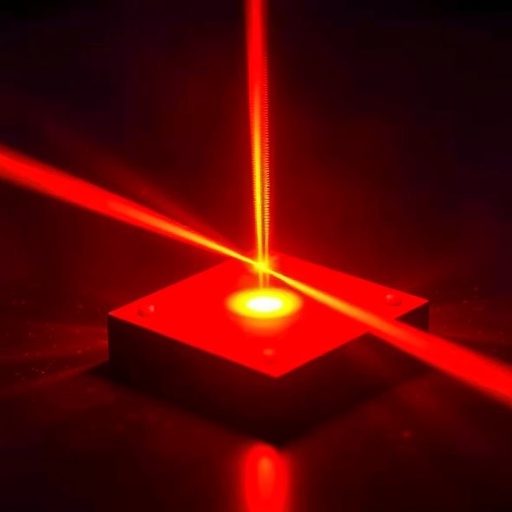
In a groundbreaking advancement for laser technology, researchers have overcome a longstanding limitation imposed by the physical dimensions of optical resonators in semiconductor lasers. Traditionally, laser emissions are confined to discrete cavity modes with specific frequencies determined by the fixed geometry of the optical cavity. This intrinsic constraint leads to spectral emission gaps and a fixed repetition rate, restricting the versatility of lasers in applications requiring broad tunability across spectral or temporal domains. The team led by Senica et al. have now demonstrated a monolithic semiconductor laser capable of dynamically tuning its repetition rate across an unprecedented range from 4 GHz to 16 GHz.
Conventional laser resonators generate light confined to fixed modes because the optical path length inside the cavity sets discrete resonance conditions. These fixed cavity modes produce emission frequencies separated by constant intervals, which means emission wavelength tuning must rely on physically altering the cavity length or structure—processes that are complex and limited in speed. This fundamental limitation affects a variety of applications, from high-resolution spectroscopy to communication systems that benefit from tailored pulse sequences and frequency combs with adjustable mode spacing.
The authors circumvent this bottleneck by introducing a novel approach utilizing a microwave driving signal to induce a spatiotemporal gain modulation throughout the entire laser cavity. This dynamic modulation effectively breaks the constraints of fixed cavity resonances by continuously tailoring the intracavity gain profile over both space and time. The induced modulation pattern results in actively mode-locked pulses that maintain coherence while having a tunable repetition rate. This method enriches the laser’s operational flexibility without the need for mechanical tuning or cavity reconfiguration.
An essential feature of this approach lies in the ability to manipulate the group velocity of light within the laser medium in a continuously tunable manner. By controlling the microwave drive, the researchers can directly influence the effective propagation dynamics of the intracavity mode-locked pulses. This control not only adjusts the pulse repetition rate but also impacts the spectral characteristics, enabling the generation of frequency combs with mode spacings that can be tailored on demand. Such level of tunability opens avenues for novel experiments focusing on ultrafast phenomena and frequency metrology.
The work builds fundamentally on decades of laser physics, including classical theories of mode locking outlined by pioneers such as Kuizenga and Siegman, and later developments in semiconductor laser technology pioneered by Faist, Köhler, and others. Unlike earlier architectures that fixed the repetition rate according to the cavity length, this new monolithic device integrates electronic modulation to dynamically shape the laser gain, marking a paradigm shift for compact chip-scale lasers.
The scientific team demonstrated that the laser produces coherent pulse trains that can be tuned smoothly throughout the 4 to 16 GHz range. This continuous tunability in repetition rate was previously unattainable in integrated semiconductor lasers and is instrumental for applications requiring precise timing control. Compared to free-space or fiber-based tunable lasers, this solution offers a compact footprint with robust integration potential, making it highly attractive for portable and integrated photonic systems.
Crucially, the generation of frequency combs with continuously variable mode spacing allows for direct tailoring of their spectral output. Frequency combs serve as optical rulers with equidistant frequency lines essential in frequency metrology, spectroscopy, and telecommunications. The ability to vary their spacing without moving parts or external cavity modifications enables sophisticated dual-comb spectroscopy schemes, increasing both resolution and bandwidth while simplifying system architectures.
From a technical perspective, the demonstrated effect arises because the microwave modulation enforces a spatiotemporal gain pattern along the cavity length, effectively locking modes across the laser spectrum with a controllable relative phase. This forced mode locking leads to pulse formation inside the cavity, where the pulse repetition rate corresponds to the externally applied microwave frequency. The continuous variation of this external drive modulates pulse timing and spectral content in a highly controllable fashion.
This research highlights the interplay between electronic and photonic controls in semiconductor lasers, leveraging high-frequency electronic signals to create entirely new operational regimes for on-chip coherent light sources. By bringing frequency agility and pulse control to semiconductor devices, it paves the way for fully tunable solid-state lasers integrated into photonic circuits, with direct applications in telecommunications, precision sensing, and quantum information processing.
Moreover, the monolithic nature of the semiconductor laser ensures its scalability and compatibility with existing fabrication technologies, enabling mass production of tunable laser sources at reduced cost and complexity. This compatibility with integrated electronic and photonic elements presents a compelling route towards miniaturized devices that can replace bulky tunable laser systems currently used in research and industry.
The implications of this work extend beyond laser engineering. High-resolution spectroscopic measurements, such as high-precision molecular fingerprinting, environmental monitoring, and biomedical diagnostics, will benefit from the ability to modulate both the temporal and spectral properties of the emitted light quickly and reliably. Additionally, the laser’s tunability promises advancements in advanced communication protocols that exploit frequency comb structures for multiplexing and secure data transmission.
In conclusion, the study by Senica and colleagues marks a milestone in laser science by demonstrating the first monolithic semiconductor laser capable of continuously tunable coherent pulse generation over a wide GHz range. By employing a spatiotemporal gain modulation driven by an external microwave signal, they have expanded the boundaries of what chip-scale lasers can achieve in terms of spectral and temporal agility. This innovation stands to transform precision photonics, enabling new classes of experiments and applications that were previously limited by static laser cavity constraints.
Cite Scienmag News
Denise Maddox. (April 15, 2026). Semiconductor Laser Enables Tunable Coherent Pulses. Scienmag. https://scienmag.com/semiconductor-laser-enables-tunable-coherent-pulses/
Denise Maddox. "Semiconductor Laser Enables Tunable Coherent Pulses." Scienmag, 15 April 2026, https://scienmag.com/semiconductor-laser-enables-tunable-coherent-pulses/. Accessed 4 September 2026.
Denise Maddox. "Semiconductor Laser Enables Tunable Coherent Pulses." Scienmag. April 15, 2026. https://scienmag.com/semiconductor-laser-enables-tunable-coherent-pulses/


