


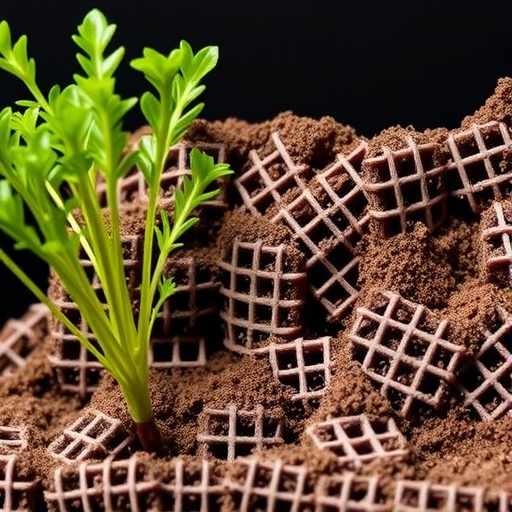
In a groundbreaking fusion of nature, material science, and architecture, researchers at the University of Colorado Boulder have unveiled an innovative approach to 3D-printing earthen construction materials. This novel technique leverages biopolymers—a class of large molecules produced by living organisms—to enhance the printability and performance of clay and sand mixtures, traditionally difficult to manipulate in additive manufacturing processes. This advancement not only paves the way for more sustainable building practices but could fundamentally transform how we source, process, and utilize construction materials on a global scale.
The inspiration behind this breakthrough lies hidden in the complex architectures built by animals in the natural world. Termites sculpt elaborate mounds; wasps construct delicate, yet resilient nests; honeycomb worms form reef-like structures, all without synthetic adhesives or cement. Instead, these creatures rely on biopolymers that act as natural binders, effectively gluing together soil particles and other particulates into durable forms. Recognizing this, lead researcher Wil Srubar and his multidisciplinary team sought to harness similar biological strategies for human construction, specifically focusing on the challenges associated with 3D-printing with earthen materials.
One of the major obstacles when working with traditional earth mixtures is their mechanical behavior through the print nozzle. Earth-based materials tend to clump or resist flow, making continuous, controlled extrusion difficult and limiting the structural integrity of the printed forms. To address this, the researchers experimented with five distinctive biopolymers derived from natural sources such as legumes and seaweed. Among these were guar gum and locust bean gum—commonly used in food applications to maintain texture and stability—as well as sodium alginate and xanthan gum, which have recognized roles in food science and bioengineering.
Their findings revealed a compelling dichotomy in the behavior of these biopolymers. Locust bean gum, for instance, demonstrated remarkable binding capabilities, reinforcing the structural network of soil particles and thereby increasing the composite’s strength. However, this came at the expense of printability; the mixture became too viscous and difficult to extrude. Conversely, sodium alginate—a seaweed-derived polymer popular in culinary techniques like spherification—acted through a different mechanism entirely. It altered the electrostatic characteristics of clay particles, causing mutual repulsion much like identical poles on a magnet, which kept the particles suspended and allowed for a stable, flowable mixture suitable for 3D printing.
Delving deeper, the team fine-tuned their formulations, ultimately discovering that integrating a mere 0.12% concentration of sodium alginate with local earth materials collected from a granite quarry near Golden, Colorado, resulted in optimal performance. This subtle addition not only improved the printability and flow characteristics but also enhanced the mechanical strength of the printed material by approximately 25% compared to unmodified earth mixtures. Moreover, this modified earthen blend allowed for printing speeds approximately 33% faster, offering compelling evidence for the viability of large-scale applications.
The structural capabilities of this composite material were demonstrated through the fabrication of an 8-millimeter-thick wall section, designed with dramatic outward tilts reaching angles of up to 60 degrees. Remarkably, this wall maintained its stability without any reinforcement—a feat surpassing even iconic leaning structures like the Leaning Tower of Pisa. Such resilience underscores the potential for creating dynamic architectural forms that were previously unfeasible with conventional earthen materials.
From a sustainability perspective, the implications are profound. Construction and excavation activities routinely generate vast quantities of loose soil and debris, much of which is relegated to landfills, representing a significant waste stream. By repurposing this excavated earth with biopolymer additives for on-site 3D printing, the construction industry could dramatically reduce its environmental footprint. This approach promotes circular material flows and diminishes reliance on carbon-intensive materials such as Portland cement, notorious for its high greenhouse gas emissions during production.
The natural properties of earthen materials confer additional advantages beyond structural integrity. According to expert Samuel Armistead, an associate researcher involved in the study, earth-based constructions inherently stabilize indoor environments by regulating moisture levels, filtering airborne pollutants, and providing exceptional thermal insulation. These attributes contribute to healthier and more energy-efficient living spaces, aligning gracefully with contemporary green building standards and occupant wellbeing priorities.
Srubar emphasized the universality of these findings, noting that because clay and sand are accessible in nearly every region on Earth, the principles outlined by their research furnish a scalable, global blueprint for future construction methods. The flexibility of biopolymer formulations allows adaptation to local resources and environmental conditions, presenting an exciting avenue for advancing resilient and sustainable habitats, particularly in areas lacking conventional building materials.
Looking ahead, the framework established by Srubar’s team serves as a foundation upon which further research can expand. While their current focus was optimizing printability, the same methodological approach could evaluate other biopolymers or combinations thereof to enhance attributes such as durability, weather resistance, or even self-healing capacities. This iterative, bioinspired process promises a new paradigm for materials science in the built environment.
In summary, this pioneering work illustrates the power of interdisciplinary innovation, blending biology, engineering, and environmental stewardship to unlock the hidden potential of ancient building materials for modern applications. It signals a transformative step toward leveraging sustainable earth-based resources amplified by biotechnology to address pressing global challenges of material scarcity, waste management, and carbon reduction within the construction sector. Through such advances, the age-old human practice of building with earth is poised to enter a new era defined by precision, efficiency, and ecological harmony.
Keywords
Biopolymers, 3D Printing, Earthen Materials, Sustainable Construction, Earth Architecture, Sodium Alginate, Clay, Sand, Material Science, Additive Manufacturing, Environmental Impact, Bioinspired Design
Cite Scienmag News
Denise Maddox. (June 22, 2026). Seaweed-Derived Ingredient Transforms Dirt into 3D-Printed Walls. Scienmag. https://scienmag.com/seaweed-derived-ingredient-transforms-dirt-into-3d-printed-walls/
Denise Maddox. "Seaweed-Derived Ingredient Transforms Dirt into 3D-Printed Walls." Scienmag, 22 June 2026, https://scienmag.com/seaweed-derived-ingredient-transforms-dirt-into-3d-printed-walls/. Accessed 4 September 2026.
Denise Maddox. "Seaweed-Derived Ingredient Transforms Dirt into 3D-Printed Walls." Scienmag. June 22, 2026. https://scienmag.com/seaweed-derived-ingredient-transforms-dirt-into-3d-printed-walls/


