


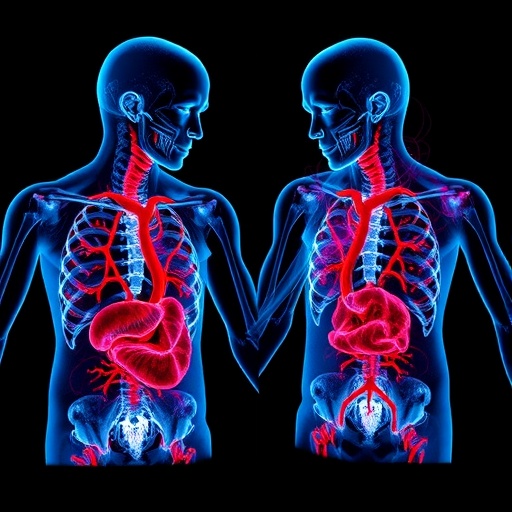
A new perspective in Light: Science & Applications is putting an ambitious idea at the center of vascular medicine: the possibility of creating continuously updated, intelligent models of a patient’s entire circulatory system. The article, “From intravascular imaging to adaptive vascular care: intelligent photonics and digital twins in panvascular disease,” describes how advanced optical technologies, artificial intelligence and digital twins could transform the way doctors detect, monitor and treat disease across arteries and veins. Rather than viewing a blockage as an isolated event, the proposed approach treats the vascular system as a connected, dynamic network whose condition changes over time.
Cardiovascular disease is often managed through snapshots. A patient may undergo a scan, receive a diagnosis and then return months later for another examination, while important biological changes occur between visits. Intravascular imaging offers a closer look by placing miniature imaging devices inside blood vessels. Technologies such as intravascular ultrasound and optical coherence tomography can reveal the structure of vessel walls, plaque deposits and implanted stents with far greater detail than many external imaging methods. The article presents these tools as the foundation for a more responsive form of care, in which information from inside the vessel can guide decisions with greater precision.
Photonics is central to this vision because light can carry detailed information about tissue composition and microscopic structure. Optical coherence tomography, for example, uses reflected near-infrared light to produce high-resolution cross-sectional images, allowing clinicians to examine thin fibrous caps, small dissections and the surfaces of stents. Other optical approaches, including near-infrared spectroscopy and photoacoustic imaging, can add chemical or molecular information. Photoacoustic systems work by delivering short pulses of light and detecting the acoustic waves created when tissue absorbs that energy. In principle, combining these signals could help distinguish stable plaque from lesions more likely to rupture.
The challenge is that vascular disease rarely follows the boundaries of a single organ or one anatomical location. Atherosclerosis can affect coronary, carotid, renal, peripheral and cerebral vessels at the same time, while systemic inflammation, diabetes, high blood pressure and abnormal lipid metabolism influence the entire circulation. This “panvascular” perspective is important because treating one narrowed segment may not address the processes driving disease elsewhere. The article argues that intelligent photonics could help link local images with broader physiological data, creating a more complete picture of vascular health rather than focusing only on the most visible obstruction.
Artificial intelligence could make this expanding stream of information clinically useful. Intravascular scans contain enormous numbers of pixels and complex patterns that may be difficult to interpret consistently, even for experienced specialists. Machine-learning systems can be trained to identify vessel boundaries, measure plaque volume, classify tissue characteristics and evaluate the position or expansion of stents. When combined with patient histories, laboratory measurements, medication records and blood-flow simulations, these algorithms could support risk assessment and help physicians compare changes across repeated examinations. The goal is not simply automated image reading, but the integration of diverse data into clinically meaningful predictions.
At the heart of the proposed framework is the digital twin: a computational representation of an individual patient that is updated as new measurements become available. In engineering, digital twins are used to monitor machines and predict failures. In medicine, a vascular digital twin could combine three-dimensional anatomy, blood-flow dynamics, tissue properties and biological risk factors. Computational fluid dynamics could estimate how blood moves through narrowed or branching vessels, while imaging data could refine the model’s geometry. As new scans or physiological measurements arrive, the virtual representation could be adjusted, allowing clinicians to explore how a disease might progress or how a proposed intervention could alter circulation.
Such a system could eventually support adaptive vascular care, in which treatment changes according to the patient’s evolving condition rather than following a fixed schedule. A digital model might help assess whether a plaque is becoming more dangerous, whether a stent is causing abnormal flow, or whether medication is reducing the biological activity associated with disease. It could also provide a framework for testing possible interventions virtually before they are performed. However, these possibilities depend on reliable data, validated algorithms and careful clinical oversight. A prediction generated by software would need to be tested against real outcomes before it could be trusted in routine care.
The article also highlights major barriers between an attractive concept and a usable medical platform. Imaging systems must become faster, safer and easier to operate, while the data they generate must be standardized across hospitals and manufacturers. Artificial intelligence models need large, diverse and well-annotated datasets so that they do not perform well only on the patients used during development. Privacy and cybersecurity are essential because a digital twin would contain highly sensitive medical information. Most importantly, prospective clinical studies must determine whether these technologies actually improve diagnosis, treatment decisions and patient outcomes, rather than merely producing more detailed images.
The emerging message is that vascular medicine may be moving from episodic diagnosis toward continuous, data-driven monitoring. Intelligent photonics could reveal what is happening inside vessels at microscopic and molecular scales, while artificial intelligence could organize those observations and digital twins could place them into a personalized physiological model. The paper does not present this future as a finished clinical reality; instead, it offers a roadmap for connecting imaging, computation and patient care across the vascular system. If the technical and ethical challenges can be solved, the result could be a new generation of medicine that detects danger earlier, adapts treatment more precisely and views circulation as one interconnected living network.
Cite Scienmag News
Katie Riggs. (August 4, 2026). Intelligent Photonics and Digital Twins Advance Adaptive Care for Panvascular Disease. Scienmag. https://scienmag.com/intelligent-photonics-and-digital-twins-advance-adaptive-care-for-panvascular-disease/
Katie Riggs. "Intelligent Photonics and Digital Twins Advance Adaptive Care for Panvascular Disease." Scienmag, 4 August 2026, https://scienmag.com/intelligent-photonics-and-digital-twins-advance-adaptive-care-for-panvascular-disease/. Accessed 3 September 2026.
Katie Riggs. "Intelligent Photonics and Digital Twins Advance Adaptive Care for Panvascular Disease." Scienmag. August 4, 2026. https://scienmag.com/intelligent-photonics-and-digital-twins-advance-adaptive-care-for-panvascular-disease/


