


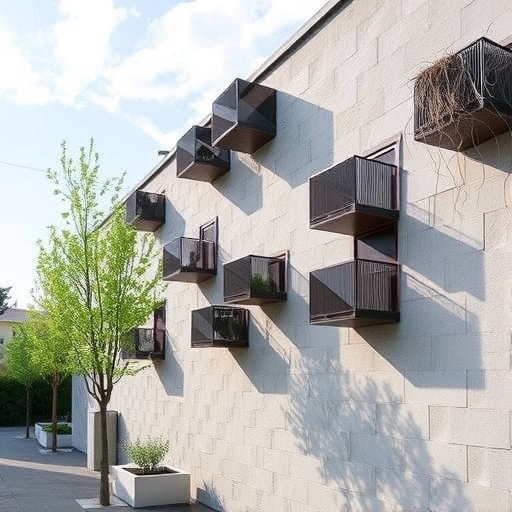
Graz University of Technology (TU Graz) researchers have developed a striking new approach to urban cooling: small, 3D-printed ceramic cubes that use water evaporation to lower temperatures without compressors, refrigerants or large amounts of electricity. Made from highly porous clay and shaped into complex internal structures, the cubes are designed to cool indoor spaces and, potentially, outdoor environments increasingly threatened by heatwaves and the urban heat-island effect.
The technology is based on evaporative cooling, a physical process familiar in hot, dry regions for centuries. When water changes from a liquid into a vapor, it absorbs heat from its surroundings. This energy transfer lowers the temperature of nearby air and surfaces. Traditional clay vessels and wind towers have long used the same principle, but the TU Graz team is combining it with digital design and additive manufacturing to create ceramic structures with an exceptionally large evaporation surface.
“3D printing enables us to produce highly complex, porous and functionally optimised geometries from clay mixtures,” says Milena Stavric of TU Graz’s Institute of Architecture and Media. “These special structures store water particularly efficiently and, despite their small volume, create an enormous evaporation surface.” The result is a cooling device that resembles a compact architectural component rather than a conventional machine.
Each cube measures approximately 23 centimetres on a side and is digitally designed before being 3D-printed from a specially prepared ceramic clay mixture. After printing, the objects are fired at relatively low temperatures. This preserves a highly porous consistency, allowing water to enter and move through the ceramic by capillary action. Instead of remaining only on the outer surface, the water is distributed throughout the cube’s internal structure, creating a large area from which evaporation can occur continuously.
A central feature of the design is a mathematically defined geometry known as a triply periodic minimal surface, or TPMS. These structures consist of interconnected, repeating surfaces that create extensive internal areas while using relatively little material. In the cooling cubes, the geometry provides pathways for water movement and exposes more wet ceramic to the surrounding air. As water evaporates from these surfaces, heat is drawn from the nearby environment, producing a localized cooling effect.
The researchers are also testing a bio-inspired method to increase the material’s water-holding capacity. In experiments conducted in the institute’s Shape Lab, fungal cultures and sawdust are mixed into the clay before printing. The fungal component, known as mycelium, consists of a network of microscopic filaments that can grow through the material. During firing, the fungal matter and sawdust burn away, leaving behind additional micro- and macropores. These empty channels can help water spread more efficiently through the cube and may increase the surface available for evaporation.
An indoor field test at TU Graz demonstrated the potential of the system under demanding conditions. Researchers installed a water-filled cube in a hot attic and measured a temperature reduction of almost seven degrees Celsius in the immediate vicinity of the object. The cooling was also noticeable across the room, according to Kristijan Ristoski, whose master’s thesis examined how the cubes and their water supply could be integrated into a cooling wall. The result does not mean that a single cube can replace an air-conditioning system in every building, but it shows how passive, water-based cooling could contribute to more comfortable spaces with far lower energy demand.
The team is investigating materials that could make the technology more sustainable and easier to scale. One candidate is sediment from Lake Neusiedl, a shallow lake in Austria that requires regular dredging to slow silting. Much of this sediment is currently treated as waste. Incorporating it into printable ceramic mixtures could turn a disposal challenge into a locally sourced building material, while reducing the need for newly extracted raw materials. The researchers are examining how such sediments affect printability, strength, porosity and long-term water performance.
The concept could eventually be incorporated into walls, façades, waiting areas, schools, offices and public spaces where conventional cooling is expensive or difficult to install. TU Graz researchers have already erected a free-standing, two-by-two-metre clay demonstration wall at the university’s Campus Neue Technik in Stremayrgasse, Graz. The technology can also be viewed at the Museum of Perception in Graz. By combining porous ceramics, computational geometry and passive heat transfer, the project offers a glimpse of architecture that responds to rising temperatures with material intelligence rather than ever-larger energy systems. The project, “3D-Printed ceramic cooling walls for sustainable urban architecture,” was carried out with TU Graz’s Institute of Building Physics, Services and Construction and funded by Austria Wirtschaftsservice GmbH through its proof-of-concept programme.
News Publication Date: 26-May-2026
Web References: https://doi.org/10.1515/9783986123260-007
References: DOI: 10.1515/9783986123260-007
Keywords
3D-printed ceramics, evaporative cooling, passive cooling, urban heat islands, porous materials, sustainable architecture, TPMS geometry, mycelium materials, additive manufacturing, TU Graz
Cite Scienmag News
Denise Maddox. (August 4, 2026). Graz University Researchers Develop Cooling Ceramic Walls to Reduce Urban Heat. Scienmag. https://scienmag.com/graz-university-researchers-develop-cooling-ceramic-walls-to-reduce-urban-heat/
Denise Maddox. "Graz University Researchers Develop Cooling Ceramic Walls to Reduce Urban Heat." Scienmag, 4 August 2026, https://scienmag.com/graz-university-researchers-develop-cooling-ceramic-walls-to-reduce-urban-heat/. Accessed 3 September 2026.
Denise Maddox. "Graz University Researchers Develop Cooling Ceramic Walls to Reduce Urban Heat." Scienmag. August 4, 2026. https://scienmag.com/graz-university-researchers-develop-cooling-ceramic-walls-to-reduce-urban-heat/


