


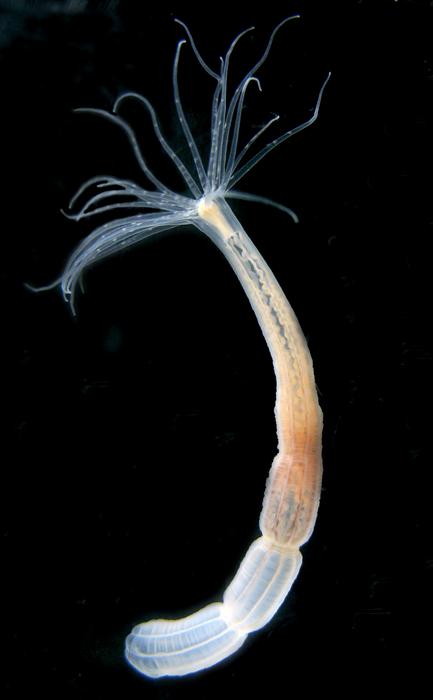
The sea anemone Nematostella vectensis is potentially immortal. Using molecular genetic methods, developmental biologists led by Ulrich Technau from the University of Vienna have now identified possible candidates for multipotent stem cells in the sea anemone for the first time. These stem cells are regulated by evolutionary highly conserved genes, which in humans are usually only active in the formation of egg and sperm cells, but give ancient animal phyla such as cnidarians a high degree of regenerative capacity to even escape ageing. The results are currently being published in Science Advances and could also provide insights into the human ageing process in the future.

Credit: Yulia Kraus
The sea anemone Nematostella vectensis is potentially immortal. Using molecular genetic methods, developmental biologists led by Ulrich Technau from the University of Vienna have now identified possible candidates for multipotent stem cells in the sea anemone for the first time. These stem cells are regulated by evolutionary highly conserved genes, which in humans are usually only active in the formation of egg and sperm cells, but give ancient animal phyla such as cnidarians a high degree of regenerative capacity to even escape ageing. The results are currently being published in Science Advances and could also provide insights into the human ageing process in the future.
“We live as long as our stem cells” is a somewhat bold but essentially accurate statement. Stem cells contribute to the constant renewal of various cells and tissues in humans, e.g. blood cells, skin or hair. If stem cells lose this ability or their number decreases in the course of life, the body ages or develops diseases. Stem cells are therefore of great interest for biomedical research.
While humans and most vertebrates can only regenerate parts of certain organs or limbs, other animal groups have far stronger regeneration mechanisms. This ability is made possible by pluripotent or multipotent stem cells, which can form (differentiate) almost all cell types of the body. The sea anemone Nematostella vectensis is also highly regenerative: it can reproduce asexually by budding and also shows no signs of ageing, which makes it an interesting subject for stem cell research. However, researchers have not yet been able to identify any stem cells in these animals.
Using the new “Single Cell Genomics” method, Technau and his team could identify cells of a complex organism based on their specific transcriptome profiles and determine from which stem cells they have developed. “By combining single-cell gene expression analyses and transgenesis, we have now been able to identify a large population of cells in the sea anemone that form differentiated cells such as nerve cells and glandular cells and are therefore candidates for multipotent stem cells,” explains first author Andreas Denner from the University of Vienna. They have remained undiscovered until now due to their tiny size.
These potential stem cells express the evolutionarily highly conserved genes nanos and piwi, which enable the development of germ cells (sperm and egg cells) in all animals, including humans. By specifically mutating the nanos2 gene using the CRISPR gene scissors, the scientists were also able to prove that the gene is necessary for the formation of germ cells in sea anemones. It has also been shown in other animals that this gene is essential for the production of gametes.
This proves that this gene function emerged around 600 million years ago and has been preserved to this day. In future studies, Ulrich Technau and his team now want to investigate which special properties of the sea anemone’s stem cells are responsible for its potential immortality.
Journal
Science Advances
Article Title
Nanos2 marks precursors of somatic lineages and is required for germline formation in the sea anemone Nematostella vectensis.
Article Publication Date
19-Aug-2024
Cite Scienmag News
Violet Maxwell. (August 19, 2024). Searching old stem cells that stay young forever. Scienmag. https://scienmag.com/searching-old-stem-cells-that-stay-young-forever/
Violet Maxwell. "Searching old stem cells that stay young forever." Scienmag, 19 August 2024, https://scienmag.com/searching-old-stem-cells-that-stay-young-forever/. Accessed 3 September 2026.
Violet Maxwell. "Searching old stem cells that stay young forever." Scienmag. August 19, 2024. https://scienmag.com/searching-old-stem-cells-that-stay-young-forever/

