


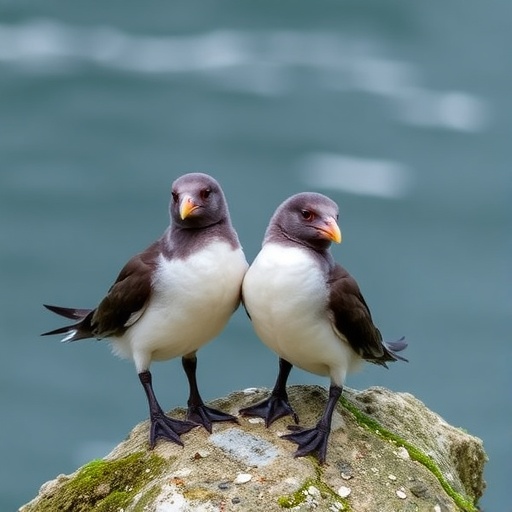
High-energy breeding seasons may reshape seabirds’ future—sometimes in ways that look counterintuitive at first glance. In a multi-year field experiment led by Nagoya University researchers, black-legged kittiwakes facing experimentally increased flight costs fled the breeding colony sooner, migrated farther, and returned with a higher chance of breeding success the following year.
The team worked with 251 kittiwakes on Middleton Island, Alaska, during 2021–2024. Birds were assigned to three groups: one received additional food to lower the energetic cost of rearing chicks; a second group had several wing and tail feathers clipped near egg-laying, increasing the energy required to fly for the remainder of breeding; and a third group served as an untreated control.
To track the animals through their annual cycle, each bird carried a geolocator recording its movements during the non-breeding season. Researchers recovered 203 devices the next year and monitored the same individuals again in 2024, enabling a direct test of how a single breeding-season stressor echoes into subsequent life-history outcomes.
As expected, the high-flight-cost birds performed poorly during the breeding season, fledging only about 10% of their chicks. In contrast, the fed group and the control group fledged roughly 44% and 43%, respectively. Yet the high-cost birds left the colony around ten days earlier, initiating a longer, more intense migration.
When the researchers compared migration distance with next-year reproduction, a clear pattern emerged: birds that traveled farther were more likely to breed successfully in the subsequent season. The study therefore provides rare experimental evidence that carry-over effects can operate through changes in migration behavior, not only through breeding success itself.
But the benefits did not come for free. Survival to the next year declined in the high-cost group: only about 67% returned, compared with 83% of controls and 90% of the fed group. The results point to a hidden trade-off embedded in how animals reallocate energy across survival, reproduction, and migration.
The authors frame this strategy as “energetic flexibility”—the capacity to shift energy investment as environmental and physiological demands change. Under this lens, a difficult breeding season can trigger a compensatory migration that improves next-year reproduction while simultaneously eroding survival.
The findings arrive at a critical moment for seabirds as climate change alters prey availability and makes ocean conditions less predictable. If migration can buffer reproductive losses, populations may persist—but only if the survival costs do not become unsustainable over time.
The team plans to use miniature heart-rate loggers to quantify energy use directly throughout the year and identify the biological processes behind energetic flexibility.
Cite Scienmag News
Russell Cooper. (July 27, 2026). Seabirds boost next year’s chick survival by shifting energy use flexibly. Scienmag. https://scienmag.com/seabirds-boost-next-years-chick-survival-by-shifting-energy-use-flexibly/
Russell Cooper. "Seabirds boost next year’s chick survival by shifting energy use flexibly." Scienmag, 27 July 2026, https://scienmag.com/seabirds-boost-next-years-chick-survival-by-shifting-energy-use-flexibly/. Accessed 4 September 2026.
Russell Cooper. "Seabirds boost next year’s chick survival by shifting energy use flexibly." Scienmag. July 27, 2026. https://scienmag.com/seabirds-boost-next-years-chick-survival-by-shifting-energy-use-flexibly/


