


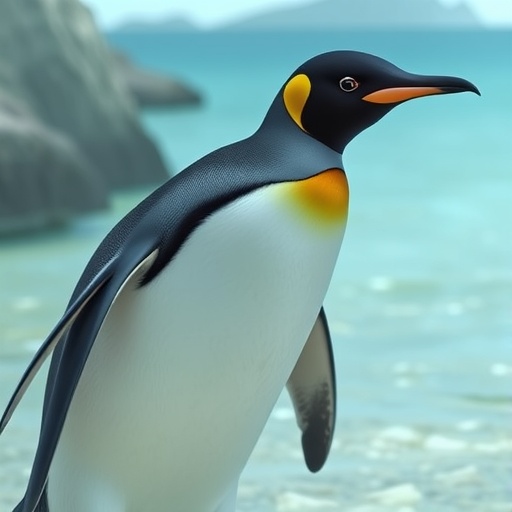
Penguins have long captivated the imaginations of scientists and nature enthusiasts alike with their seemingly awkward gait on land and their remarkable agility underwater. Recent pioneering research led by a team of anatomists from Midwestern University, in collaboration with SeaWorld San Diego and Scarlet Imaging, sheds unprecedented light on the complex musculature of the macaroni penguin (Eudyptes chrysolophus). This study reveals profound adaptations within penguin limb anatomy, explaining how these birds have evolved into specialists of aquatic locomotion while maintaining effective terrestrial movement.
Unlike most avian species which are optimized for flight through air, penguins have undergone a striking evolutionary transformation. They have traded the ability to fly in open sky for an extraordinary capacity to “fly” underwater with their wing-like flippers. These flippers function as powerful propellers, enabling penguins to navigate through dense aquatic environments at high speeds. Central to this remarkable aquatic prowess are profound modifications in the penguin’s wing musculature, markedly distinct from those of flying birds.
One of the most notable muscular adaptations documented is the hypertrophy of the supracoracoideus muscle. In typical flying birds, this muscle is primarily responsible for the upstroke of the wing during flight. However, the macaroni penguin’s supracoracoideus is significantly enlarged, a morphological specialization that allows the bird to generate propulsive power not just on the downstroke but also on the upstroke of the wing beat underwater. This bi-directional power output is critical for maneuvering through viscous water with minimal energy loss, effectively translating the conventional avian wing stroke into an efficient underwater “flight” stroke.
Further investigation reveals a unique muscular configuration around the penguin’s shoulder, supporting an “underwater flying” stroke with an enhanced backward component. This kinematic adaptation increases propulsion force, allowing macaroni penguins to swiftly chase prey and evade predators in aquatic habitats. Such biomechanical expertise underscores the intricate evolutionary pathway from airborne flight to aquatic locomotion, revealing a convergence of form and function optimized for life beneath the waves.
The study also addresses a century-old anatomical enigma concerning the musculature of the penguin’s hindlimbs. For over 100 years, there has been confusion within the scientific community about a particular muscle involved in leg positioning. The research team decisively identifies this muscle, which appears pivotal for maintaining a streamlined posture by keeping the penguin’s legs close together during swimming. This posture reduces drag and enhances hydrodynamic efficiency, enabling rapid and controlled movement underwater.
Crucially, the same muscle also plays a vital role in terrestrial locomotion. Standing and walking upright require balance and limb stability, and this newly characterized muscle, which the researchers have named the adductor tibialis, contributes significantly to bipedal posture control. By stabilizing the legs in close alignment beneath the body, the adductor tibialis facilitates the penguin’s familiar side-to-side waddle—a gait that, while seemingly cumbersome, represents an energetically optimized adaptation for dual-mode locomotion.
These anatomical discoveries provide more than a fascinating glimpse into penguin biology—they bear significant implications for conservation, veterinary care, and animal rehabilitation. Penguins are frequent exhibits in zoos and aquatic rehabilitation centers, yet until now, detailed musculoskeletal maps have been scarce. By offering a modern, comprehensive chart of macaroni penguin musculature, this study empowers veterinary professionals with improved tools to diagnose and treat injuries accurately and design rehabilitation protocols that respect the biomechanical foundations of penguin locomotion.
From an evolutionary biology perspective, the research enriches our understanding of how birds transitioned from airborne to aquatic lifestyles. By comparing the musculature of macaroni penguins with that of flying birds, the study elucidates functional trade-offs and morphological innovations underpinning this remarkable shift. It also reveals how muscle structure and function are intricately tied to ecological niche specialization, providing a model system for studying evolutionary adaptations in vertebrate locomotion.
Beyond specialized swimming mechanics, the insights extend to explaining the penguin’s iconic terrestrial behavior. The waddling gait—often perceived as eccentric or inefficient—now emerges as a sophisticated biomechanical strategy. The limb positioning, regulated by specialized muscles like the adductor tibialis, promotes energy-efficient movement on land. Though distinct from human bipedalism, penguin locomotion exemplifies how different species evolve distinct solutions to the universal challenge of mobility in varied environments.
The researchers undertook meticulous dissections of two macaroni penguins, employing comparative anatomical analysis alongside advanced imaging techniques at Scarlet Imaging. Their work exemplifies how integrative anatomical research bridges classic dissection methods with modern technology to unravel complex biological mysteries. The study’s findings are published in the renowned journal The Anatomical Record, underscoring its contribution to the field of vertebrate morphology and functional anatomy.
This breakthrough opens new avenues for multidisciplinary research integrating biomechanics, evolutionary biology, and conservation science. Understanding the penguin’s muscular architecture not only informs species-specific care but also advances broader questions about the evolutionary mechanisms enabling vertebrates to exploit fledgling ecological niches—from sky to sea. It is a vivid demonstration of how deep anatomical knowledge continues to illuminate the natural world and inspire innovative scientific inquiry.
As we deepen our appreciation of the macaroni penguin’s unique adaptations, this study serves as a reminder that what may superficially appear as awkward or inefficient may, in fact, be the finely tuned product of millions of years of evolutionary refinement. The penguin’s waddling gait and aquatic agility coexist in a harmonious balance engineered by the precision of muscular design. Such revelations enrich our understanding of the natural world and deepen our commitment to preserving these extraordinary creatures.
Cite Scienmag News
Gavin Prescott. (April 21, 2026). Scientists Uncover the Secrets of Penguins’ Waddle and Underwater “Flight”. Scienmag. https://scienmag.com/scientists-uncover-the-secrets-of-penguins-waddle-and-underwater-flight/
Gavin Prescott. "Scientists Uncover the Secrets of Penguins’ Waddle and Underwater “Flight”." Scienmag, 21 April 2026, https://scienmag.com/scientists-uncover-the-secrets-of-penguins-waddle-and-underwater-flight/. Accessed 4 September 2026.
Gavin Prescott. "Scientists Uncover the Secrets of Penguins’ Waddle and Underwater “Flight”." Scienmag. April 21, 2026. https://scienmag.com/scientists-uncover-the-secrets-of-penguins-waddle-and-underwater-flight/


