


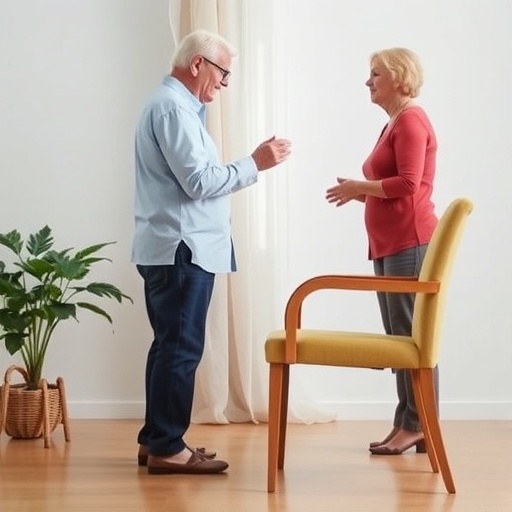
In the quest for early and accessible indicators of chronic health risks among aging populations, a remarkable new study has illuminated an unexpectedly simple yet powerful predictor: the ability to stand up from a seated position after prolonged sitting. This basic functional task, often taken for granted in daily life, may serve as a crucial bellwether for future declines in mental health and physical quality of life in older adults. The implications of these findings, published in the esteemed journal Calcified Tissue International, suggest that a swift and cost-free clinical question could transform preventive geriatric care and public health strategies worldwide.
Led by Professor M. Azhar Hussain of the University of Sharjah, this comprehensive observational study leveraged an unprecedentedly large European cohort involving over 50,000 adults aged 50 and above, tracked longitudinally for nearly ten years. Participants were initially queried about their experiences with rising from a chair following extended periods of sitting – a seemingly minor physical challenge that nearly 20% of respondents acknowledged facing difficulties with. Surprisingly, this straightforward self-report emerged as a strong prognostic indicator of a multitude of adverse health outcomes in subsequent years.
The study’s longitudinal design allowed researchers to carefully control for confounders such as age, body mass index, and pre-existing medical diagnoses. Despite these adjustments, difficulty in chair rising maintained a robust association with later development of depressive symptoms, osteoarthritis, and low overall quality of life—metrics that capture an individual’s subjective well-being, emotional state, and physical functionality. Professor Hussain highlights that these results underscore the clinical relevance of functional mobility as a window into complex physiological and psychosocial processes.
At a mechanistic level, standing up from a seated position necessitates the integrated coordination of multiple bodily systems, including muscular strength, balance control, joint integrity, and neurocognitive function. Impairment in any of these domains can plausibly contribute to difficulty in this task, thus reflecting early underlying changes that precede manifest chronic conditions. This multifactorial relationship explains why self-reported chair-rise difficulty portends not only musculoskeletal morbidity such as osteoarthritis but also psychosocial sequelae like depression and diminished life satisfaction.
Interestingly, the research found no consistent linkage between mobility challenges in chair rising and future cardiometabolic diseases such as heart disease or diabetes mellitus, pointing to the complex and multifactorial etiologies of these conditions that may not be directly captured by this mobility measure. This distinction highlights the specificity of chair-rise difficulty as a marker predominantly for psychosocial decline and musculoskeletal health, rather than a broad-spectrum indicator of all chronic illnesses.
Khalid Saeed, senior researcher at the University of Helsinki and co-author, emphasizes the broader social implications of these findings. Difficulty with rising may herald a cascade of behavioral and cognitive changes including reduced activity levels, social withdrawal, and feelings of vulnerability. This feedback loop can exacerbate mood disorders and physical frailty, thereby accelerating the trajectory toward dependency and decreased autonomy in older adults.
From a public health and geriatric clinical perspective, these findings offer a potentially transformative tool. The simplicity of asking a patient about chair-rising difficulty, without the need for elaborate equipment or costly evaluations, invites seamless incorporation into routine health assessments. This question can serve as an early warning system to identify individuals at elevated risk of debilitating outcomes, enabling timely, targeted interventions that could delay or mitigate decline.
The research team advocates for heightened clinical vigilance towards this easily assessed functional limitation. Recognition and documentation of impaired chair rise capacity could galvanize earlier referrals for physical therapy, mental health support, or social services, aligning with preventive medical paradigms that prioritize maintaining independence and quality of life in aging individuals. The study thus bridges biochemical and symptomatic analyses by incorporating a functional performance element that directly influences patient experience and outcomes.
Importantly, the findings resonate against the backdrop of global demographic shifts toward older populations, where health systems face mounting pressures to manage chronic conditions and maximize healthy life expectancy. This pragmatic, low-cost assessment tool represents a scalable strategy to address these challenges, offering a streamlined approach to functional health surveillance that could be employed at community, primary care, and specialized care levels.
Moreover, this research underscores the integral role of longitudinal, multinational cohort studies in unearthing nuanced health predictors that single-time-point analyses may overlook. The extensive European-wide sample bolsters the generalizability of findings across diverse sociodemographic contexts while simultaneously providing a granular perspective on the evolving trajectories of physical and mental health correlates in the aging process.
In conclusion, the ability to rise unaided from a seated position is far more than a mere physical convenience; it embodies a composite biomarker of deeper biological and psychosocial resonance. This study’s compelling evidence establishes chair-rise difficulty as a sentinel measure of early risk for psychosocial decline and musculoskeletal disorders, carrying profound implications for clinical practice, public health policy, and aging research. By capitalizing on this simple question, healthcare providers can unlock significant insights, offering older adults a clearer path toward sustained autonomy and enhanced quality of life.
News Publication Date: 1-Apr-2026
Web References: http://dx.doi.org/10.1007/s00223-026-01523-9
References: Hussain, M.A., et al. (2026). Can Difficulty Standing from a Chair Signal Early Risk of Chronic Illness? Insights from a Multi-Wave European Cohort. Calcified Tissue International. DOI: 10.1007/s00223-026-01523-9
Cite Scienmag News
Beatrice Stafford. (April 21, 2026). How Older Adults Stand Up from a Chair May Impact Their Quality of Life. Scienmag. https://scienmag.com/how-older-adults-stand-up-from-a-chair-may-impact-their-quality-of-life/
Beatrice Stafford. "How Older Adults Stand Up from a Chair May Impact Their Quality of Life." Scienmag, 21 April 2026, https://scienmag.com/how-older-adults-stand-up-from-a-chair-may-impact-their-quality-of-life/. Accessed 5 September 2026.
Beatrice Stafford. "How Older Adults Stand Up from a Chair May Impact Their Quality of Life." Scienmag. April 21, 2026. https://scienmag.com/how-older-adults-stand-up-from-a-chair-may-impact-their-quality-of-life/


