


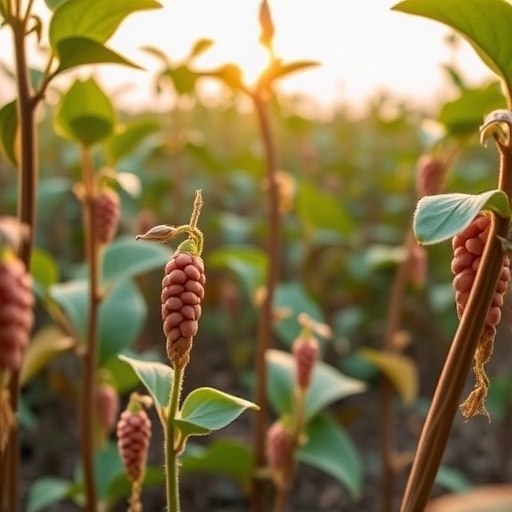
In the relentless heat of a scorching summer afternoon, when the sunlight seems merciless and the air remains dry and unyielding, soybean plants exhibit a fascinating defense mechanism that scientists are only beginning to fully understand. Researchers at the University of Missouri have uncovered a remarkable physiological strategy in soybeans known as differential transpiration. This natural process distinctly alters how different tissues in the plant manage water loss and cooling, effectively safeguarding the vital reproductive organs—flowers and seed pods—from the damaging effects of extreme weather stressors.
Differential transpiration, in essence, is a highly specialized form of water regulation within the plant’s anatomy. While the larger leaf surfaces close their stomata—minute pores that normally facilitate gas exchange and evaporative cooling—the stomata located on the reproductive tissues remain open. This selective stomatal behavior allows the flowers and pods to maintain transpirational cooling, a process akin to evaporative cooling in humans, thereby preserving their function and development under high temperature and drought conditions. This discovery opens a new window into understanding plant resilience strategies at a microenvironmental scale.
Professor Ron Mittler, Curators’ Distinguished Professor of Plant Science and Technology at the University of Missouri, explains that this mechanism acts somewhat like a targeted air-conditioning system deployed by the plants. “Soybeans keep the stomata on their flowers and pods open, enabling water vapor release and cooling, while the larger leaf surface stomata close to minimize overall water loss,” Mittler states. By doing so, the plants can conserve up to 95 percent of the water they would normally expend, a monumental saving under drought and heat stress, where every drop counts.
The physiological underpinnings of differential transpiration are tied to the strategic regulation of stomatal aperture, which influences both the plant’s photosynthetic efficiency and its cooling capacity. Under typical conditions, stomata across the leaf surface open and close in response to environmental cues to balance carbon dioxide uptake with water conservation. However, the observation that flowers and pods maintain an open stomatal state under severe stress indicates an evolved prioritization; the survival and reproductive success of the plant hinge upon effective thermal regulation of these sensitive tissues.
This research provides profound insight into plant responses to abiotic stress, emphasizing the complexity of adaptive strategies at the tissue-specific level. It challenges the traditional perspective where stomatal regulation is considered uniform throughout the plant canopy and highlights the need to reexamine models of plant water use and stress tolerance with finer spatial resolution. Understanding such mechanisms has paramount importance for agriculture, particularly in the face of climate change, where heatwaves and water scarcity threaten crop yields worldwide.
Looking ahead, the implications of harnessing differential transpiration for crop improvement are substantial. Mittler envisions that through focused breeding programs or genetic engineering aimed at enhancing stomatal density specifically on reproductive structures, it might be possible to develop soybean varieties, and potentially other crops, with heightened resilience to combined heat and drought stress. Such innovations could considerably mitigate yield losses during extreme weather events while optimizing water use efficiency—goals critically needed to sustain global food security.
The published study, appearing in the journal Physiologia Plantarum, represents a significant advance over previous work by the team, which had initially identified differential transpiration in soybeans through articles in New Phytologist and Plant Physiology. This progression from discovery to detailed physiological characterization underscores the rigorous scientific method employed and the evolving understanding of plant adaptive strategies. The current paper documents the behavior of differential transpiration across a broad spectrum of water deficit and heat stress combinations, reinforcing its relevance beyond isolated experimental conditions.
Methodologically, the researchers employed advanced imaging and gas exchange measurement techniques to quantify stomatal conductance, water vapor flux, and tissue temperature differentials. These quantitative assessments were critical to demonstrate conclusively that reproductive tissues maintain distinct transpiration profiles compared to vegetative leaves. The integration of physiological data with environmental stress metrics provides a robust framework for interpreting plant-environment interactions at multiple scales.
Moreover, this research aligns with broader ecological and evolutionary frameworks by illustrating how plants modulate physiological functions to optimize reproductive success under adverse conditions. Heat and drought stresses are among the principal environmental factors limiting agricultural productivity, and the nuanced control of stomatal behavior exhibits an evolutionary refinement that prioritizes reproduction over vegetative maintenance when resources are scarce. Understanding these priorities enables agronomists and plant biologists to tailor interventions more precisely.
The ongoing support from the National Science Foundation underscores the wider scientific community’s recognition of the significance of this work. By bridging fundamental plant biology with applied agricultural sciences, the research fosters multidisciplinary collaboration to address real-world challenges. Future studies will likely explore the genetic pathways governing stomatal differentiation and responsiveness on reproductive tissues, enhancing our molecular toolbox for crop enhancement.
This discovery also invites speculation about whether similar differential transpiration mechanisms operate in other economically important crops, such as maize, wheat, and rice. Cross-species comparisons could reveal conserved or divergent adaptations, expanding possibilities for biotechnological applications. The possibility that differential transpiration contributes broadly to plant resilience offers a fertile ground for integrating physiological ecology with genomics and breeding strategies.
In summary, the unveiling of differential transpiration in soybeans provides a compelling glimpse into nature’s intricate adaptations to climate adversity. This tissue-specific water regulation confers a survival advantage during drought and heat by enabling reproductive tissues to remain cool while conserving water at the whole-plant level. With the escalating challenges posed by global warming, a deeper understanding and eventual manipulation of such mechanisms bear promise for sustaining crop productivity, heralding a new frontier in resilient agriculture.
News Publication Date: 1-May-2025
Web References: 10.1111/ppl.70251
References: Mittler R., Sinha R., Peláez-Vico M. Á., Fritschi F. B. (2025). Differential transpiration occurs in soybean under a wide range of water deficit and heat stress combination conditions. Physiologia Plantarum. DOI: 10.1111/ppl.70251
Cite Scienmag News
Alan Morgan. (July 31, 2025). Scientists Uncover Crucial Survival Mechanism in Soybeans Amid Heat and Drought. Scienmag. https://scienmag.com/scientists-uncover-crucial-survival-mechanism-in-soybeans-amid-heat-and-drought/
Alan Morgan. "Scientists Uncover Crucial Survival Mechanism in Soybeans Amid Heat and Drought." Scienmag, 31 July 2025, https://scienmag.com/scientists-uncover-crucial-survival-mechanism-in-soybeans-amid-heat-and-drought/. Accessed 3 September 2026.
Alan Morgan. "Scientists Uncover Crucial Survival Mechanism in Soybeans Amid Heat and Drought." Scienmag. July 31, 2025. https://scienmag.com/scientists-uncover-crucial-survival-mechanism-in-soybeans-amid-heat-and-drought/


