


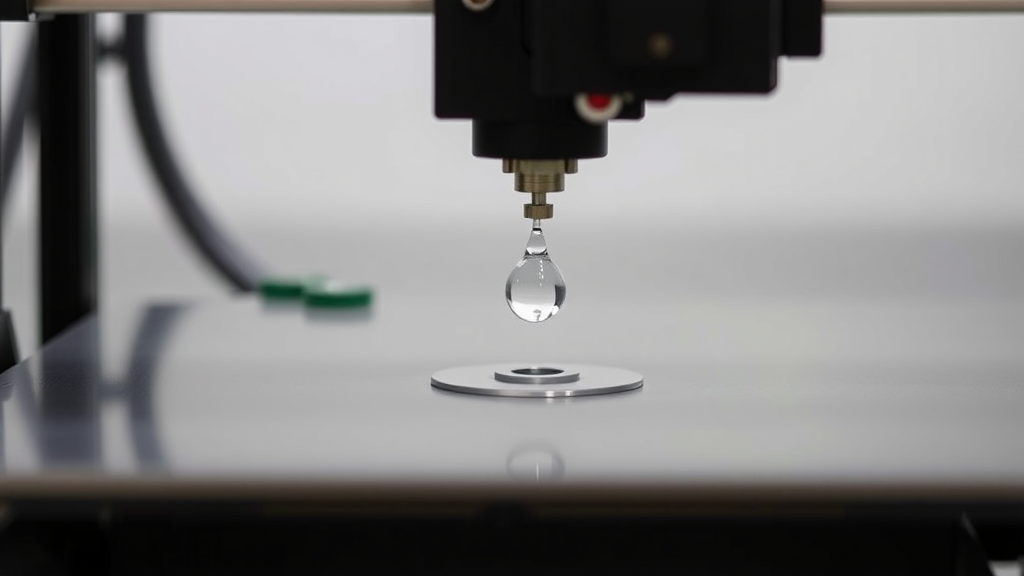
Inside a small laboratory, an ordinary desktop 3D printer has been reborn as something quite different: a machine that dispenses precise droplets of liquid onto paper with a repeatability that rivals commercial equipment costing tens of thousands of dollars. Researchers reporting in the open-access journal HardwareX describe CRISP, short for Controlled Robotic Inkjet Solution on Paper, a platform built by stripping the heated extruder from a Creality Ender-3 printer and replacing it with a custom syringe pump fabricated largely from 3D-printed brackets and a handful of inexpensive off-the-shelf components. The total added cost comes to about 235 dollars, and the entire design is openly licensed and freely downloadable, putting precision solution printing within reach of almost any laboratory with a soldering-iron-adjacent skill set.
The motivation behind the project lies in a persistent bottleneck in materials research. Solution-based printing, the family of techniques that includes inkjet, aerosol jet, gravure and screen printing, underpins modern work on flexible electronics, chemical sensors and printed diagnostics, all of which depend on depositing inks and functional fluids in exact locations on diverse substrates. Commercial tools such as the Fujifilm Dimatix Materials Printer DMP-2850 handle this task admirably, but their price places them beyond many academic groups. Meanwhile, the drive toward self-driving laboratories, where robots, liquid handlers and inline instruments work in concert to accelerate discovery, has exposed another cost barrier: automation platforms like the Opentrons OT-2 robot start at more than 15,000 dollars before a single experiment runs. The CRISP team set out to demonstrate that a frugal twin could be assembled from commodity hardware without sacrificing meaningful performance.
The engineering insight at the heart of the project is that a fused deposition modeling printer already contains nearly everything a liquid-dispensing robot needs. The Ender-3 provides robust three-axis motion control, a stepper motor for extrusion, an Arduino-class motherboard running Marlin firmware, and a mature G-code ecosystem. The researchers removed the hot end, heating block and filament spool holder, then mounted a syringe pump assembly on the printer’s upper frame. That pump is deliberately simple: a stainless-steel trapezoidal lead screw driven by the printer’s stock extruder stepper motor, a brass flanged nut riding on a 3D-printed gantry bracket, and two mounts that clamp a standard 20 milliliter Luer-lock syringe in place. When the motor turns, the threaded rod advances and the gantry bracket pushes the syringe plunger with kinematic regularity, converting rotational steps into volumetric dispensing.
Ink reaches the substrate through a length of fluorinated ethylene propylene tubing, roughly 75 centimeters long with a one-sixteenth-inch inner diameter, which press-fits into a nozzle made from a disposable polypropylene pipette tip. The choice of pipette tips as nozzles is a small piece of design genius: at 10 to 20 cents apiece, they are effectively consumables, and a clogged nozzle is solved by pulling the tip off and pressing on a new one rather than performing delicate surgery on an expensive printhead. The tips used in the demonstration have orifice diameters between roughly 0.35 and 0.50 millimeters, but because deposition is volumetric rather than nozzle-limited, the final droplet size on porous paper is governed mainly by the dispensed volume and how the fluid wicks into the fibers.
Because the syringe pump borrows the printer’s native extruder motor, it is programmed with ordinary G-code, the same command language hobbyists use to print plastic. This gives CRISP a surprisingly sophisticated feature set for its price: the number of programmed dispensing steps is limited only by how many G-code commands a user writes, which allows multi-step routines comparable to those of programmable laboratory pumps that cost several thousand dollars. For calibration, the team primed the tubing through the printer’s own interface, loaded a G-code file onto a microSD card, and let the machine execute its run from file. The comparison point is stark: a Chemyx 4000X programmable syringe pump runs about 4,400 dollars, while CRISP’s pumping hardware costs a fraction of that and integrates directly into a motion platform.
Validation began with a deliberately humble test fluid, a blue dye dissolved in water, chosen so that printing parameters could be optimized without the expense and opacity of metal nanoparticle inks. The team printed repeated five-by-five arrays of droplets on cardstock with dots spaced 20 millimeters apart and a programmed volume of 0.026 milliliters per drop. Quantitative image analysis using the open-source computer vision library OpenCV revealed a mean droplet circularity of 0.87 with a standard deviation of only 0.02, a coefficient of variation of 2.30 percent that indicates highly uniform droplet morphology. Positional accuracy proved equally respectable: the mean deviation between programmed and actual droplet centers was 0.65 millimeters, with a worst case of 1.25 millimeters, and the error distribution was random rather than systematic, confirming that the added syringe hardware introduces no mechanical drift into the printer’s kinematics.
Weighing the droplets provided an independent check on volumetric fidelity. Across five trials in which the system dispensed ten droplets into a tared dish, the average total mass was 265.9 milligrams, implying 26.59 microliters per drop against a kinematic prediction of 26.0 microliters, a percent error of just 2.3 with a coefficient of variation of 1.6 percent. Deposited on porous cardstock, the drops spread into hemispheres averaging about 4.6 millimeters in diameter, exactly matching volumetric expectations. The researchers note that the practical minimum droplet volume for this configuration is roughly 3 to 5 microliters, bounded by the stepper motor’s step resolution and fluid surface tension, though switching to a smaller syringe barrel would stretch that limit further by amplifying plunger travel per dispensed volume.
The team is candid about the platform’s boundaries. The nozzle holder as built maintains a physical gap of about 7 millimeters between tip and substrate, which is ideal for falling droplets but prevents the close tip-to-surface contact needed for a stable meniscus during continuous line printing; attempts to write continuous features with aqueous dye produced lines that thinned and broke. Paper remains the sweet spot because its fibrous structure absorbs liquid quickly, pinning particles before uneven drying can occur, whereas non-porous glass slides exhibited anomalous drying behavior related to well-known evaporative defects such as the coffee ring effect. The dead volume of the delivery tubing, roughly 1.5 milliliters, also matters when working with expensive reagents, and the authors recommend shorter, stiffer tubing and a heated print bed to tame environmental drying variability.
What makes CRISP more than a clever hack is its framing within the growing frugal-twin movement in chemistry and materials science, where low-cost replicas of commercial instruments are validated against their expensive counterparts. Structurally, the design resembles prior Ender-3 liquid-handling conversions, but it differs in relying entirely on stock printer hardware and 3D-printed brackets rather than an external syringe pump, keeping the added cost below 200 dollars. With results showing dispensing circularity of 98.2 percent and relative positional accuracy of 96.8 percent, the authors argue that stepper-driven commodity hardware offers sufficient repeatability for routine patterning tasks. Their ultimate goal is the deposition of metal nanoparticle inks for paper-based sensors, and with every CAD file, STL, G-code script and dataset published under open licenses on the Open Science Framework, CRISP invites laboratories worldwide to print droplets, not just plastic, for the price of a good dinner out.
Subject of Research: A low-cost 3D printer-based platform for precision solution printing on paper-based substrates
Article Title: CRISP: A 3D printer-based platform for precision solution printing on paper-based substrates
Article References: Lutfiyev, I., McCoy, S. A., Star, R., Giordano, A. N., Rist, B., Baldwin, L. A., & Rao, R. (2026). CRISP: A 3D printer-based platform for precision solution printing on paper-based substrates. HardwareX, 28, Article e00842. https://doi.org/10.1016/j.ohx.2026.e00842
Image Credits: AI Generated
DOI: 10.1016/j.ohx.2026.e00842
Keywords: CRISP, 3D printing, syringe pump, solution printing, paper-based substrates, Ender-3, open-source hardware, G-code, droplet deposition, frugal science, flexible sensors, HardwareX
Cite Scienmag News
Denise Maddox. (September 21, 2026). Scientists turn a $175 3D printer into a precision droplet printer. Scienmag. https://scienmag.com/scientists-turn-a-175-3d-printer-into-a-precision-droplet-printer/
Denise Maddox. "Scientists turn a $175 3D printer into a precision droplet printer." Scienmag, 21 September 2026, https://scienmag.com/scientists-turn-a-175-3d-printer-into-a-precision-droplet-printer/. Accessed 4 October 2026.
Denise Maddox. "Scientists turn a $175 3D printer into a precision droplet printer." Scienmag. September 21, 2026. https://scienmag.com/scientists-turn-a-175-3d-printer-into-a-precision-droplet-printer/


