


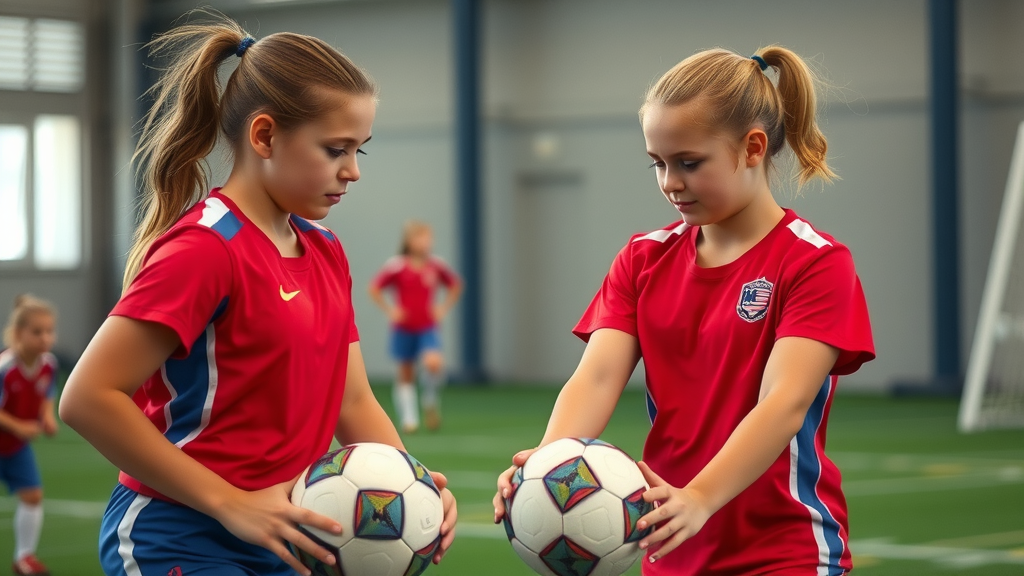
Strength training has long been treated as the physical side of soccer preparation, a way to win duels, protect joints and sprint faster. A new randomized controlled trial now argues that the barbell may also sharpen the mind. In a study published in Sports Medicine – Open, researchers led by Mariem Bousselmi of the University of Sfax, together with colleagues including Hassane Zouhal, Urs Granacher and Anthony C. Hackney, report that just two weekly strength sessions over twelve weeks improved not only muscle strength and passing accuracy but also executive function in highly trained adolescent female soccer players. The results arrive at a moment when women’s soccer is expanding globally and scientists are racing to understand how the body’s physical workloads shape the brain behind the feet.
The research team recruited twenty-two players from the Tunisian national U15 soccer program, all of whom qualified as Tier 3, or highly trained, athletes under the classification framework proposed by McKay and colleagues. The girls, aged 14.9 plus or minus 0.8 years and assessed at Tanner stage 3 of pubertal development, were randomly assigned to either a strength training group of eleven players or an active control group of eleven who continued their normal soccer schedule. Both groups trained five times per week for ninety minutes and played a competitive match each weekend, and statistical analysis confirmed that total training loads, calculated by multiplying session ratings of perceived exertion by session duration, were essentially identical between groups at roughly 1,160 arbitrary units. That equivalence matters, because any difference in outcomes could then be attributed to the strength intervention itself rather than to a simple mismatch in workload.
The strength program was deliberately periodized across three four-week cycles. In the first cycle, players performed full-body exercises such as leg press, hip thrust, squat, bench press, lat pull-down and calf raises at 40 to 60 percent of their one-repetition maximum, completing three sets of fifteen repetitions with deliberately slow movement. The second cycle escalated to three sets of twelve, ten and eight repetitions at 60 to 75 percent of one-repetition maximum, while the third cycle climbed to sets of ten, eight and six repetitions at intensities approaching 85 percent. One-repetition maximum tests were repeated before each cycle to recalibrate loads, ensuring progressive overload, and no strength work was performed during the fourth week of each cycle to allow recovery and consolidation of adaptations.
The physical results were unambiguous. After twelve weeks, the strength group posted large and statistically significant gains in maximal dynamic strength across all three tested lifts, with one-repetition maximum improvements on the bench press, lat pull-down and leg press reaching post hoc significance at p less than 0.001 and partial eta squared values of 0.41, 0.43 and 0.36 respectively, all well beyond the threshold for large effects. Body composition shifted in parallel: the strength group gained lean body mass while simultaneously reducing body fat percentage, a combination the authors attribute to stimulated muscle hypertrophy and increased energy expenditure. The control group showed no comparable changes. Because these athletes had never previously undergone systematic strength training, the researchers suggest the early gains were driven largely by neural adaptations, including improved motor unit recruitment and firing frequency, a phenomenon typically dominant during the first four to six weeks of a resistance program before hypertrophy becomes the primary mechanism.
The soccer-specific findings may be the most striking for coaches. Using the Loughborough Soccer Passing Test, a validated field assessment in which players complete sixteen timed passes against color-coded targets while penalties are added for misses, wrong targets and handling errors, the strength group improved its total score by roughly 22 percent. Crucially, the improvement came overwhelmingly from a reduction in penalties, which fell by more than 65 percent in the strength group compared with only about 11 percent in controls. The test demands simultaneous ball control, rapid decision-making and precise body positioning in a confined space, so the authors interpret the penalty reduction as evidence of better information processing and a strengthened connection between cognition and motor execution. Previous reviews have shown that various training modalities can improve passing test scores, but demonstrating this from a pure strength intervention in adolescent girls adds a genuinely novel data point.
Executive function, the suite of mental skills that governs inhibition, cognitive flexibility and attentional control, was assessed with the classic Stroop test, in which participants must name the ink color of a word when the word itself names a different color, thereby forcing the brain to suppress an automatic reading response. Across three subtasks covering word reading, color naming and the interfering word-color condition, the strength training group improved significantly, with the critical group-by-time interaction for the Stroop word-color test reaching p equal to 0.006 and a large effect size, while the control group did not improve beyond time-related practice effects. The authors caution that some portion of the gain may reflect measurement variability or learning effects, but the pattern aligns with a 2020 meta-analysis by Landrigan and colleagues showing that resistance exercise reliably lifts cognitive performance, and with neurophysiological work by Kidgell and by Hortobágyi linking strength training to enhanced corticospinal excitability and synaptic efficiency.
The study also probed the molecular machinery that is often assumed to underlie these cognitive benefits. Blood samples were drawn in a fasted state, twenty-four hours after the final training session and during the follicular phase to control for hormonal fluctuation, and analyzed for basal serum concentrations of brain-derived neurotrophic factor, or BDNF, and insulin-like growth factor 1, or IGF-1. In animal models, exercise-induced elevations of these molecules drive neurogenesis, long-term potentiation and synaptic plasticity, and several human studies have reported increased IGF-1 after resistance training. Yet here, despite clear behavioral improvements, neither marker changed significantly between or within groups. The authors suggest several explanations: athletes with already high fitness levels may maintain BDNF and IGF-1 at a physiological homeostasis that leaves little room for further elevation, participants had an average body mass index below 25, a range in which exercise typically produces no detectable BDNF change, and the effects of long-term training on circulating BDNF may be transient rather than cumulative, with acute spikes returning to baseline between sessions.
The findings carry practical weight for a sport in which cognition increasingly appears to separate elite from sub-elite performers. Soccer constantly presents players with multi-task demands, requiring them to dribble or pass while simultaneously tracking opponents, teammates and passing lanes under severe time pressure, and prior research has shown that Stroop performance can distinguish high-level from low-level players. If two supervised strength sessions per week, easily accommodated within an in-season schedule, can meaningfully sharpen inhibitory control and reduce passing errors, the cost-benefit calculation for youth academies changes considerably. The researchers explicitly recommend that coaches integrate strength training into regular programs to develop both physical fitness and cognitive function in young female athletes, noting that adherence in this trial exceeded 99 percent and that no training-related injuries occurred.
The study is not without limitations, which the authors transparently enumerate. Executive flexibility was measured with only a narrow test battery; additional neurotrophins such as NT-3 and NT-4 were not sampled; sleep, stress and fatigue were uncontrolled; and the power analysis was based on a single outcome despite multiple tested domains, leaving a residual risk of type I error. Pubertal development and menstrual cycle phase may also have introduced variability despite careful scheduling of blood draws. Still, as the first trial of its kind in young, highly trained female soccer players, the work opens a productive line of inquiry. The authors call for future studies measuring neurovascular and neuroendocrine responses during and after strength interventions, and for trials comparing strength training against dedicated cognitive training, to determine whether the mental gains observed here can be amplified, sustained and, ultimately, translated into match-day advantage on the pitch.
Subject of Research: Effects of strength training on cognitive function and neuroplasticity markers in highly trained young female soccer players.
Article Title: Effects of Strength Training on Cognitive Function, Brain-Derived Neurotrophic Factor and Insulin-Like Growth Factor 1 in Highly-Trained Young Female Soccer Players
Article References: Bousselmi, M., Zouhal, H., Darragi, M., Karamti, H. M., Ben Hmid, A., Zamali, I., Ben Ahmed, M., Krir, A., Zouita, S., Laher, I., Hackney, A. C., Granacher, U., & Ben Moussa Zouita, A. (2026). Effects of Strength Training on Cognitive Function, Brain-Derived Neurotrophic Factor and Insulin-Like Growth Factor 1 in Highly-Trained Young Female Soccer Players. Sports Medicine – Open, 12(1), Article 138. https://doi.org/10.1186/s40798-026-01103-z
Image Credits: AI Generated
DOI: 10.1186/s40798-026-01103-z
Keywords: strength training, cognitive function, female soccer, BDNF, IGF-1, Stroop test, LSPT, youth athletes, neuroplasticity, muscle strength, executive function, randomized controlled trial
Cite Scienmag News
Ophelia Keating. (September 21, 2026). Lifting Smarter: Two Strength Sessions a Week Boost Muscle, Skills and Thinking in Young Female Soccer Players. Scienmag. https://scienmag.com/lifting-smarter-two-strength-sessions-a-week-boost-muscle-skills-and-thinking-in-young-female-soccer-players/
Ophelia Keating. "Lifting Smarter: Two Strength Sessions a Week Boost Muscle, Skills and Thinking in Young Female Soccer Players." Scienmag, 21 September 2026, https://scienmag.com/lifting-smarter-two-strength-sessions-a-week-boost-muscle-skills-and-thinking-in-young-female-soccer-players/. Accessed 4 October 2026.
Ophelia Keating. "Lifting Smarter: Two Strength Sessions a Week Boost Muscle, Skills and Thinking in Young Female Soccer Players." Scienmag. September 21, 2026. https://scienmag.com/lifting-smarter-two-strength-sessions-a-week-boost-muscle-skills-and-thinking-in-young-female-soccer-players/


