


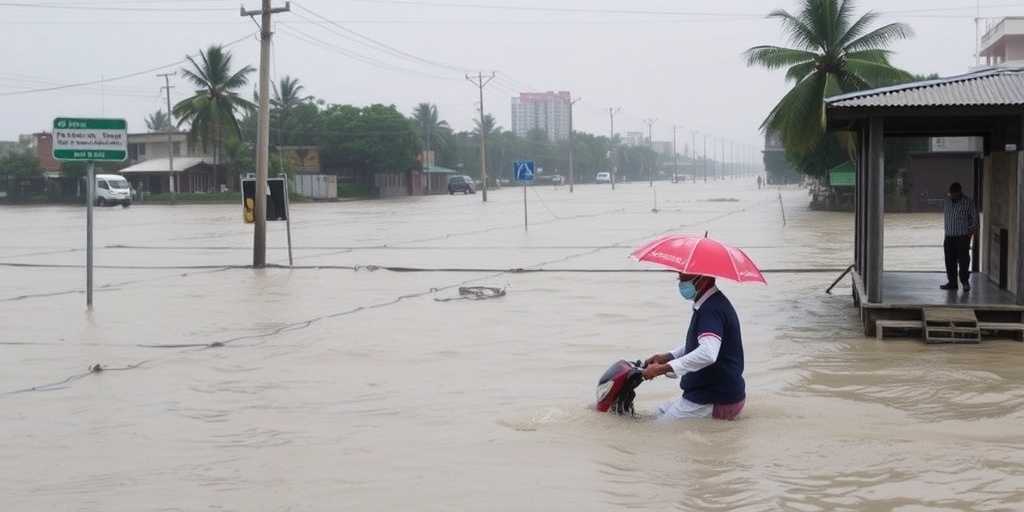
Tropical cyclones, often referred to as hurricanes in certain regions, form over tropical oceans and pose significant threats to coastal areas, particularly when they move inland. The severity of these storms can be magnified by storm tides—elevated seawater levels driven by both tides and storm surges—that wreak havoc on coastal landscapes, leading to catastrophic flooding. Recent research conducted by scientists at the Massachusetts Institute of Technology (MIT) reveals alarming trends regarding these storm tides, particularly for Bangladesh, a nation uniquely susceptible to such disasters.
In a groundbreaking study published in the journal One Earth, the researchers project that the frequency of destructive storm tides impacting Bangladesh could rise dramatically as climate change continues to alter weather patterns. This area, long known for its limited elevation and vulnerability to storm surges, now faces an increase in these hazardous events. What was previously classified as a 100-year event—a storm tide that might strike once in a century—could soon occur every decade or even more frequently by the century’s end if current fossil fuel consumption trends continue unabated.
Bangladesh, characterized by its densely populated landscape and geographic vulnerabilities, exemplifies the disproportionate risks posed by climate change. The nation’s population of over 171 million people occupies a geographical area comparable to that of New York State, rendering it particularly susceptible to the whims of nature. Given its low-lying status within the Ganges-Brahmaputra delta, the country has long battled the threats posed by tropical storms. Historical patterns show that Bangladesh has endured some of the most severe floods on record, with each storm exacerbating the challenges faced by its agricultural economy.
The findings from the MIT study illuminate the potential for an unprecedented overlap between tropical cyclones and the country’s monsoon season—two weather phenomena that historically remained separated in timing. As climate dynamics shift due to global warming, cyclones may begin to intrude on the months characterized by heavy monsoon rains, creating a blueprint for compounding disasters where the aftermath of storm flooding could coincide with the torrential downpours known to saturate the soil. This overlap could lead to catastrophic scenarios where communities receive no respite between successive waves of flooding.
Past efforts to mitigate such risks in Bangladesh have included substantial investments in storm preparedness initiatives. Improvements to early warning systems, reinforced village embankments, and better access to community shelters represent some of the proactive measures taken by the nation. Yet, these preparations have primarily been informed by historical storm frequencies, leaving them at risk of being inadequate in the face of rapidly changing climate dynamics and increased storm intensities predicted by the new research.
The imperative for behavioral change surrounding storm preparedness is echoed by Sai Ravela, a principal research scientist in MIT’s Department of Earth, Atmospheric, and Planetary Sciences (EAPS) and a co-author of the study. Ravela warns that while Bangladesh is active in addressing climate risks, their strategies might not account for the future scenarios outlined in the study. The tenfold increase in storm tide recurrence reported demands a reevaluation of contemporary protection efforts, emphasizing that current strategies may no longer be sufficient in the face of escalating climate threats.
To conduct their research, the MIT team employed a sophisticated modeling technique that utilizes physics-based downscaling. This methodology integrates a broad, low-resolution model of the global ocean and atmosphere with a more finely-tuned simulation capable of capturing the intricacies of individual hurricanes. By introducing simulated hurricane "seeds" to the model, the scientists examined which storms proliferated and made landfall, systematically observing their behavior over time.
The research team further integrated a hydrodynamical model into their simulation framework, which evaluates storm surge heights based on wind patterns at the time of the storm. By tracking tidal waters and accounting for the effects of rising sea levels, the model offered a comprehensive view of how storm tides would behave as cyclones made landfall. Each simulation yielded estimates on the maximum storm tide levels along Bangladesh’s coastline, allowing the team to assess the relative frequency of various flood scenarios under distinct climate futures.
Through their extensive modeling efforts, the researchers discovered that under certain climate trajectories—especially those characterized by sustained global warming—storms that historically occurred once every century could occur at a rate of once per decade or less by the century’s end. The findings underscore the urgency for surrounding nations and climate experts to rethink current risk mitigation tactics. Given that the storms could occur nearly simultaneously with the monsoon season, the compounded risks of flooding present another layer of complexity to disaster preparedness.
Ravela articulated the clear dangers posed by the convergence of saturated soil conditions due to monsoon rains and potential cyclonic activity in Bangladesh’s future climate. This combination not only amplifies the risk for flooding but also creates significant challenges for communities that may have no reprieve from extreme weather events. With the planet steadily warming, the catastrophic nature of storm interactions will become increasingly prevalent, demanding urgent attention and action.
This research highlights that Bangladesh’s vulnerabilities are a microcosm of a growing climate crisis that is expected to affect various regions around the globe in distinctive ways. Ravela posits that while the specific threats may differ—for instance, some areas might experience heightened droughts or wildfires—the underlying narrative of escalating climate-related disasters remains consistent. The implications of this research may serve as a cautionary tale for other nations facing similar warming trends.
The results of this study hold vital information for policymakers and disaster response teams in Bangladesh. By refining their understanding of evolving storm risks, local experts can design more effective strategies to protect their communities. As the patterns of extreme weather continue to escalate, it will be crucial for developing nations like Bangladesh to partner with scientific communities to glean insights from research endeavors such as these.
Ultimately, with continued support from various initiatives focused on climate resilience, there lies a possibility to avert future catastrophes stemming from these evolving storm patterns. Nations must recognize that proactive, well-informed planning and response will be necessary in addressing the realities of climate change in the years to come.
As we forge ahead into an uncertain future wracked by climate changes, the research findings provide critical insight into how we might navigate these unprecedented challenges. In Bangladesh, as well as in many vulnerable areas globally, understanding the implications of this research compels immediate action to protect and enhance the resilience of coastal communities facing the brunt of an increasingly hostile climate environment.
Cite Scienmag News
Violet Maxwell. (April 11, 2025). Scientists Reveal Bangladesh Experiences Century-Scale Storm Tides Every Few Decades. Scienmag. https://scienmag.com/scientists-reveal-bangladesh-experiences-century-scale-storm-tides-every-few-decades/
Violet Maxwell. "Scientists Reveal Bangladesh Experiences Century-Scale Storm Tides Every Few Decades." Scienmag, 11 April 2025, https://scienmag.com/scientists-reveal-bangladesh-experiences-century-scale-storm-tides-every-few-decades/. Accessed 4 September 2026.
Violet Maxwell. "Scientists Reveal Bangladesh Experiences Century-Scale Storm Tides Every Few Decades." Scienmag. April 11, 2025. https://scienmag.com/scientists-reveal-bangladesh-experiences-century-scale-storm-tides-every-few-decades/


