


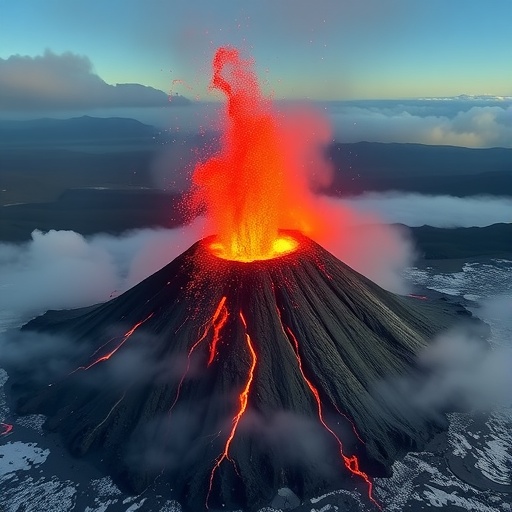
In January 2022, the South Pacific was shaken by one of the most violent volcanic eruptions in recent history: the explosion of the submarine volcano Hunga Tonga–Hunga Ha’apai. This dramatic natural event captivated the world with its raw power and devastating aftermath. Yet, beyond the immediate spectacle, the eruption unveiled a remarkable and unexpected atmospheric phenomenon that could have far-reaching implications in the fight against climate change. Researchers utilizing cutting-edge satellite technology uncovered that the volcano, while spewing significant methane—a potent greenhouse gas—also initiated a natural cleansing process that reduced some of this methane pollution. This revelation opens up new horizons for how Earth’s natural processes might be leveraged to mitigate global warming.
The cornerstone of this discovery is the detection of unusually elevated levels of formaldehyde in the massive volcanic plume emitted during and after the eruption. Formaldehyde is a transient compound that arises in the atmosphere predominantly as an intermediate during the oxidation of methane. Thus, its presence in the volcanic plume did not simply signal pollution but indicated active methane destruction. Using the sophisticated TROPOMI instrument aboard the European Space Agency’s Sentinel-5P satellite, scientists tracked this formaldehyde cloud for over ten days, astonishingly following it all the way to the South American continent. Given that formaldehyde typically survives just a few hours in the atmosphere, this continuity suggested a sustained chemical reaction breaking down methane for more than a week.
This finding challenges prior assumptions about volcanic eruptions, which until now were primarily understood as methane sources. “Volcanic ash has long been considered only as a pollutant, but our data reveal it also plays a dynamic role in atmospheric chemistry,” explains Dr. Maarten van Herpen, lead author of the pivotal study. His team proposes that volcanic ash, laden with salts and airborne particulates derived from the eruption’s interaction with seawater, catalyzes complex chemical reactions. These reactions result in the generation of reactive chlorine species, which act as agents to oxidize methane molecules efficiently in the stratosphere.
The discovery builds upon earlier research conducted by the team in 2023 concerning aerosol chemistry over the Atlantic Ocean. There, they observed that dust particles transported from the Sahara Desert combined with sea salt aerosols in ocean spray, forming iron salt aerosols. Photolysis of these aerosols under sunlight released chlorine atoms, which subsequently engaged in methane oxidation. This mechanism significantly altered the understanding of methane’s lifecycle in the troposphere. Remarkably, strikingly similar chemical pathways now appear to operate in the stratospheric volcanic plume, despite the starkly different environmental conditions of higher altitude, lower temperature, and different radiation environments.
Volcanic eruptions hurl vast quantities of not only ash but also seawater vapor mixed with salts into the atmosphere. The Hunga Tonga eruption exemplified this, injecting enormous amounts of salty material directly into the stratosphere. When exposed to solar radiation, these salty aerosols triggered photochemical reactions releasing active chlorine atoms. These atoms are highly reactive and capable of attacking methane molecules, initiating their breakdown into less harmful compounds. The formaldehyde detected by satellites served as a clear marker of this reaction’s occurrence, providing compelling evidence that methane oxidation was indeed being accelerated naturally by the volcanic plume.
Methane’s role in climate change is both significant and complex. Accounting for approximately one-third of human-driven global warming, methane is a greenhouse gas with a global warming potential roughly 80 times higher than carbon dioxide over a 20-year horizon. Despite its potency, methane naturally decomposes relatively swiftly in the atmosphere, typically degrading within a decade. This transient nature offers a unique opportunity: reductions in methane emissions can translate into relatively rapid climate benefits. For that reason, strategies targeting methane mitigation are often considered an “emergency brake” on global warming, buying crucial time while the world grapples with longer-term carbon dioxide emissions reduction.
The implications of the volcanic plume-driven methane oxidation extend beyond natural atmospheric chemistry into potential technological applications. The discovery suggests that artificially replicating or enhancing such oxidation processes could become a crucial tool in climate change mitigation strategies. Various engineered approaches aimed at accelerating methane breakdown in the atmosphere are already under investigation, though significant hurdles remain in accurately measuring and verifying their effectiveness. Harnessing satellite observations, as demonstrated in this study, provides an invaluable method to monitor these processes remotely, ensuring that applied solutions produce real, measurable methane reductions.
Deploying satellite-derived data to verify methane removal processes represents a methodological breakthrough. Traditionally, tracking methane fluxes and oxidations at the necessary spatial and temporal scales posed enormous challenges. However, the advanced capabilities of the TROPOMI instrument aboard Sentinel-5P have enabled unprecedented sensitivity to trace gases, including the highly reactive formaldehyde intermediates. The research team had to innovate data correction techniques to account for the unusual strain on the instrument posed by the stratospheric plume’s altitude and complex chemical interferences, such as high sulfur dioxide concentrations. These refinements were crucial to discerning true atmospheric signals from potential observational artifacts.
The volcanic event’s methane emissions scaled to about 300 gigagrams, comparable to annual methane release by over two million cows. Surprise came in the form of the simultaneous methane removal rate — approximately 900 megagrams daily, matching the daily output of two million cows. Such magnitudes challenge conventional global methane budget models, which until now have overlooked the influence of airborne dust and particulate-matter chemistry in atmospheric methane dynamics. Revising these budgets to incorporate these newly identified mechanisms is critical to improving global climate models and developing effective intervention strategies.
Leading the charge in uncovering these phenomena, experts emphasize caution but optimism about future technological innovations inspired by this natural methane-cleansing mechanism. Industry and environmental engineers might explore scalable solutions mimicking the volcanic ash and salt aerosol chemistry to accelerate atmospheric methane breakdown artificially. Yet, safety, environmental impact, and verification remain frontiers needing rigorous research before any geoengineering applications can proceed. Satellite-based observation techniques developed in this work will be indispensable to these evaluations, providing a transparent and high-resolution monitoring framework.
In summary, the Hunga Tonga–Hunga Ha’apai eruption not only symbolized geological volatility but also illuminated a vital natural process with transformative implications for atmospheric chemistry and climate mitigation. Satellite data emphatically confirmed that methane, often regarded solely as a pollutant arising from natural and anthropogenic sources, can be actively broken down by chlorine chemistry triggered through the interaction of volcanic ash and seawater aerosols. This interplay adds a nuanced layer to the global methane budget and opens new scientific and technological pathways in the urgent quest to curb climate change impacts.
News Publication Date: 7-May-2026
Web References: https://doi.org/10.1038/s41467-026-72191-4
References: van Herpen et al. (2026), Nature Communications
Cite Scienmag News
Russell Cooper. (May 7, 2026). Scientists Astonished: Volcano Naturally Purifies Air by Removing Methane. Scienmag. https://scienmag.com/scientists-astonished-volcano-naturally-purifies-air-by-removing-methane/
Russell Cooper. "Scientists Astonished: Volcano Naturally Purifies Air by Removing Methane." Scienmag, 7 May 2026, https://scienmag.com/scientists-astonished-volcano-naturally-purifies-air-by-removing-methane/. Accessed 3 September 2026.
Russell Cooper. "Scientists Astonished: Volcano Naturally Purifies Air by Removing Methane." Scienmag. May 7, 2026. https://scienmag.com/scientists-astonished-volcano-naturally-purifies-air-by-removing-methane/


