


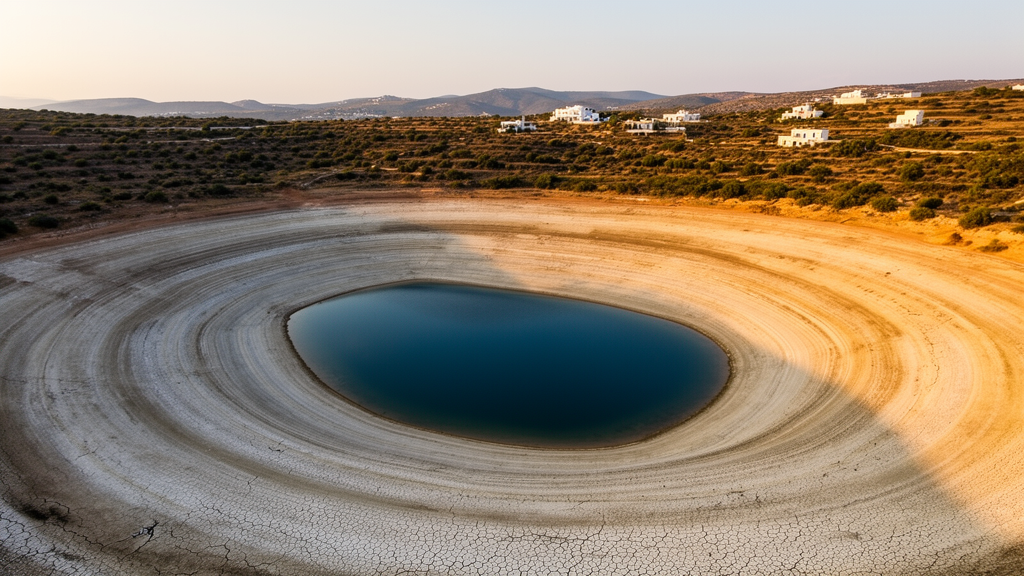
Greece is losing water, and it is not just the kind of water that vanishes from reservoirs and rivers during a hot summer. A new study published in Theoretical and Applied Climatology shows that the country’s total land water storage, the combined sum of groundwater, soil moisture, surface water, and other reservoirs of freshwater, has been in a generalized decline over more than two decades. The finding comes not from rain gauges or well measurements, but from a pair of satellites that weigh the Earth from orbit, and it paints a picture of a Mediterranean nation whose water supplies are being drained faster than nature can refill them.
The research, carried out by Dimitrios Tsoulis and Charalampos Chaidas of the Department of Geodesy and Surveying at Aristotle University of Thessaloniki, covers the period from 2002 to 2025 and relies on data from NASA’s Gravity Recovery and Climate Experiment, known as GRACE, and its successor mission GRACE Follow-On. These twin-satellite systems measure tiny variations in Earth’s gravity field caused by the movement of water across the planet’s surface. When a region gains water, its mass increases slightly and the satellites detect a marginally stronger gravitational pull; when water is lost, the signal weakens. By tracking these minute gravitational fluctuations month after month, scientists can estimate changes in terrestrial water storage with a precision that no ground-based network of wells and gauges can match over large regions.
To translate the raw gravity data into a usable drought indicator, the researchers combined the GRACE and GRACE-FO observations with the GLDAS land surface model, which simulates the exchange of water and energy between the land and the atmosphere. From this fusion they computed two satellite-based drought metrics: the GRACE Drought Severity Index, or GRACE-DSI, and the GRACE-based Groundwater Drought Index, known as GGDI. These were then compared against the conventional drought indices that hydrologists have used for decades, including the Standardized Precipitation Index, the Standardized Precipitation Evapotranspiration Index, and the Standardized Runoff Index. Each of the traditional indices captures a different slice of the drought story, from rainfall deficits to the balance between precipitation and atmospheric demand for water, but none of them sees the full picture of what is actually stored beneath the surface.
The comparison produced one of the study’s most striking results. The GRACE-based indicators recorded a greater frequency and persistence of droughts in Greece than the conventional indices did. In other words, the satellites saw droughts that the traditional metrics missed, and they found that once a drought set in, it tended to linger longer than the rainfall-based measures suggested. This matters because drought is not simply a matter of a dry month or a hot spell. It is a slow-moving deficit that accumulates in aquifers and soils, and indices built only on precipitation can underestimate how deeply and how long a region’s water reserves have been depleted.
Behind the trend in total storage, the study identified the main culprits: groundwater depletion and declining soil moisture. Groundwater is the invisible backbone of Mediterranean water security, supplying agriculture, households, and ecosystems during the dry months when surface sources dwindle. When aquifers are pumped faster than rainfall can recharge them, the loss shows up unmistakably in the gravity record. The fact that soil moisture reduction also emerged as a key driver points to a double burden, in which less water infiltrates the ground and what does infiltrate is increasingly drawn down by evaporation in a warming climate.
The spatial pattern of the decline was equally revealing. The strongest negative changes in water storage were found in the continental regions of Greece, the inland basins and plains where agriculture concentrates and where aquifers have historically been exploited most intensively. This geography is consistent with earlier research on Greek aquifers, which has documented overexploitation in several major basins, including the Thessaly plain and the Lake Karla region, where decades of intensive abstraction have led to well-documented water table declines. The satellite record now places those local observations into a national, two-decade-long context, showing that the problem is not confined to a handful of stressed basins but is part of a broader, systematic trend.
To understand what was driving the variability in water storage, the researchers turned to wavelet analysis, a mathematical technique that examines how the relationship between two time series changes across both time and frequency. Unlike classical correlation, which assumes a relationship is stable over the entire record, wavelet coherence can reveal whether two variables move together only during certain periods or at certain rhythms, such as the annual cycle. Applied to the GRACE storage data and the hydrometeorological variables from the ERA5 reanalysis, the analysis showed that temperature and evapotranspiration were the most important factors affecting the variability of water storage in Greece. This is a significant finding, because it means the fate of Greek water reserves is increasingly governed not by how much rain falls, but by how hot it gets and how much water the atmosphere pulls out of the land.
ERA5, the reanalysis product of the Copernicus Climate Change Service, provided the atmospheric side of the equation. A reanalysis combines historical observations with a numerical weather model to produce a physically consistent record of past climate, and ERA5 offers monthly fields of air temperature, precipitation, potential evaporation, and surface runoff across the entire globe. By pairing this with ground-based precipitation and temperature observations from the Hellenic National Meteorological Service, the researchers could anchor their satellite-derived storage changes in the actual climatic conditions of the period. The consistency between the space-based gravity measurements and the independent meteorological data strengthens confidence that the observed decline is real rather than an artifact of any single dataset.
The study also examined drought persistence using Markov chain analysis, a statistical framework that treats drought classes as states and estimates the probabilities of transitioning between them. If a region is in drought this month, a Markov chain can quantify the likelihood that it will remain in drought the following month, revealing how sticky, or persistent, drought conditions tend to be. Combined with the wavelet coherence analysis, this approach showed that the satellite-based drought indices captured a more persistent drought regime than the conventional indices, reinforcing the conclusion that water storage deficits in Greece are not fleeting anomalies but conditions that build up and hold on.
The implications extend well beyond Greece. The Mediterranean is one of the regions identified by the Intergovernmental Panel on Climate Change as a climate change hotspot, where warming is projected to outpace the global average and where water scarcity is expected to intensify. What the Greek case demonstrates is that the traditional toolkit for monitoring drought, built largely on precipitation and temperature records, may systematically understate the severity and duration of hydrological drought in a warming world. Satellite gravimetry offers a way to close that gap, providing an integrated measure of the water actually available in the ground rather than the water that merely falls from the sky. As the GRACE and GRACE-FO archives continue to grow, and as similar analyses are extended to other water-stressed regions, the ability to weigh a nation’s water supplies from orbit may become one of the most important tools in managing the slow, invisible crisis of groundwater depletion that is unfolding across the Mediterranean and far beyond it.
Subject of Research: Satellite-based assessment of long-term terrestrial water storage decline and drought dynamics in Greece
Article Title: Assessing long-term water storage and drought relationships under climate variability using GRACE/GRACE-FO and ERA5 data
Article References: Assessing long-term water storage and drought relationships under climate variability using GRACE/GRACE-FO and ERA5 data. (n.d.). https://doi.org/10.1007/s00704-026-06542-y
Image Credits: AI Generated
DOI: 10.1007/s00704-026-06542-y
Keywords: GRACE, GRACE-FO, drought, Greece, groundwater depletion, terrestrial water storage, ERA5, Mediterranean climate, soil moisture, wavelet analysis, Markov chain, water resources
Cite Scienmag News
Violet Maxwell. (October 8, 2026). Satellites Reveal Greece Is Quietly Running Out of Water. Scienmag. https://scienmag.com/satellites-reveal-greece-is-quietly-running-out-of-water/
Violet Maxwell. "Satellites Reveal Greece Is Quietly Running Out of Water." Scienmag, 8 October 2026, https://scienmag.com/satellites-reveal-greece-is-quietly-running-out-of-water/. Accessed 8 October 2026.
Violet Maxwell. "Satellites Reveal Greece Is Quietly Running Out of Water." Scienmag. October 8, 2026. https://scienmag.com/satellites-reveal-greece-is-quietly-running-out-of-water/


