


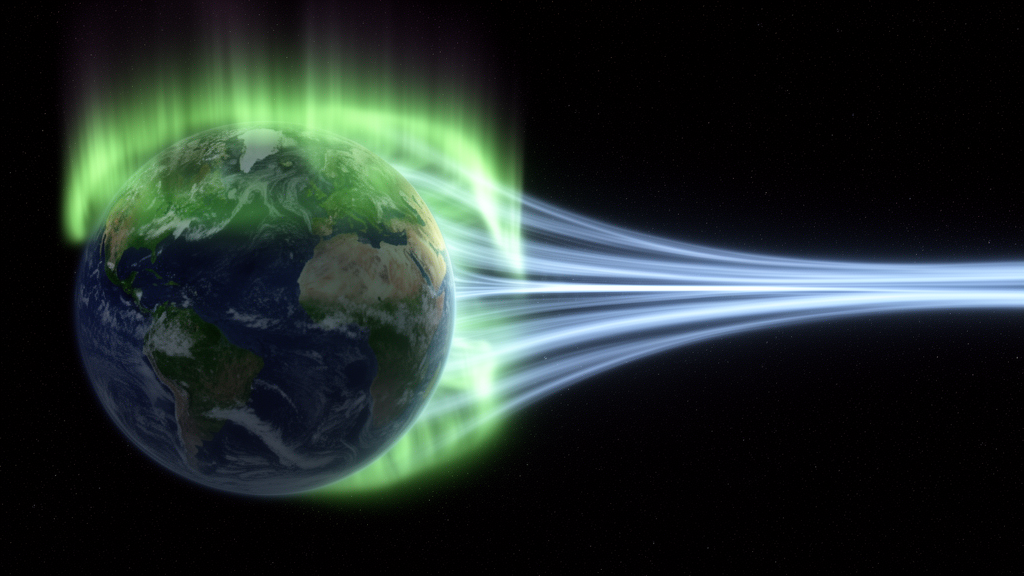
On the evening of 7 December 2023, a remarkable alignment of spacecraft, ground magnetometers and all-sky cameras over northern Fennoscandia captured something space physicists had long suspected but rarely witnessed in such detail: a sequence of fast plasma jets surging earthward through Earth’s magnetotail, each one kicking the upper atmosphere, until the accumulated disturbances finally tipped the system into a full-blown auroral substorm. A new case study published in Annales Geophysicae by Vanina Lanabere of the Swedish Institute of Space Physics and an international team of collaborators dissects this four-hour drama, revealing how small, transient events in the distant magnetic tail can stack up into a large-scale magnetic disruption visible from the ground.
The jets in question are known as bursty bulk flows, or BBFs. They form when magnetic reconnection snaps stretched, energy-laden field lines in the magnetotail, the long nightside extension of Earth’s magnetic field. The newly reconnected flux tubes contract earthward under magnetic tension, accelerating plasma toward the inner magnetosphere at hundreds of kilometers per second. Each jet typically carries a dipolarization front, a boundary where the magnetic field abruptly snaps back toward a more dipolar, compressed geometry. Together, BBFs and their dipolarization fronts are thought to transport a large fraction of the energy and momentum that ultimately powers auroras and disturbs ground-based technology.
Between 18:00 and 22:00 UT on that December evening, the three inner THEMIS probes, positioned in the near-Earth plasma sheet, detected six distinct BBF intervals, with clear dipolarization signatures in the last four. Crucially, the magnetic footpoints of these flows, traced down the field lines to an altitude of 110 kilometers, mapped into the pre-midnight sector directly over northern Fennoscandia, an exceptionally well-instrumented patch of the auroral zone. There, the IMAGE magnetometer network, all-sky cameras at Skibotn and Kilpisjärvi, and the low-altitude Swarm A and C satellites stood ready to record whatever the tail threw at the ionosphere.
At the start of the interval, the team found the ionospheric current system in a stable configuration known as the Harang discontinuity, a boundary region where eastward and westward currents meet and turn northward. With each successive BBF arrival, this configuration became progressively distorted. The mapped footpoint of each flow landed in a region of counterclockwise vorticity in the horizontal equivalent current, the signature expected above an upward field-aligned current. Current magnitudes shifted within seconds to minutes, an auroral arc brightened in step with the flow detection, and the familiar Harang pattern gradually gave way to a clear, intensifying westward electrojet, the strong westward current channel that characterizes substorm expansion.
The escalation followed a striking progression. The first two dipolarizing intervals produced only auroral pseudo-breakups, modest brightenings of pre-existing arcs that shared some morphology with substorms but never developed the poleward expansion and global current reconfiguration of the real thing. The final two intervals, by contrast, displayed textbook auroral breakups with poleward expansion, classified as genuine substorms by the SOPHIE technique applied to SuperMAG ground data. In the last event, THEMIS measured a flow peaking at 605.5 kilometers per second, the westward electrojet surged and expanded, and the aurora bifurcated, brightened and raced poleward in near-perfect synchrony with the magnetotail signatures.
The scientific centerpiece of the study came during the fourth BBF, when the Swarm A and C satellites, flying side by side at roughly 480 kilometers altitude, crossed the mapped footpoint of the flow within minutes of its detection in the tail. Both spacecraft recorded a sharply localized pair of upward and downward field-aligned currents spanning only 35 to 50 kilometers in latitude, with current densities exceeding 1 microampere per square meter and peaks reaching 6.2 microamperes per square meter. The upward current sat directly beneath a discrete auroral arc, and the arc intensified at the very moment the current was measured. Notably, the dual-satellite method, which resolves only structures larger than about 150 kilometers, smoothed this narrow pair away entirely, showing that the finest structure of the BBF current system can only be captured by single-spacecraft measurements.
A multiscale minimum variance analysis of the Swarm magnetic data added further texture. The downward current proved planar and east-west aligned, while the upward current was distinctly non-planar and inclined away from the east-west direction, exactly the geometry predicted for the field-aligned currents flanking an earthward-moving plasma bubble. The team also tracked enhancements of 9 to 20 kiloelectronvolt electron fluxes in the tail that coincided with each arc brightening, suggesting these electrons, channeled along field lines, were sufficient to produce the auroral light without requiring additional acceleration closer to Earth.
The study also quantified the space weather consequences. Rapid variations of the horizontal ground magnetic field, the quantity that drives geomagnetically induced currents in power grids, spiked simultaneously with each of the last four dipolarizations, with peak amplitudes growing as the sequence progressed. The largest perturbation reached 213 nanotesla per minute at Tromsø, a value comparable to peaks reported in a recent catalog of events associated with actual power-grid disturbances, though the geophysical conditions in this case were milder. Maps of the Rate-Of-TEC-Index, a measure of ionospheric electron-density irregularities that degrade GPS signals, intensified in step with each dipolarization, peaking near 67 to 69 degrees north, right at the BBF footprints.
Taken together, the observations provide the first direct, multi-instrument picture of a coherent, time-aligned chain of coupling signatures linking recurrent magnetotail flows to the high-latitude ionosphere: localized vorticity in ionospheric currents, discrete arc brightenings, field-aligned current pairs on arc scales, and cumulative escalation toward substorm onset. The results lend strong support to the wedgelet picture of the substorm current wedge, in which many small current elements generated by individual flow bursts superpose to build the large-scale current system traditionally attributed to a single monolithic structure. For space weather forecasting, the message is sobering: even in the absence of a full substorm, BBFs with strong dipolarization fronts can generate localized, sharp perturbations capable of stressing technological systems, which means the small, fast events in the tail deserve attention in their own right.
Subject of Research: Magnetotail bursty bulk flows, dipolarization fronts, and their coupling to ionospheric currents and auroras during a substorm sequence
Article Title: Ionospheric currents and auroral signatures during successive earthward bursty bulk flows and dipolarization: a 7 December 2023 case study
Article References: Lanabere, V., Buchert, S., Blagau, A., George, H., Nanjo, S., Juusola, L., Dimmock, A. P., Wharton, S., Vanhamäki, H., Marghitu, O., Richard, L., Cai, L., Wallner, A. V. L., Kotova, D., Jin, Y., Hoppe, T., Carter, J. A., & Aikio, A. (2026). Ionospheric currents and auroral signatures during successive earthward bursty bulk flows and dipolarization: a 7 December 2023 case study. Annales Geophysicae, 44(2), 977-1001. https://doi.org/10.5194/angeo-44-977-2026
Image Credits: AI Generated
DOI: 10.5194/angeo-44-977-2026
Keywords: bursty bulk flows, dipolarization, magnetotail, ionosphere, field-aligned currents, aurora, substorm, THEMIS, Swarm, space weather, geomagnetically induced currents, Fennoscandia
Cite Scienmag News
Violet Maxwell. (October 8, 2026). Fast Plasma Jets in Earth’s Magnetic Tail Build Up to Full Auroral Substorms, Case Study Shows. Scienmag. https://scienmag.com/fast-plasma-jets-in-earths-magnetic-tail-build-up-to-full-auroral-substorms-case-study-shows/
Violet Maxwell. "Fast Plasma Jets in Earth’s Magnetic Tail Build Up to Full Auroral Substorms, Case Study Shows." Scienmag, 8 October 2026, https://scienmag.com/fast-plasma-jets-in-earths-magnetic-tail-build-up-to-full-auroral-substorms-case-study-shows/. Accessed 8 October 2026.
Violet Maxwell. "Fast Plasma Jets in Earth’s Magnetic Tail Build Up to Full Auroral Substorms, Case Study Shows." Scienmag. October 8, 2026. https://scienmag.com/fast-plasma-jets-in-earths-magnetic-tail-build-up-to-full-auroral-substorms-case-study-shows/


