


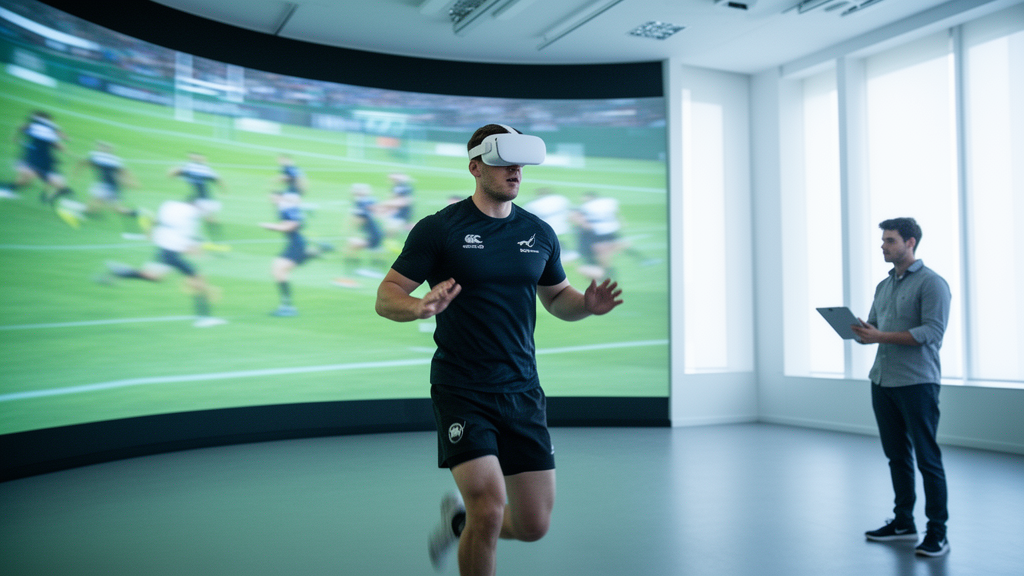
Professional rugby players who scored a try in a virtual replica of a packed stadium did not just feel as if they were there. In a new experiment, they measurably shifted who they thought they were. When virtual teammates rushed to congratulate them, sang their club anthem from the stands and gathered around them in a huddle, the players reported a sharp rise in social identity — the sense of being a “we” rather than an “I” — along with a surge of pleasant, high-arousal emotion. When the same try was framed as a purely personal triumph, with supporters waving signs bearing the player’s own name and teammates standing indifferently nearby, almost nothing changed. The study, published in PLOS One by Solène Neyret of the Arts et Metiers Institute of Technology and colleagues, demonstrates for the first time that identity levels can be deliberately switched on and measured in elite athletes without ever breaking the spell of immersion.
The theoretical backbone of the work is the Social Identity Approach, a long-standing framework in social psychology which holds that people can perceive themselves at different levels: as unique individuals or as members of a group. Which level is salient at any moment changes how information from the environment is processed. A player who identifies strongly with the team treats what benefits the group as benefiting the self, and prior research has repeatedly linked higher social identity to more pleasant affective states in athletes. Because emotions in sport are deeply tied to these self-categorisation processes, the authors argue that coaching staff need tools to help athletes manage identity-driven emotional fluctuations — and that virtual reality, with its capacity to recreate emotionally charged game contexts on demand, is an ideal laboratory for doing so.
Recreating one of rugby’s most emotionally loaded moments was the team’s central design challenge. They chose the try. Forty male professional and aspiring professional players from three French clubs, with an average age of about 21, were fitted with an HTC Vive Pro head-mounted display and five body trackers — one on each hand, one on each foot and one below the navel — so that their real movements drove their virtual body in real time. The virtual environment, built in Unity3D, reproduced the Stade de France, complete with a giant screen, customised club colours and flags, and a crowd whose chants and songs were mixed from real recordings, including footage captured at a 2021 Autumn Nations Series match in Bordeaux. The congratulatory voices of the virtual teammates were recorded by researchers using a script written with an actual rugby player, so that the shouts echoing across the pitch matched what players genuinely say after a score.
Before anything happened, each participant went through an embodiment phase. Standing alone on an empty virtual pitch, they watched their avatar — a generic rugby player model whose skin colour had been matched to their own — reflected in a virtual mirror while moving their arms and legs. This visuo-motor synchrony is a well-established trigger for the body ownership illusion, the sensation that a virtual body is one’s own, which arises from the brain’s multisensory integration of visual and motor signals. Previous work shows that once people experience ownership over an avatar, they accept it as a partial representation of themselves even when it does not resemble them. Only after this foundation was laid did the experiment proper begin: participants were told they had just scored, and the two-minute try scene unfolded around them.
The experiment used a within-subjects design, so every player experienced both conditions. In the collective condition, the stadium announcer declared that the player’s team had scored, supporters held signs reading “GO” followed by the team’s name, a replay of the try played on the giant screen beneath the club logo, and virtual teammates sprinted in to celebrate before forming a huddle at centre field while the captain delivered a motivational speech. In the individual condition, the announcer named the player personally, supporters waved signs with his own name, his photo replaced the team logo on the big screen, and his teammates — dressed in neutral colours — ignored him entirely. The question was whether these carefully engineered social cues could steer the players’ sense of self in opposite directions.
Measuring the answer without destroying the illusion required a genuine technical innovation. Traditionally, presence and embodiment are assessed with questionnaires filled in after immersion, forcing participants to reconstruct fading memories. Asking questions mid-immersion, meanwhile, risks shattering presence the moment a floating questionnaire appears. The team’s solution was the “transparent bubble”: when a measurement was needed, the surrounding environment darkened, ambient sounds were toned down and the depth of field shifted, giving players the impression of being inside a soap bubble. A two-metre-long visual analogue scale, or a 9-by-9 affect grid adapted from Russell’s classic measure, materialised sixty centimetres in front of them at chest height, and they moved a yellow cursor with their virtual hand. Identity was probed with three instruments: a scalar scale for social identity (“I feel like a member of my team”), a scalar scale for personal identity, and a bipolar scale forcing a trade-off between the two.
The results were strikingly one-sided. In the collective condition, social identity rose by roughly 14 percent, from a mean of 73.1 to 83.1 on the 0-to-100 scale, while personal identity fell by nearly 30 percent, from 45.3 to 31.9. The bipolar identity scale swung toward the group by about 24 percent. Affective valence climbed from 77.3 to 87.5 and arousal from 64.6 to 79.5, both statistically significant. In the individual condition, by contrast, none of these variables changed significantly — personal identity did not rise, arousal did not budge, and pleasant affect stayed flat. Linear mixed-effects models confirmed that neither rugby expertise nor prior VR experience explained these shifts, ruling out the possibility that only VR-savvy or less elite players were susceptible.
The immersion metrics added an unexpected twist. Place illusion — the sensation of genuinely being on the pitch — increased significantly in the collective condition, from 69.8 to 80.3, and co-presence, the feeling of sharing the field with one’s teammates, was far higher there (a mean of 80.3) than in the individual condition (59.3). The authors interpret this through the lens of predictive processing: the virtual teammates behaved exactly as real teammates would, matching the players’ learned expectations of post-try rituals, and the synchronised human voices seemed to confirm that the space was genuinely shared with other agents. Intriguingly, professional players reported lower body ownership and place illusion than aspiring professionals, which the authors suggest may reflect experts’ heightened body awareness and sharper sensitivity to discrepancies between the simulation and the real stadiums they know intimately.
Perhaps the most conceptually important finding concerns how the two identity levels relate. In the collective condition they moved in opposite directions, consistent with classical self-categorisation theory, yet across conditions they behaved largely independently — social identity remained high even when the scene was engineered to spotlight the individual. The authors conclude that it is changes in social identity, not personal identity, that primarily drive athletes’ psychological experience in team sports, and that the failure of the individual condition suggests “being alone” is simply the absence of social cues rather than their symmetrical opposite. The study’s identity measures, while grounded in the literature, have not yet undergone full psychometric validation, and the authors call for physiological measures such as heart rate and electrodermal activity, gaze tracking, and cybersickness controls in future work.
Even with those caveats, the implications reach well beyond rugby. The transparent bubble technique offers social scientists a way to collect in-the-moment subjective data without ejecting participants from the very experience being measured — a meaningful advance for VR methodology across psychology. For practitioners, the study sketches a realistic path toward mental training programmes in which coaches and sport psychologists can dial specific identity cues up or down, recreating the emotional texture of a roaring stadium on a Tuesday afternoon. If emotions in team sport flow through identity, this experiment shows the tap can now, at least in part, be turned by design.
Subject of Research: Inducing and measuring social and personal identity in professional rugby players using immersive virtual reality
Article Title: Inducing and measuring identity levels in professional rugby players during immersion in an interactive virtual environment
Article References: Neyret, S., Pellet, J., Ryard, J., Campo, M., & Chardonnet, J.-R. (2026). Inducing and measuring identity levels in professional rugby players during immersion in an interactive virtual environment. PLOS One, 21(10), e0359964. https://doi.org/10.1371/journal.pone.0359964
Image Credits: AI Generated
DOI: 10.1371/journal.pone.0359964
Keywords: virtual reality, social identity, rugby, sport psychology, embodiment, presence, co-presence, affect, body ownership illusion, mental training, team sports, visual analogue scales
Cite Scienmag News
Glenn Wilkins. (October 8, 2026). Virtual Reality Puts Rugby Players Inside the Try That Rewires Their Sense of Self. Scienmag. https://scienmag.com/virtual-reality-puts-rugby-players-inside-the-try-that-rewires-their-sense-of-self/
Glenn Wilkins. "Virtual Reality Puts Rugby Players Inside the Try That Rewires Their Sense of Self." Scienmag, 8 October 2026, https://scienmag.com/virtual-reality-puts-rugby-players-inside-the-try-that-rewires-their-sense-of-self/. Accessed 8 October 2026.
Glenn Wilkins. "Virtual Reality Puts Rugby Players Inside the Try That Rewires Their Sense of Self." Scienmag. October 8, 2026. https://scienmag.com/virtual-reality-puts-rugby-players-inside-the-try-that-rewires-their-sense-of-self/


