


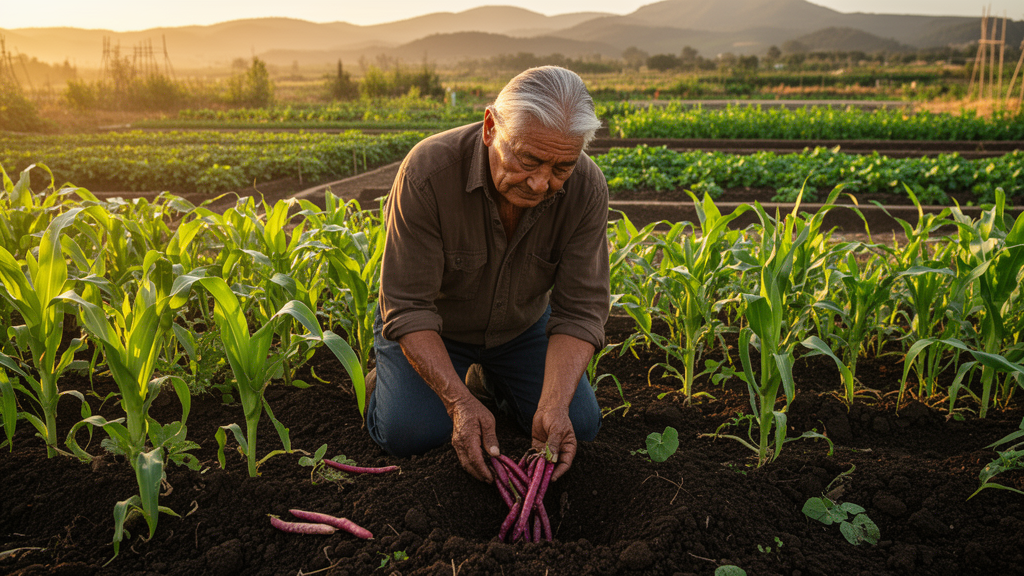
Across Southern Africa, the future of food may depend on knowledge that is centuries old. A new review published in Discover Sustainability argues that Indigenous Knowledge Systems, the accumulated ecological understanding of farming communities developed over generations, offer a scientifically credible and economically viable foundation for regenerative agriculture in a region where climate stress is steadily eroding crop production. The paper, authored by Albert Thembinkosi Modi of Walter Sisulu University in South Africa, synthesizes evidence from 37 publications examining how indigenous practices contribute to sustainable crop production across the subcontinent, and it reaches a conclusion that is likely to resonate far beyond the region: the convergence between indigenous knowledge and modern regenerative agriculture is not a romantic notion but a measurable, functional reality.
The context is stark. Agricultural production in Southern Africa is increasingly constrained by climate variability, declining soil fertility, water scarcity, biodiversity loss, and rising pest pressures. These pressures fall hardest on rain-fed smallholder farming systems, which dominate the region’s agricultural landscape and have little access to irrigation, synthetic inputs, or insurance against failed seasons. In such systems, a single drought or pest outbreak can wipe out a household’s food supply for a year. It is precisely within these vulnerable systems, Modi argues, that indigenous knowledge has been refined by necessity, producing context-specific approaches that align closely with the core principles of regenerative agriculture: building soil health, conserving water, enhancing biodiversity, and maintaining productivity under stress.
The review organizes its evidence around six pillars: soil health, soil biological activity, water-use efficiency, ecological pest regulation, crop productivity, and climate resilience. Across all six, the synthesis finds consistent support for indigenous regenerative practices. These include organic soil amendments such as manure and compost, the retention of crop residues on fields, crop diversification, intercropping, agroforestry, water harvesting, and botanical pest management. Each of these techniques, long practiced by smallholder communities, produces effects that modern soil science can now quantify. The evidence indicates that they improve soil organic carbon, enhance microbial activity, increase water retention, and stabilize yields under climatic stress.
The soil findings deserve particular attention. Soil organic carbon is the currency of soil fertility, governing water-holding capacity, nutrient availability, and the structural stability of the soil matrix. In degraded agricultural landscapes, rebuilding it is the central challenge of regenerative farming. The review shows that indigenous practices, especially organic amendments and residue retention, measurably raise soil organic carbon levels, and that this increase is accompanied by enhanced microbial activity. Soil microbes drive the decomposition and nutrient-cycling processes on which crops depend, and a biologically active soil is more resilient to both drought and disease. In effect, the review documents that indigenous farmers have been managing the soil microbiome for generations, long before the term entered the scientific lexicon.
Water is the second critical frontier. Southern Africa’s rain-fed agriculture lives or dies by how efficiently each drop of rainfall is captured, stored, and used. Indigenous water-harvesting techniques, which range from planting basins and mulching to landscape-scale runoff capture, increase water retention in the root zone and improve water-use efficiency. Combined with intercropping and agroforestry, which shade the soil and reduce evaporation, these practices allow crops to survive dry spells that would devastate conventionally managed fields. The review’s synthesis indicates that these water-focused practices contribute directly to the yield stability observed under climatic stress, a finding with obvious implications as climate models project increasingly erratic rainfall across the region.
Perhaps the most striking evidence concerns pest management. The review finds that indigenous pest management strategies frequently maintain pest populations below the economic injury threshold, the density of pests at which control measures become economically justified. This is a technical benchmark with real significance: it means that botanical pesticides, crop diversification, and ecological regulation by natural enemies are not merely reducing pesticide use as a matter of preference, but are actually keeping pest damage within tolerable limits. The result is reduced dependence on synthetic pesticides, lower input costs for farmers who can rarely afford them, and continued support for the ecosystem services, pollination, natural pest suppression, and nutrient cycling, that synthetic chemicals often undermine.
Modi frames these findings within a broader intellectual convergence. Indigenous Knowledge Systems, he writes, overlap substantially with agroecology, integrated pest management, conservation agriculture, and regenerative agriculture, four frameworks that have gained institutional momentum in international research and policy circles over recent decades. The overlap is not coincidental. All of these approaches reject the input-substitution logic of industrial agriculture in favor of ecological process management: diversifying crops rather than monocultures, feeding the soil rather than the plant, and regulating pests through ecosystem design rather than chemistry. Indigenous systems arrived at these principles empirically, through generations of trial, observation, and adaptation to local agroecosystems, which is exactly the kind of long-term, context-specific experimentation that formal agricultural science struggles to conduct.
The review does not stop at documentation. It proposes concrete pathways for integrating indigenous ecological indicators, the environmental cues that farmers use to time planting, anticipate rainfall, and detect pest risk, into formal decision-support systems, crop models, and precision agriculture technologies. Such integration could give modern digital tools the local sensitivity that indigenous observers have always possessed, while giving indigenous practices the quantitative validation and scalability that formal science can provide. The review also connects the work to the United Nations Sustainable Development Goals, arguing that indigenous regenerative agriculture contributes directly to Zero Hunger, Responsible Consumption and Production, Climate Action, and Life on Land, a mapping that positions the findings within the global policy agenda rather than the margins of ethnographic interest.
Yet the review is candid about its limits. Despite growing recognition of indigenous knowledge within sustainability and climate adaptation agendas, significant gaps remain in quantitative validation, longitudinal assessment, and integration into formal agricultural research and policy frameworks. Much of the existing evidence is observational or localized, and few studies have tracked the long-term performance of indigenous practices under controlled comparison. The 37 publications synthesized here represent a foundation, not a finished edifice. Modi’s argument is that closing these gaps requires genuine collaboration between knowledge systems, in which indigenous practitioners are treated as research partners rather than subjects, and in which scientific methods are used to test, refine, and scale practices rather than replace them.
The implications extend well beyond Southern Africa. The review’s conclusion, that Indigenous Knowledge Systems constitute a scientifically credible and economically viable foundation for regenerative agriculture, speaks directly to the broader Global South, where hundreds of millions of smallholder farmers face the same compound pressures of climate change, soil degradation, and input scarcity. If the convergence documented here can be operationalized, through participatory research, policy support, and technology designed around indigenous indicators rather than imposed on them, the region’s oldest agricultural traditions may prove to be its most modern asset. As the author acknowledges, the foundation of this evidence is the indigenous farming communities of Southern Africa themselves, whose generational engagement with local ecosystems produced the practices now being recognized as a blueprint for resilience. The task ahead, the review suggests, is not to invent sustainable agriculture from scratch, but to listen to those who have been practicing it all along.
Subject of Research: Integration of Indigenous Knowledge Systems into regenerative agriculture for sustainable crop production in Southern Africa
Article Title: Integrating indigenous knowledge systems into regenerative agriculture for sustainable crop production in southern Africa
Article References: Modi, A. T. (2026). Integrating indigenous knowledge systems into regenerative agriculture for sustainable crop production in southern Africa. Discover Sustainability. https://doi.org/10.1007/s43621-026-04926-8
Image Credits: AI Generated
DOI: 10.1007/s43621-026-04926-8
Keywords: indigenous knowledge, regenerative agriculture, soil health, climate resilience, agroecology, smallholder farming, water-use efficiency, pest management, Southern Africa, food security, sustainable development goals, soil organic carbon
Cite Scienmag News
Alan Morgan. (October 8, 2026). Ancient Indigenous Farming Wisdom Emerges as a Scientific Blueprint for Regenerative Agriculture. Scienmag. https://scienmag.com/ancient-indigenous-farming-wisdom-emerges-as-a-scientific-blueprint-for-regenerative-agriculture/
Alan Morgan. "Ancient Indigenous Farming Wisdom Emerges as a Scientific Blueprint for Regenerative Agriculture." Scienmag, 8 October 2026, https://scienmag.com/ancient-indigenous-farming-wisdom-emerges-as-a-scientific-blueprint-for-regenerative-agriculture/. Accessed 8 October 2026.
Alan Morgan. "Ancient Indigenous Farming Wisdom Emerges as a Scientific Blueprint for Regenerative Agriculture." Scienmag. October 8, 2026. https://scienmag.com/ancient-indigenous-farming-wisdom-emerges-as-a-scientific-blueprint-for-regenerative-agriculture/


