


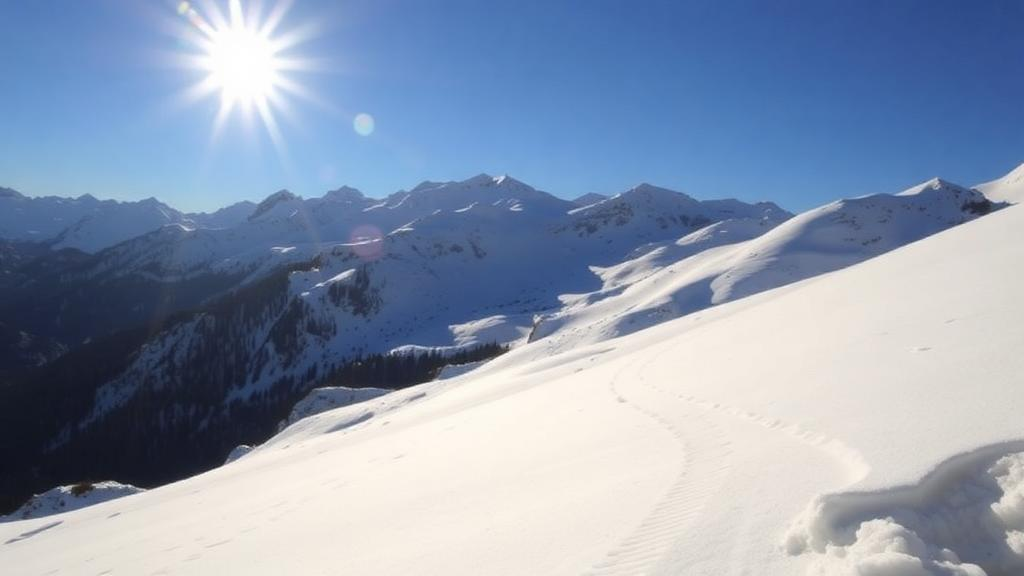
High in the Swiss Alps, the surface of a melting snowfield slowly transforms into something that looks almost sculpted: a field of rounded, cup-shaped hollows separated by smooth ridges, known to glaciologists as suncups. These features are far more than a curiosity of spring. New research published in The Cryosphere shows that suncups play a measurable and previously underappreciated role in darkening snow, reducing the fraction of sunlight it reflects and thereby accelerating the very melt that creates them. Over three consecutive ablation seasons at the Weissfluhjoch research station near Davos, a team led by Francesca Carletti of the WSL Institute for Snow and Avalanche Research used an automated terrestrial laser scanner to track the birth, growth, and radiative consequences of these hollows at hourly resolution, producing the most temporally extensive record of natural suncup roughness ever assembled.
The physics of why suncups darken snow rests on two distinct optical mechanisms. The first is the effective-angle effect: on a rough surface, some facets tilt toward the sun and receive light at a steeper incidence angle than a flat surface would, absorbing more energy, while other facets fall into shadow or catch only grazing illumination and contribute little to the reflected flux. The second is multiple reflections: photons that strike the inside of a concave hollow tend to bounce between its walls rather than escape, and with each collision the probability of absorption rises. This photon-trapping effect is strongest where snow albedo hovers near 0.5, typically in the near-infrared part of the spectrum, and it operates under both direct sunshine and diffuse overcast light. Together, these mechanisms mean that a rough, suncup-covered snowfield reflects measurably less solar radiation than a flat snowfield with identical grain properties.
But suncups do not act alone. As snow melts, light-absorbing particles such as black carbon and mineral dust are retained at the surface because percolating meltwater is inefficient at flushing them out, a process called melt amplification that can multiply surface concentrations by up to a factor of five during extreme events. In some years, blooms of the red snow alga Sanguina nivaloides add further darkening. The central difficulty, and the scientific puzzle the new study set out to address, is that suncup growth and impurity enrichment co-evolve: the same meltwater that deepens the hollows also washes dark particles into them, concentrating dirt in the concavities while leaving ridges relatively clean. Separating the optical signature of geometry from that of impurities on a natural snowfield has therefore remained one of the stubborn problems of snow optics.
The observational setup was deceptively simple in concept but demanding in execution. A fixed FARO Focus3D S120 laser scanner monitored roughly 300 square meters of snow surface adjacent to the Weissfluhjoch station, at 2,536 meters above sea level, scanning every hour through three melt seasons. After filtering out noise from snowfall and blowing snow, the team interpolated the point clouds into digital surface models on a five-millimeter grid, yielding nearly ten thousand surface reconstructions. From these they derived two complementary families of roughness descriptors: vertical measures anchored in the aerodynamic roughness length, the height at which the logarithmic wind profile extrapolates to zero, and horizontal measures based on the correlation length of surface height fluctuations, whose ratio reveals whether the relief is directionally organized or isotropic.
The time series revealed two sharply distinct roughness regimes. During the smooth phase, the horizontal index swung widely, often in sync with wind gusts, while the vertical roughness length barely moved above its one-millimeter baseline, indicating that wind-driven redistribution of dry snow was reshaping the surface without building vertical relief. The rough phase began on 11 May 2022, 22 May 2023, and 3 June 2024, and its onset required three concurrent conditions: sustained daytime surface melting, wet-bulb temperatures consistently above freezing, and reduced wind speeds. In every year, the transition occurred when the snow surface sat at zero degrees Celsius for roughly twenty hours per day and the snowpack held about two percent liquid water by volume. Because these thresholds can be detected with ordinary weather stations and snow models, the authors propose them as a practical diagnostic for flagging the shift from flat to rough surface conditions in energy balance schemes.
Suncups formed in all three seasons, but their geometry varied dramatically with the weather. In 2022, the most radiatively favorable year, with the highest net shortwave gains, the warmest wet-bulb temperatures, and the weakest winds, the hollows grew deep, small, circular, and evenly distributed, reaching an average depth of seven centimeters in a compressed seventeen-day window. In 2023, cooler and clearer conditions with remarkably steady northwesterly winds produced shallower but markedly elongated suncups aligned with the prevailing wind. In 2024, frequent cloud cover suppressed solar input and strong, highly variable winds favored turbulent ablation, yet suncups still formed, likely aided by exceptional Saharan dust deposition and a red algal bloom that insulated the surface locally. Deepening tracked the radiative energy balance, while orientation and elongation followed wind speed and directional constancy.
To quantify the optical consequences, the team compared measured broadband albedo from pyranometers against simulations from the TARTES radiative transfer model, forced with snow properties from the SNOWPACK model and run for a perfectly flat surface. After correcting for a systematic wet-snow bias in the simulations, the residual between measurement and flat-surface prediction isolated the combined signature of suncup roughness and impurities. That signature amounted to a broadband albedo reduction of 0.03 to 0.1, depending on illumination geometry and assumed impurity load, consistent with earlier controlled experiments and field campaigns in the Sierra Nevada and Finnish Lapland. Notably, the residual was roughly twice as large under diffuse overcast light as under direct sun, an asymmetry that suncup geometry alone cannot explain, since the effective-angle effect requires direct beam illumination and photon trapping peaks in the near-infrared where the overcast spectrum carries little weight. The excess instead points to visible-range absorption by impurities and algae, preferentially weighted under diffuse conditions.
Webcam imagery added a vivid clue to how the two darkening agents interact. Over early-stage suncups, impurities appeared spread homogeneously across the surface; as the hollows deepened, dark particles concentrated visibly into the concavities, leaving the exposed surface apparently cleaner despite likely higher total loading. The researchers propose that this even early distribution is particularly effective at accelerating albedo loss, because uniformly scattered absorbers raise the probability of absorption at every photon collision, whereas later clustering into hollows makes the loading spatially heterogeneous and may dampen its radiative impact. Aeolian transport contributed as well: dark rock debris blown from steep northwestern slopes dusted the upwind edge of the study plot, while years with southeasterly winds, which open onto the valley, showed far less debris.
The practical payoff of the study is a robust logarithmic relationship between broadband albedo and the aerodynamic roughness length, with a correlation strong enough to serve as a proxy for the combined roughness-impurity darkening regardless of their relative contributions. This matters because the roughness length evolves by a full order of magnitude through the ablation season, from about one millimeter to roughly fifteen millimeters, yet nearly all snow models hold it constant. Treating it as static misrepresents both the turbulent heat fluxes it governs directly and, through its link to albedo, the radiative fluxes it now demonstrably influences. The authors argue for an explicit, time-varying roughness length in physics-based snow models, and they point to a promising observational route: C-band radar backscatter from satellites such as Sentinel-1 is highly sensitive to early suncup development on wet snow, meaning a single remotely sensed roughness signal could constrain both the turbulent and radiative components of the surface energy balance precisely during the phase when each changes fastest.
As warming shortens the snow season across the world’s mountains, every feedback that hastens melt carries weight far beyond a single research plot. Seasonal snow can cover up to half of the Northern Hemisphere in winter, and even marginal albedo reductions ripple through the planetary energy budget. By showing that the humble, photogenic suncup is not merely a symptom of melting but an active amplifier of it, and by offering a single measurable quantity that captures its darkening effect, the Weissfluhjoch record gives snow scientists and modelers a new handle on one of the cryosphere’s most intricate feedback loops. The next step, the authors acknowledge, will require instruments that can track both surface geometry and impurity distribution across wavelengths at the same fine scale, a challenge that remains open, but the path toward roughness-aware snow models now has a clear empirical foundation.
Subject of Research: Seasonal evolution of suncup surface roughness and its control on broadband albedo decay of melting alpine snow
Article Title: Seasonal evolution of suncup roughness describes broadband albedo decay on alpine snow
Article References: Carletti, F., Helbig, N., Wever, N., Brouet, L., Bavay, M., Walter, B., & Lehning, M. (2026). Seasonal evolution of suncup roughness describes broadband albedo decay on alpine snow. The Cryosphere, 20(10), 5653-5673. https://doi.org/10.5194/tc-20-5653-2026
Image Credits: AI Generated
Keywords: suncups, snow albedo, surface roughness, aerodynamic roughness length, Swiss Alps, light-absorbing particles, black carbon, mineral dust, snow algae, LiDAR, SNOWPACK, TARTES
Cite Scienmag News
Sloane Callahan. (October 8, 2026). Suncups That Trap Sunlight Are Quietly Accelerating Alpine Snowmelt. Scienmag. https://scienmag.com/suncups-that-trap-sunlight-are-quietly-accelerating-alpine-snowmelt/
Sloane Callahan. "Suncups That Trap Sunlight Are Quietly Accelerating Alpine Snowmelt." Scienmag, 8 October 2026, https://scienmag.com/suncups-that-trap-sunlight-are-quietly-accelerating-alpine-snowmelt/. Accessed 8 October 2026.
Sloane Callahan. "Suncups That Trap Sunlight Are Quietly Accelerating Alpine Snowmelt." Scienmag. October 8, 2026. https://scienmag.com/suncups-that-trap-sunlight-are-quietly-accelerating-alpine-snowmelt/


