


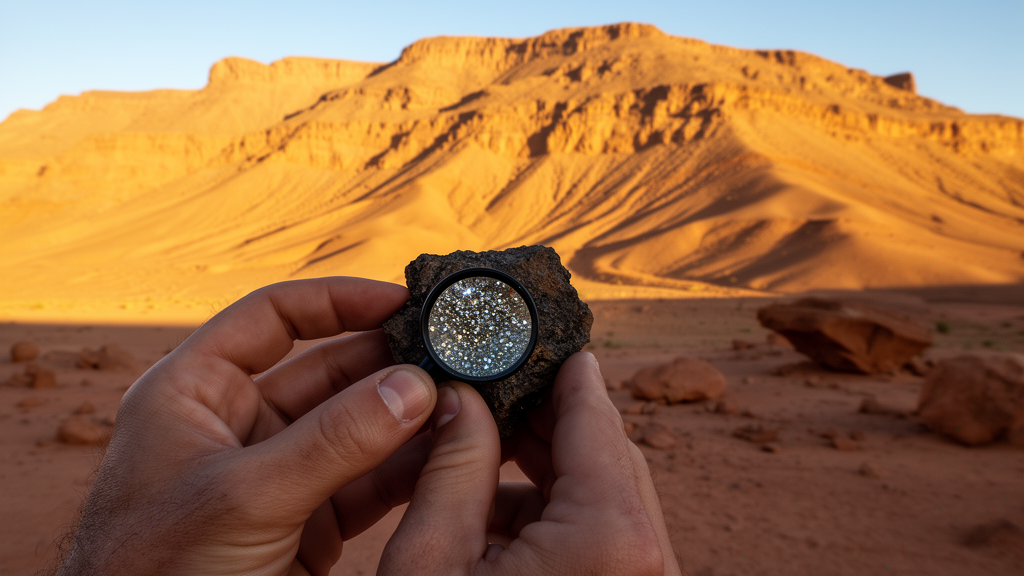
Deep in the Anti-Atlas Mountains of southern Morocco, a team of geologists has pieced together a 600-million-year-old story of colliding continents, collapsing mountain belts, and a hidden block of crust that may be far larger than anyone suspected. The new study, published in the journal Solid Earth, focuses on the Sirwa massif in the Central Anti-Atlas, where Ediacaran rocks between roughly 630 and 539 million years old record the final, turbulent chapters of the Pan-African Orogeny. By combining laser-ablation U-Pb zircon dating, whole-rock geochemistry, and samarium-neodymium isotopes, the researchers reconstructed how two successive rock groups, the Saghro Group and the overlying Ouarzazate Group, were formed in fundamentally different tectonic settings. Their findings carry implications that stretch well beyond Morocco, touching on the shape of the ancient supercontinent Gondwana and the true northern limit of the West African Craton.
The West African Craton is one of Earth’s great stable blocks of continental crust, and its northern margin has long been a battleground for geologists trying to understand how it was assembled into Gondwana. The Anti-Atlas belt preserves two major orogenic cycles: the roughly 2.2-billion-year-old Eburnean Orogeny in the west, and the Neoproterozoic Pan-African Orogeny, which culminated around 650 million years ago with the accretion of oceanic arc and ophiolite complexes such as those at Bou Azzer and Sirwa. A major structure called the Anti-Atlas Major Fault has traditionally been drawn as the boundary between the ancient Eburnean basement and the younger Pan-African terranes. Whether Paleoproterozoic crust extends north of that fault, however, has remained one of the most contested questions in the region, and it is precisely here that the new detrital zircon data deliver their most striking result.
The team analyzed a fine- to medium-grained greenish sandstone collected near the entrance of the Zgounder silver mine, part of the Imghi Formation of the Saghro Group. This unit consists of thick-bedded greywackes and graded turbidites, the classic deposits of deep-water sediment gravity flows. Of 138 laser-ablation analyses on 93 zircon grains, 90 were concordant, and the age spectrum turned out to be remarkably narrow. The youngest coherent cluster of grains yielded a maximum depositional age of 2025 million years, while the overall distribution is dominated by a single sharp peak at about 2100 million years, with one lone grain as old as 3700 million years. Crucially, not a single zircon younger than 1600 million years was found, despite the fact that Pan-African igneous rocks between 883 and 640 million years old are abundant in the surrounding Sirwa inlier and are commonly reported in Saghro Group sediments elsewhere.
That absence is the key. The narrow gap between the 2100-million-year peak and the 2025-million-year maximum depositional age suggests that the sediments were dumped into a basin flanked by an uplifted, pristine block of Eburnean basement that acted as the exclusive sediment source. The basin received no volcanic ash or erosional debris from the Ediacaran magmatism that was raging elsewhere in the belt. In other words, the Saghro Group basin in the Sirwa area was walled by 2.1-billion-year-old continental crust. Because the number of grains analyzed is well above the thresholds normally considered adequate for provenance work, the authors argue the result is robust rather than a sampling artifact. The implication is that Paleoproterozoic crust of the West African Craton extends beneath the Sirwa massif and continues northward beyond the Anti-Atlas Major Fault, possibly as far as the South Atlas Fault, which would shift the location of the definitive craton-margin suture zone significantly to the north.
The magmatic rocks tell an equally compelling story, in two acts. The first act belongs to the Saghro Group, whose mafic volcanic and intrusive rocks, basalts, basaltic andesites, dolerites, and a gabbro from the Tittalt Formation, define a calc-alkaline suite with a within-plate geochemical signature. On normalized multi-element diagrams they show enrichment in large-ion lithophile elements such as cesium, rubidium, barium, and potassium relative to high-field-strength elements, together with the negative niobium-tantalum and titanium anomalies that are the classic fingerprint of subduction-zone influence. Yet tectonic discrimination diagrams place them in the fields of continental tholeiites adjacent to back-arc basin basalts. The combination points to an early Ediacaran extensional phase in which advanced lithospheric thinning allowed asthenospheric decompression melting of a sub-continental lithospheric mantle that had been chemically fertilized, or metasomatized, by an earlier Cryogenian subduction event.
Isotopes reinforce this picture of a young, mantle-dominated magma system. The Saghro Group samples yield strongly positive initial epsilon-neodymium values of +3.2 to +4.6, calculated at a reference age of 620 million years, with depleted-mantle model ages of 1.02 to 0.91 billion years. A binary mixing model, using a metasomatized mantle end-member and a Paleoproterozoic crustal end-member with an epsilon-neodymium of about -16, indicates that the Saghro magmas contain 88 to 92 percent mantle-derived material and only 8 to 12 percent crustal input. These are among the most juvenile signatures known from the Ediacaran of the Anti-Atlas, and they suggest the back-arc basin was opening above a mantle source that had been only lightly contaminated by older crust, consistent with the thinning lithosphere of a maturing basin behind the Cadomian subduction zone that fringed the Gondwanan margin.
The second act is the Ouarzazate Group, and it could hardly be more different. New U-Pb zircon ages of 575 plus or minus 3 million years for a rhyolitic dike and 564 plus or minus 2 million years for a granite intersected in a drill hole at 555 to 568 meters depth bracket roughly 11 million years of post-collisional magmatism. These ages match, within uncertainty, a suite of previously dated intrusions in the Sirwa massif, including the Askaoun granodiorite, the Tikhfist rhyolite, and the Imourkhssen granite, indicating a rapid succession of intrusive events. Geochemically, the Ouarzazate rocks form a high-K calc-alkaline to shoshonitic, felsic-to-intermediate series with silica contents reaching nearly 80 weight percent, pronounced negative europium anomalies, and strong depletion in strontium, phosphorus, niobium, tantalum, and titanium, the hallmarks of extensive plagioclase and accessory-mineral fractionation combined with a strongly crustal source.
The isotopic contrast between the two groups is stark. Ouarzazate Group rocks cluster near or below the chondritic reference line, with initial epsilon-neodymium values between -0.8 and +1.1 and model ages of 1.30 to 1.15 billion years, far older than their crystallization ages. The mixing model quantifies the shift: crustal contributions rise from about 15 percent in a granodiorite to 25 percent in a rhyolite. Without such contamination, a purely mantle-derived magma at 570 million years ago would be expected to show epsilon-neodymium values of +7 to +8, so the near-zero values represent a major isotopic pull from ancient basement. A single inherited zircon grain of 2156 plus or minus 54 million years in the granite provides direct physical evidence of that reworking, matching widespread Paleoproterozoic inheritance reported in Ouarzazate ignimbrites and granites across the Anti-Atlas.
Putting the pieces together, the authors propose a coherent geodynamic sequence. Around 630 to 600 million years ago, the Saghro Group sediments and their associated calc-alkaline mafic magmas accumulated in a back-arc basin whose shoulders were built of uplifted 2.1-billion-year-old Eburnean crust. As the basin matured, magmas progressively tapped deeper, less contaminated asthenospheric reservoirs, a transition mirrored by the rift-tholeiite, ocean-island-basalt, and mid-ocean-ridge-basalt signatures seen in basalts higher in the Saghro stratigraphy at Sidi Flah and Boumalne. Then, in the late Ediacaran, the tectonic regime flipped. Lithospheric delamination and possible slab break-off injected a thermal pulse into the lower continental crust, triggering widespread melting of both the crust and a subduction-modified lithospheric mantle. The result was a massive flare-up of silicic volcanism and plutonism, part of a Silicic Large Igneous Province recognized across the Anti-Atlas, whose A2-type granites and shoshonitic ignimbrites record post-collisional crustal collapse on the fractured, metacratonic margin of the craton.
Beyond rewriting the tectonic map of northwest Gondwana, the study has practical resonance. The Zgounder deposit, one of Morocco’s most important silver mines, sits within exactly this Ediacaran magmatic framework, and the same extensional structures that channeled deep-sourced magmas upward also focused mineralizing fluids. More broadly, the work demonstrates how a single handful of detrital zircons, when read carefully, can relocate a continental suture by hundreds of kilometers and reveal that the craton beneath modern Morocco is far more extensive than its surface outcrops suggest. As similar isotopic and geochronological toolkits are applied to other contested craton margins around the world, hidden blocks of ancient crust may well continue to surface from the sedimentary record itself.
Subject of Research: Petrogenesis and geodynamic setting of Ediacaran sedimentary and magmatic rocks in the Sirwa massif, Central Anti-Atlas, Morocco
Article Title: Petrogenesis and geodynamic setting of Ediacaran rocks from the Sirwa massif, Central Anti-Atlas of Morocco
Article References: Ben-Tami, A., Belkacim, S., El Kabouri, J., Baidada, B., Davies, J. H. F. L., Perrot, M. G., Bhilisse, M., Assalmi, M., Ferraq, M., & Bouabdellah, M. (2026). Petrogenesis and geodynamic setting of Ediacaran rocks from the Sirwa massif, Central Anti-Atlas of Morocco. Solid Earth, 17(9), 1063-1086. https://doi.org/10.5194/se-17-1063-2026
Image Credits: AI Generated
Keywords: Anti-Atlas, Morocco, Ediacaran, detrital zircons, U-Pb geochronology, West African Craton, Pan-African Orogeny, back-arc basin, post-collisional magmatism, Sm-Nd isotopes, Saghro Group, Ouarzazate Group
Cite Scienmag News
Violet Maxwell. (October 8, 2026). Ancient zircons in Morocco reveal hidden crust beneath the Atlas and a vanished volcanic province. Scienmag. https://scienmag.com/ancient-zircons-in-morocco-reveal-hidden-crust-beneath-the-atlas-and-a-vanished-volcanic-province/
Violet Maxwell. "Ancient zircons in Morocco reveal hidden crust beneath the Atlas and a vanished volcanic province." Scienmag, 8 October 2026, https://scienmag.com/ancient-zircons-in-morocco-reveal-hidden-crust-beneath-the-atlas-and-a-vanished-volcanic-province/. Accessed 8 October 2026.
Violet Maxwell. "Ancient zircons in Morocco reveal hidden crust beneath the Atlas and a vanished volcanic province." Scienmag. October 8, 2026. https://scienmag.com/ancient-zircons-in-morocco-reveal-hidden-crust-beneath-the-atlas-and-a-vanished-volcanic-province/


