


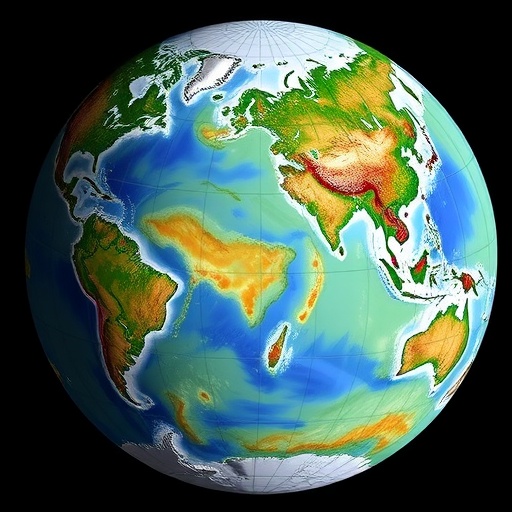
Marine primary productivity—the engine that supports marine food webs and draws down carbon dioxide—may have been overestimated for decades, according to a new analysis that reconsiders how Earth-observing satellites translate light into biological output. The study, published in Commun Earth & Environment, argues that the global ocean’s total production has been lower than widely reported, while production has shifted in where it occurs across hemispheres during the satellite era.
Using satellite-derived proxies for chlorophyll and photosynthetic capacity, the authors reassessed the relationship between observed optical signals and marine carbon fixation. They report that the standard conversion pathways can introduce systematic biases, particularly when the same assumptions are applied across diverse water types and seasonal regimes.
A central result is a “reduced estimate” of global marine primary productivity, suggesting that earlier reconstructions may have amplified productivity by effectively scaling up the carbon implied by optical measurements. The team also finds evidence of hemispheric redistribution: production appears to have moved, not uniformly changed, with different regions showing contrasting trends over the period covered by satellites.
To support these conclusions, the researchers compare modeled and observational constraints across time, focusing on how satellite-era retrievals align with known physical drivers such as nutrient availability and mixed-layer dynamics. Because primary productivity depends on both light and the supply of nutrients to surface waters, any mismatch in how satellites capture changing ocean conditions can translate into persistent errors in estimated carbon fixation.
The implications are significant for climate and ecosystem projections. If the baseline productivity used to calibrate Earth system models is too high, then estimates of how effectively the ocean absorbs anthropogenic carbon could also be skewed. Likewise, shifts in where productivity occurs can affect fisheries productivity, marine biogeochemical cycling, and oxygen dynamics, with downstream effects for biodiversity.
The authors emphasize that improving satellite-to-biology translation requires more robust treatment of uncertainties, including water-column properties, atmospheric corrections, and the ecological variability that links chlorophyll signatures to photosynthetic rates. They call for continued refinement of algorithms and cross-validation with in-situ measurements to close the gap between observed light and biological carbon production.
By reframing the satellite-era record, the work highlights a broader lesson for “viral” science narratives: when remote sensing is used to infer complex ecosystems, calibration choices matter as much as the data themselves. As new satellite missions expand coverage and resolution, the field will need to ensure that productivity estimates reflect not only what satellites see, but what ocean biology is truly doing.
Cite Scienmag News
Violet Maxwell. (July 28, 2026). Satellite era shows reduced global marine primary productivity and shifted hemispheres. Scienmag. https://scienmag.com/satellite-era-shows-reduced-global-marine-primary-productivity-and-shifted-hemispheres/
Violet Maxwell. "Satellite era shows reduced global marine primary productivity and shifted hemispheres." Scienmag, 28 July 2026, https://scienmag.com/satellite-era-shows-reduced-global-marine-primary-productivity-and-shifted-hemispheres/. Accessed 3 September 2026.
Violet Maxwell. "Satellite era shows reduced global marine primary productivity and shifted hemispheres." Scienmag. July 28, 2026. https://scienmag.com/satellite-era-shows-reduced-global-marine-primary-productivity-and-shifted-hemispheres/


