


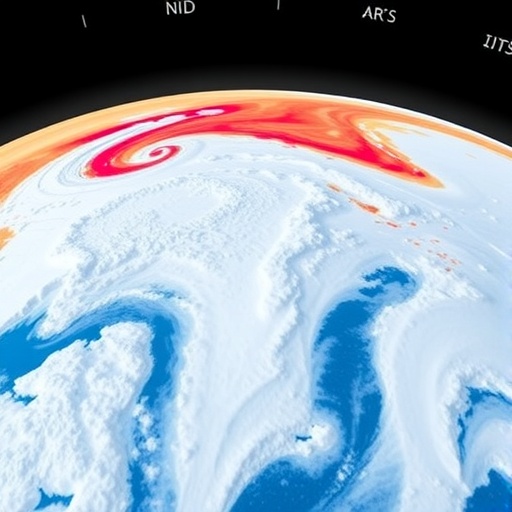
In a groundbreaking advancement for oceanographic research, a team of scientists led by Fu, Han, and Wang has unveiled a detailed portrait of the western Arctic Ocean, revealing previously undetected hotspots of small mesoscale eddies. Utilizing state-of-the-art wide-swath satellite altimetry technology, this study, soon to be published in Communications Earth & Environment, sheds light on the complex and dynamic nature of the Arctic’s mesoscale circulation. This breakthrough offers transformative insights into how these small eddies influence regional oceanography, sea ice dynamics, and the broader Arctic climate system, potentially enabling improved climate predictions and navigation safety in one of the most vulnerable regions on Earth.
Mesoscale eddies—swirling masses of ocean water ranging from a few to several tens of kilometers in diameter—play a crucial role in ocean mixing, nutrient transport, and heat distribution. However, capturing the full spectrum of these features in the Arctic has been historically challenging due to sparse observational coverage and the limitations of traditional satellite altimetry techniques. These conventional methods often miss smaller eddies or produce spatially incomplete datasets. The novel approach taken by Fu and colleagues employs wide-swath satellite altimetry, which greatly expands the measurable ocean surface area in each satellite pass, dramatically increasing spatial resolution and coverage.
This enhanced resolution has enabled the detection of numerous clusters of small mesoscale eddies concentrated in the western Arctic Ocean, an area previously thought to be relatively quiescent in terms of small-scale turbulent activity. The ability to quantify the scale, frequency, and spatial distribution of these eddies provides oceanographers with a new lens to understand the Arctic Ocean’s circulation patterns, energy transfers, and their interplay with sea ice. This is particularly significant given the Arctic’s rapid transformation under climate change, where changes in eddy activity could alter thermal and salinity gradients, impacting local ecosystems and global climate feedback mechanisms.
One of the study’s most compelling findings is the identification of “hotspots”—regions where small mesoscale eddies are especially dense and persistent throughout the observational period. These hotspots were conspicuously located near bathymetric features such as continental shelves and slopes, where interactions between water masses and the seafloor generate energetic vortices. Such regions represent critical zones for vertical mixing and cross-shelf exchange, processes vital to nutrient recycling, carbon sequestration, and the distribution of biological productivity in the Arctic marine environment.
The research leveraged cutting-edge sensor technology capable of capturing detailed sea surface height anomalies, crucial for identifying the swirling movements that indicate eddy presence. This methodological innovation marks a significant step forward from previous altimetry missions that struggled with ice coverage and limited swath widths, as the wide-swath instruments can measure ocean surface topography even in challenging polar conditions. This opens up vast new opportunities for long-term monitoring of mesoscale dynamics under the unprecedented seasonal sea ice loss unfolding in the Arctic.
Fu and colleagues used sophisticated data processing and machine learning algorithms to distinguish true eddy signatures from measurement noise and other oceanographic features. They validated their findings against in situ observations and high-resolution ocean models, ensuring robustness and reliability. The refined detection of smaller eddies enriches understanding of ocean turbulence in the Arctic and challenges the previously simplified models of regional circulation that primarily accounted for larger, more easily detectable features.
From a climatological perspective, these eddies have considerable implications for heat transport. Small-scale eddies contribute to the lateral redistribution of ocean heat and freshwater, potentially influencing sea ice melt rates and feedback loops that accelerate Arctic warming—a phenomenon with global repercussions. As such, the discovery of concentrated eddy hotspots highlights critical regions where ocean-atmosphere interactions may be intensified, directly affecting weather patterns and polar amplification of climate change.
The study also advances the frontier of remote sensing in polar regions, demonstrating that future satellite missions equipped with wide-swath altimeters can continuously observe and analyze mesoscale structures with unprecedented clarity. This capability enables the creation of comprehensive eddy climatologies and real-time monitoring systems that could inform marine navigation and resource management in increasingly accessible Arctic waters due to ice retreat.
In ecological terms, enhanced eddy activity hotspots may foster localized biological productivity by enhancing vertical nutrient fluxes from deeper waters. This process can influence food webs, affecting everything from phytoplankton blooms to higher trophic levels including commercially important fish species and marine mammals. Understanding where and when these eddies develop thus has important implications for Arctic fisheries and conservation strategies.
The findings reported by Fu, Han, Wang, and their team pave the way for integrating high-resolution mesoscale dynamics into coupled climate and Earth system models. By providing unprecedented detail on the spatial heterogeneity of eddy activity, these results challenge existing assumptions and underscore the need for more sophisticated representation of oceanic fine-scale processes in predictive frameworks.
Moreover, these mesoscale eddy hotspots may serve as sentinel indicators for broader changes in the Arctic system, responding sensitively to shifts in wind patterns, ocean stratification, and ice cover. Monitoring their evolution could yield early warning signals of ecosystem disruption or tipping points in the Arctic marine environment, thus enhancing adaptive management practices.
The research highlights the vital importance of international collaboration and investment in next-generation satellite infrastructure to probe earth system dynamics in hard-to-reach polar areas. As nations eye Arctic shipping routes and resource extraction, understanding the physical oceanographic complexity shaped by mesoscale eddies will be essential for safe and sustainable operations.
In summary, this pioneering study unlocks a heretofore hidden dimension of Arctic oceanography by revealing the ubiquity and significance of small mesoscale eddies in the western Arctic Ocean. The application of wide-swath satellite altimetry has not only expanded our observational capabilities but also transformed conceptual models of polar ocean dynamics. As the Arctic rapidly evolves, such insights are indispensable for decoding the region’s complex environmental puzzle and anticipating the consequences for global climate.
Cite Scienmag News
Violet Maxwell. (April 13, 2026). Satellite Altimetry Uncovers Arctic’s Tiny Eddy Hotspots. Scienmag. https://scienmag.com/satellite-altimetry-uncovers-arctics-tiny-eddy-hotspots/
Violet Maxwell. "Satellite Altimetry Uncovers Arctic’s Tiny Eddy Hotspots." Scienmag, 13 April 2026, https://scienmag.com/satellite-altimetry-uncovers-arctics-tiny-eddy-hotspots/. Accessed 3 September 2026.
Violet Maxwell. "Satellite Altimetry Uncovers Arctic’s Tiny Eddy Hotspots." Scienmag. April 13, 2026. https://scienmag.com/satellite-altimetry-uncovers-arctics-tiny-eddy-hotspots/


