


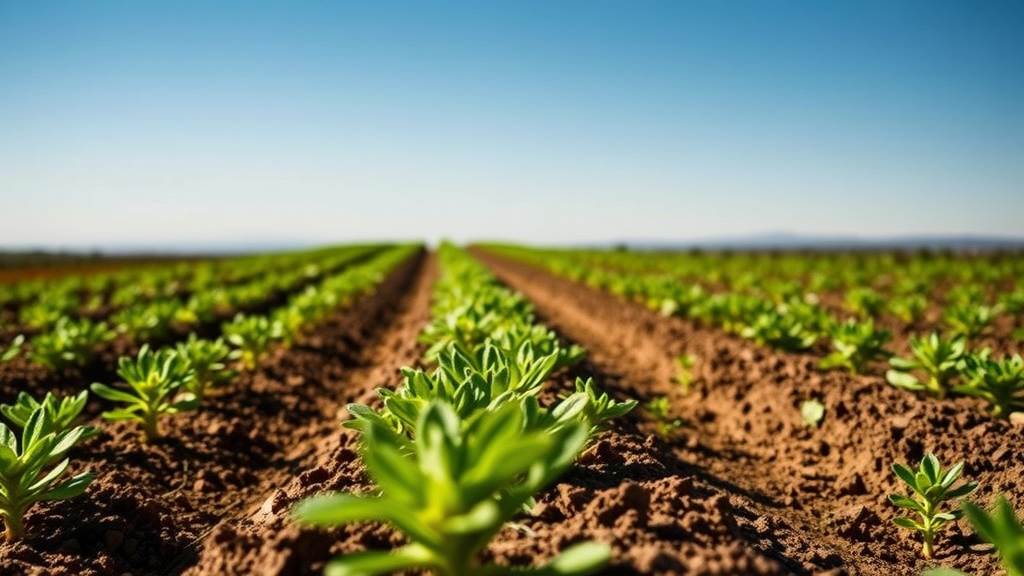
The Salk Institute for Biological Studies has received an $18 million grant from the Bezos Earth Fund to carry its climate-focused plant research out of the laboratory and into farmers’ fields. The three-year project, known as ROOTS, will test whether soybean plants engineered to grow deeper, stronger roots can lock more carbon into soil while withstanding the droughts and diseases that increasingly threaten global agriculture. For a research program that has spent six years dissecting the molecular machinery of roots, the grant marks a decisive shift from discovery science to proof-of-concept testing under real-world conditions, combining artificial intelligence, field trials, soil carbon measurements, and plant-microbe studies into a single integrated effort.
The new award builds directly on a $30 million Bezos Earth Fund grant awarded in 2020, which helped launch the first phase of Salk’s Harnessing Plants Initiative. That initial investment enabled Salk scientists to identify 347 potential gene candidates linked to carbon-storing root traits and to advance 37 separate projects spanning genes and crops. With that foundational catalog in hand, researchers can now prioritize the most promising genetic modifications and evaluate how they perform outside the controlled environment of the greenhouse. The latest grant brings the Bezos Earth Fund’s total support for the institute to $48 million, a level of sustained investment that reflects growing confidence in the idea that agriculture itself can become a carbon removal technology.
Wolfgang Busch, professor and director of the Harnessing Plants Initiative, emphasized that the transition from lab to field depends on understanding how plants behave in complex environments. “We are deeply grateful to the Bezos Earth Fund for their partnership and vision,” Busch said. “Harnessing the power of plants to address global challenges begins with foundational science and understanding how plants interact with soil, microbes, and environmental stresses. This support allows us to uncover how roots grow and function in complex environments and swiftly translate those discoveries into solutions that benefit farmers, ecosystems, and communities around the world.” His framing captures the central technical challenge of the project: a root trait that looks spectacular in a growth chamber may fail entirely when it encounters compacted soil, variable moisture, and competing microbial communities.
Roots are among the most overlooked components of the food system, yet they play an outsized role in both plant health and the global carbon cycle. Deeper roots can push carbon below the layer of soil most frequently disturbed by plowing and tilling, where it is far less likely to be released back into the atmosphere. Larger root systems deposit more plant material underground, feeding organic matter into soil profiles that can persist for decades or centuries. Perhaps most importantly, roots rich in suberin, a natural cork-like compound, can help carbon remain in soil longer because suberin decomposes slowly, acting as a molecular shield around the carbon-rich tissues it permeates. Together with beneficial soil microbes, particularly fungi that form intimate partnerships with plant roots, these traits can transform farmland from a carbon source into a carbon sink while making soils healthier and more resilient.
For the Bezos Earth Fund, the ultimate measure of success is whether the technology works for the people who grow the world’s food. “The Bezos Earth Fund looks for innovations that can change the equation for people and the planet,” said Andy Jarvis, director of Future of Food at the Bezos Earth Fund. “ROOTS is a golden opportunity to develop the next generation of crops, plants that are productive and resilient for farmers and able to draw carbon dioxide from the air and store it in the soil. That is the kind of solution agriculture needs.” The funder’s emphasis on farmer utility underscores a recurring failure mode in climate-focused crop research: varieties engineered for carbon storage that sacrifice yield, or resilience traits that only perform under laboratory conditions, simply will not be adopted at the scale needed to matter.
Central to the project’s speed is RootGPT, a planned open-access artificial intelligence platform designed by Salk scientists to accelerate the identification of useful root traits. The system will analyze the institute’s accumulated data on plant genes, root characteristics, soil carbon dynamics, and plant-fungus relationships, then suggest promising genetic changes for scientists to test in the lab, greenhouse, and field. Crucially, the results of those experiments will feed back into the platform, allowing its predictions to improve iteratively with each round of testing. The goal is to compress the timeline for identifying which root traits actually matter and moving them into crop varieties that agricultural partners can evaluate, replacing years of trial-and-error screening with a data-driven design loop.
Measuring whether deeper and stronger roots genuinely increase durable soil carbon is the scientific heart of ROOTS. Salk will conduct laboratory, greenhouse, and field studies tracking how root size, root depth, suberin content, and plant-fungus partnerships affect carbon storage over time. The project will extend an ongoing field study in Illinois and add new Midwest field trials to test whether Salk Ideal Soybean varieties can store more carbon than conventional varieties across multiple growing seasons. Multi-year trials are essential because soil carbon measurements are notoriously variable from season to season, and only sustained observation can distinguish genuine, durable sequestration from short-term fluctuations in organic matter.
The modeling behind the project is ambitious. Salk’s estimates suggest that enhanced root traits could add one to two metric tons of carbon dioxide removal per hectare per year if they perform as expected in field conditions, equivalent to roughly 0.45 to 0.89 US tons per acre annually. ROOTS is explicitly designed to test that potential and strengthen the evidence base for long-term soil carbon storage, converting a theoretical projection into measured field data. Beyond carbon, the project will evaluate whether deeper-rooted soybean lines can better tolerate drought and disease, comparing engineered lines under both stress and normal conditions while simultaneously tracking soil health and carbon storage. The team will search for trait combinations that support strong agronomic performance while moving more carbon underground, recognizing that climate-focused crops will only scale if they deliver value in farmers’ fields.
Translation from research to commercial agriculture will continue through Cquesta, a spinout company created to move Salk Ideal Plant traits from the institute’s laboratories into crop varieties that can be tested and, if successful, scaled. “Scientific discovery is the first step, but getting improved crops into farmers’ fields requires strong partnerships between research institutions and the agricultural sector,” said Andrew Baum, CEO of Cquesta. “We’re excited to continue working with Salk to translate these breakthroughs into crop varieties that strengthen agricultural resilience while bringing the benefits of advanced root traits to farms in the US and around the world.” The partnership model reflects a growing recognition that academic breakthroughs in plant genetics rarely reach farmers without dedicated commercialization pathways.
Soybean is the first target crop for practical reasons as much as scientific ones: it is widely grown across millions of hectares, well characterized genetically, and well suited for testing both carbon and resilience traits. The same root trait strategies developed in soybean could later be applied to other staple crops, including maize, rice, and wheat, multiplying the potential climate impact across the global food system. If ROOTS succeeds, farmers could one day plant soybean varieties bred to handle stress aboveground while quietly storing more carbon belowground, turning every growing season into an opportunity for climate repair. The project represents a test of one of the most compelling ideas in modern agricultural science: that the humble root, hidden beneath every field, can be reengineered to help stabilize the planet’s climate while feeding its people.
Subject of Research: Field testing of deeper-rooted, carbon-storing soybean crops enhanced through AI-driven root trait research
Article Title: Salk Institute moves deeper-rooted crop research from lab discovery to field testing
Article References: Salk Institute moves deeper-rooted crop research from lab discovery to field testing. (n.d.). Original publication
Image Credits: AI Generated
DOI: Not provided
Keywords: Salk Institute, Bezos Earth Fund, ROOTS project, Harnessing Plants Initiative, soybean, soil carbon, suberin, RootGPT, carbon sequestration, drought resilience, plant-microbe interactions, Cquesta
Cite Scienmag News
Alan Morgan. (September 22, 2026). Salk Institute Takes Deeper-Rooted Carbon-Storing Crops From Lab to Field With $18 Million Boost. Scienmag. https://scienmag.com/salk-institute-takes-deeper-rooted-carbon-storing-crops-from-lab-to-field-with-18-million-boost/
Alan Morgan. "Salk Institute Takes Deeper-Rooted Carbon-Storing Crops From Lab to Field With $18 Million Boost." Scienmag, 22 September 2026, https://scienmag.com/salk-institute-takes-deeper-rooted-carbon-storing-crops-from-lab-to-field-with-18-million-boost/. Accessed 4 October 2026.
Alan Morgan. "Salk Institute Takes Deeper-Rooted Carbon-Storing Crops From Lab to Field With $18 Million Boost." Scienmag. September 22, 2026. https://scienmag.com/salk-institute-takes-deeper-rooted-carbon-storing-crops-from-lab-to-field-with-18-million-boost/


