


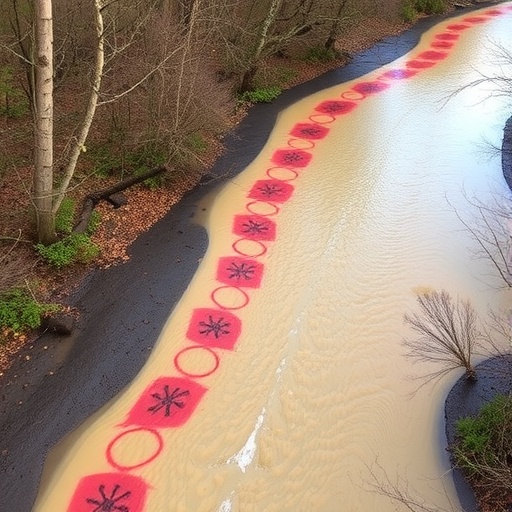
In a groundbreaking study published recently in Communications Earth & Environment, researchers have unveiled how alterations in river channels can drastically reshape flood hazards and their impacts on surrounding communities. This investigation shines a critical light on the dynamic relationship between evolving fluvial landscapes and the increasing challenges of flood risk management in a rapidly changing environment.
River channels are not static; they continuously evolve through natural processes such as sediment transport, erosion, and deposition. Yet, human activities including land use changes, dam construction, and river engineering have accelerated these modifications, sometimes with unintended consequences. The research team led by Hawker, Darby, and Slater meticulously analyzed these changes to uncover how they influence flood hazards in both immediate and downstream areas.
The core revelation of the study is that river channel adjustments can either amplify or reduce flood risk depending on their specific nature and timing. As channels shift, they may alter flow velocity, floodplain connectivity, and water storage capacity, leading to unpredictable flood hazard outcomes. For instance, river channel narrowing due to sediment deposition can increase flow depth and velocity, heightening flood hazards, while channel widening may reduce flood peaks but expand floodplain inundation zones.
Using a combination of high-resolution hydrodynamic modeling and long-term geomorphological data, the authors quantified how historical river changes have already affected flood regimes in multiple case study regions. Their models demonstrated that subtle shifts in channel morphology not only influence flood magnitudes but also rearrange the spatial distribution of floodwaters, potentially impacting areas previously considered safe.
Importantly, the study describes how the legacy of prior channel changes continues to influence present and future flood vulnerability. This “river memory” means flood risk assessments must integrate an understanding of channel evolution over decadal timescales. Traditional flood mapping that relies solely on historic flood events without considering morphological changes risks underestimating or misrepresenting flood hazards.
Another pivotal element addressed is the interplay between channel change and flood defense infrastructure. Flood barriers and levees are often designed without accounting for the dynamic river channel processes that can undermine their effectiveness. The research highlights scenarios where river adjustments have compromised defenses, causing unexpected breaches, or conversely, improved natural attenuation capacities when channels migrate away from critical infrastructure.
Climate change further complicates this already complex picture. With projections indicating more extreme precipitation patterns, rivers are poised to experience more frequent and intense flooding events. Coupled with channel modifications, these shifts increase uncertainty in predicting flood hazards. The authors stress the urgency of integrating real-time river morphology monitoring into adaptive flood risk management strategies to keep pace with these evolving risks.
The study also delves into the ecological consequences linked to river channel changes and flooding. Floodplains that became more connected due to channel migration support richer biodiversity and natural water filtration, which can mitigate flood impacts downstream. However, human-induced channel restrictions often disconnect these floodplains, leading to reduced ecosystem services and heightened flood severity.
To support their claims, the researchers employed satellite imagery, LiDAR measurements, and sediment transport models, providing a multi-faceted understanding of the river systems under review. These methodologies allowed for capturing both rapid channel shifts during extreme flood events and gradual changes over decades, presenting a comprehensive view of channel-flood hazard interactions.
Policy implications arising from this research are profound. The authors advocate for flood risk frameworks that incorporate the dynamic nature of river channels rather than static representations. This approach encourages flexible land use planning, investment in nature-based solutions, and the redesign of infrastructure to accommodate evolving river morphodynamics better.
Furthermore, the paper raises awareness about the importance of involving interdisciplinary teams in flood risk management, combining geomorphologists, hydrologists, ecologists, and engineers. Such an integrated perspective fosters more robust strategies that can anticipate and adapt to channel-driven changes affecting flood hazards.
Community engagement also emerges as a key factor for success. The study suggests that educating citizens on the implications of river channel changes can galvanize local support for adaptive measures like managed floodplain restoration and relocation initiatives. Public acceptance and participation are essential to implement these proactive approaches before catastrophic flooding events occur.
The authors underscore that ignoring river channel dynamics in flood management may result in severe economic and social consequences, as unexpected flood patterns could catch planners and residents off guard. Their findings call for a paradigm shift in how society perceives and copes with flood risks related to riverine environments.
In conclusion, this comprehensive investigation into river channel evolution’s role in flooding highlights a critical, yet often underestimated, driver of flood hazard variability. By advancing scientific understanding and offering actionable insights, Hawker, Darby, Slater, and colleagues provide a crucial template for improved flood hazard prediction and mitigation in a world where both rivers and climate are increasingly unpredictable.
This pioneering research invites further studies into the complex feedback mechanisms between hydrological extremes and river morphology and sets the stage for next-generation flood resilience efforts that blend engineering, ecology, and robust science.
Cite Scienmag News
Violet Maxwell. (May 6, 2026). River Channel Changes Amplify Flood Hazards Impact. Scienmag. https://scienmag.com/river-channel-changes-amplify-flood-hazards-impact/
Violet Maxwell. "River Channel Changes Amplify Flood Hazards Impact." Scienmag, 6 May 2026, https://scienmag.com/river-channel-changes-amplify-flood-hazards-impact/. Accessed 4 September 2026.
Violet Maxwell. "River Channel Changes Amplify Flood Hazards Impact." Scienmag. May 6, 2026. https://scienmag.com/river-channel-changes-amplify-flood-hazards-impact/


