


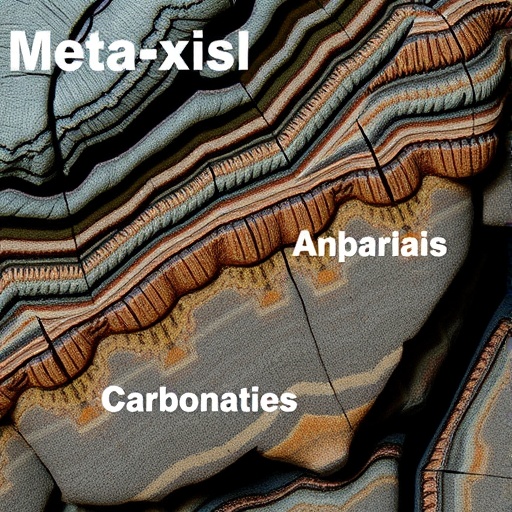
In a groundbreaking study published recently in Communications Earth & Environment, researchers have unveiled a novel geological phenomenon that is reshaping our understanding of carbonatite genesis in complex orogenic environments. The team led by Groppo, Tursi, and Frezzotti has provided compelling evidence that anatexis—partial melting—of meta-marls can generate (silico-)carbonatites, suggesting an innovative petrogenetic pathway that challenges decades of traditional theory.
Carbonatites, igneous rocks characterized predominantly by carbonate minerals, are rare but have captivated geologists due to their unique chemical composition and enigmatic origins. Historically, these rocks have been attributed to deep mantle processes, with most models proposing their formation via mantle-derived magmas rich in carbonate components. The new findings, however, highlight a crustal melting process that can produce silicate-carbonate melts directly from sedimentary precursors in collisional mountain belts, thus forging a new paradigm for their genesis.
Orogenic settings—regions of intense mountain-building through tectonic plate convergence—are typically zones of high pressure and temperature, facilitating complex metamorphic transformations. Meta-marls, sedimentary rocks rich in calcium carbonate and silicate minerals, become prime candidates for partial melting under appropriate conditions. The research team systematically investigated meta-marls subjected to high-grade metamorphism deep within orogenic roots and observed that localized melting can culminate in the production of silico-carbonatite magmas.
The process of anatexis described implicates specific pressure-temperature conditions that promote decarbonation reactions alongside silicate partial melting. Such hybrid melts embody a unique chemical signature rich in calcium, silica, and carbonate species, effectively blending characteristics typical of both silicate magmas and carbonate melts. This hybrid nature might explain some of the chemical and mineralogical complexities seen in natural carbonatite occurrences worldwide.
Crucially, this study utilized state-of-the-art petrological and geochemical analytical techniques, including high-resolution scanning electron microscopy, Raman spectroscopy, and in situ trace element analyses. These methods enabled the team to trace the transformation of solid meta-marl precursors into silico-carbonatitic melts at the microscopic scale, revealing textures and compositional gradients consistent with partial melting and melt segregation processes.
The implications of such a crustal anatectic origin for carbonatites extend beyond mere petrogenesis. The presence of silico-carbonatite magmas in orogenic settings suggests that these magmas could play a previously underestimated role in the geochemical cycling of carbon within subduction zones and continental collision zones. This finding might influence global carbon budgets by offering a pathway for mobilizing carbon from buried sedimentary sequences back to the surface or into the mantle wedge.
Moreover, silico-carbonatite magmas generated through anatexis of meta-marls could also serve as a potential source for economically important mineralization. Carbonatite complexes are known hosts for rare earth elements (REEs), niobium, and phosphorus among other critical commodities. Understanding a new petrogenetic pathway opens exciting possibilities for exploring similar deposits in orogenic belts where meta-marls are abundant yet previously overlooked.
The authors also propose that fluid processes accompanying partial melting are critical for the mobilization and concentration of volatiles, particularly CO₂, within these melts. The interplay of fluid phases and melt dynamics directly influences mineral crystallization sequences and may lead to the formation of characteristic fenitization halos observed around many carbonatite bodies.
From a broader tectonic perspective, the study enriches the concept of crustal differentiation and magmatism in convergent margin settings. Whereas previous global models emphasize mantle plume or deep mantle slab melting origins for carbonatites, this research points to significant contributions from shallow crustal reprocessing. This implies that sedimentary basin composition and tectonic burial histories must be more carefully considered when interpreting ancient carbonatite occurrences.
The recognition of silico-carbonatites emerging from meta-marl anatexis also invites reevaluation of certain enigmatic volcanic centers where mixed carbonate-silicate magmas erupt in proximity to thrust zones or metamorphic core complexes. It suggests that crustal melting under pressure-temperature regimes attainable during orogeny may be more widespread and significant than once assumed.
Furthermore, the study’s integration of experimental petrology with natural sample observations sets a new benchmark for future investigations into unusual carbonate-rich magmatism. By replicating meta-marl melting under controlled lab conditions, the researchers deciphered melt compositions, temperatures, and volatile contents that closely resemble natural silico-carbonatite magmas, providing a robust mechanistic framework.
Another exciting aspect of this research lies in the potential climatic feedbacks tied to carbonatite formation via crustal melting. Carbon mobilization associated with silico-carbonatite magmas may impact long-term carbon sequestration or release, affecting atmospheric CO₂ fluxes over geological timescales, particularly during phases of mountain belt uplift and erosion.
The revelation that meta-marls—common sedimentary rocks—can act as a direct source of carbonatite magmatism also fosters a closer interdisciplinary dialogue between sedimentologists, metamorphic petrologists, and igneous petrologists. It invites reexamination of sedimentary basin evolution and burial metamorphism not only in terms of mechanical deformation but also their capacity to generate magmatic products influencing crustal architecture.
Looking ahead, this research paves the way for refined geophysical imaging to detect silico-carbonatite bodies in active or ancient mountain ranges. If geophysical signatures associated with these melts can be identified, it would revolutionize mineral exploration efforts and broaden our understanding of orogenic magmatism’s diversity.
In conclusion, the pioneering work by Groppo and colleagues opens a transformative chapter in igneous petrology by demonstrating that anatexis of meta-marls is a viable, perhaps even widespread, mechanism for generating (silico-)carbonatites in orogenic settings. This shifts the conceptual framework surrounding carbonatite origins from a mantle-centric to a crustally integrated perspective, with profound implications for geochemical cycles, mineral resources, and tectonic processes.
As our knowledge of Earth’s deep processes grows ever more intricate, this discovery stands as a testament to the power of integrative, multi-technique research in unveiling the dynamic interplay between sedimentary, metamorphic, and magmatic realms. The carbonatite puzzle, long alluring and mysterious, gains fresh clarity through the lens of meta-marl anatexis, promising exciting advances in Earth sciences for decades to come.
Cite Scienmag News
Violet Maxwell. (May 6, 2026). Anatexis of Meta-Marls Forms Carbonatites in Orogenies. Scienmag. https://scienmag.com/anatexis-of-meta-marls-forms-carbonatites-in-orogenies/
Violet Maxwell. "Anatexis of Meta-Marls Forms Carbonatites in Orogenies." Scienmag, 6 May 2026, https://scienmag.com/anatexis-of-meta-marls-forms-carbonatites-in-orogenies/. Accessed 3 September 2026.
Violet Maxwell. "Anatexis of Meta-Marls Forms Carbonatites in Orogenies." Scienmag. May 6, 2026. https://scienmag.com/anatexis-of-meta-marls-forms-carbonatites-in-orogenies/


