


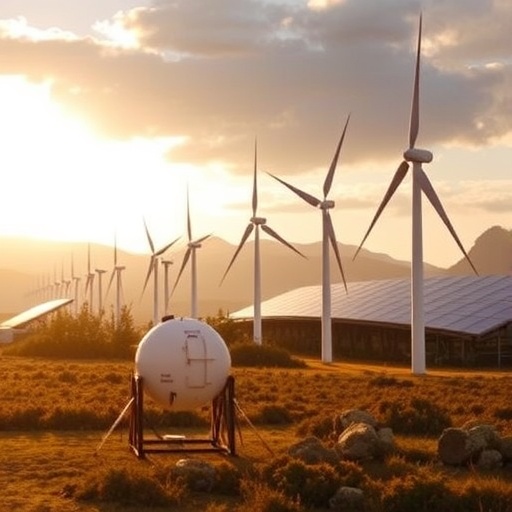
As the global energy landscape progressively shifts towards renewable sources, the reliability and efficiency of wind and solar power systems emerge as critical factors for sustaining the energy transition. Recent research by Sun, He, Li, and colleagues, published in Nature Communications (2026), delves into the intricate relationship between high-impact weather phenomena and the performance of wind and solar power infrastructure under future climate scenarios in China. This comprehensive study sheds light on how evolving weather extremes, fueled by climate change, could drastically influence the stability and output of renewable energy systems, posing new challenges and necessitating adaptive strategies.
The researchers begin by contextualizing the significance of renewables within China’s ambitious energy framework. China, being the world’s largest wind and solar power producer, has committed to dramatic expansions of its clean energy capacity to cut greenhouse gas emissions in the coming decades. However, the nation is also highly vulnerable to extreme weather events such as typhoons, heatwaves, droughts, and heavy precipitation—events that future climate models predict will increase both in frequency and intensity. Understanding how these weather extremes interact with renewable technologies is essential for both operational planning and infrastructural resilience.
Utilizing state-of-the-art climate models combined with high-resolution meteorological data, the team simulated future weather conditions under various greenhouse gas emission scenarios aligned with the IPCC framework. These models forecast alterations not only in average climatic parameters but, more crucially, in the distribution and occurrence of extreme weather events. The study specifically quantifies how these changes could affect wind and solar resource availability, turbine stress loads, and photovoltaic (PV) panel efficiency across different Chinese regions, capturing spatial heterogeneity that directly informs regional energy strategy.
One of the pivotal findings centers on the dual nature of climate impacts on solar power. While increased solar irradiance due to fewer cloud cover days could enhance photovoltaic energy yield in certain inland areas, extreme heat events pose a paradoxical threat. Elevated temperatures negatively affect PV cell efficiency by increasing thermal resistance and accelerating material degradation. Moreover, the higher frequency of dust storms in arid northern regions, exacerbated by changing precipitation patterns, leads to significant soiling losses that require increased maintenance and cleaning, adding operational costs and downtime.
In parallel, the study highlights the vulnerability of wind power systems to changing wind regimes and extreme high-impact wind events. Future projections suggest a decrease in average wind speeds in some coastal areas, which could reduce baseline wind power generation potential. However, these regions may simultaneously face an increased frequency of intense typhoons. Such storms not only produce wind speeds beyond turbine design thresholds but also cause structural damage and operational shutdowns, leading to periods of zero generation. The research underscores the necessity for wind turbine design innovation to accommodate higher gust loads and for grid operators to develop more robust contingency plans.
The interplay between temperature, humidity, and air density also reveals complex implications for turbine aerodynamics and mechanical stresses. Increased atmospheric turbulence during heatwaves and storm conditions intensifies turbine blade fatigue, potentially shortening equipment lifespans. The study draws attention to the importance of incorporating advanced materials engineering and real-time stress monitoring to extend turbine operational reliability under increasingly harsh conditions.
An additional dimension considered is the hydrological impact on solar thermal technologies and the cooling requirements of photovoltaic power plants. Regions facing prolonged drought periods may encounter water scarcity, complicating heat dissipation processes essential to maintain optimal PV performance and prevent system overheating. This nexus between water resource constraints and energy production outlines a critical area for integrated resource management and technological adaptation.
Geographically, the research finds marked regional disparities. Southern and coastal provinces may experience amplified risk from cyclonic activities and flooding, necessitating elevated structural fortifications and flood-proof infrastructure. In contrast, northern and western areas, while benefiting from increased solar irradiance, confront intensified dust exposure and temperature extremes. These insights call for regionally tailored strategies in technology deployment, maintenance schemes, and policy frameworks to maximize renewable energy robustness.
The study also evaluates the implications for grid stability and energy security. The intermittent interruptions and variability engendered by harsh weather events can impose significant stress on grid management, requiring enhanced flexibility and storage solutions. This calls for accelerated integration of battery storage, demand response technologies, and diversification of energy portfolios to buffer against supply volatility.
Sun and colleagues advocate for the integration of high-resolution climate projections into energy planning and infrastructure design processes. They argue that current standards and models insufficiently capture the multifaceted risks posed by extreme weather in a changing climate. Incorporating these insights can drive innovation in turbine and solar panel design, optimize site selection, and refine maintenance scheduling — essential moves to safeguard investments and ensure continuous energy supply.
Importantly, the research transcends technical considerations and highlights socio-economic dimensions. The disproportionate impact of weather extremes on previously disadvantaged regions could exacerbate energy access inequalities, particularly if infrastructure damage leads to prolonged outages. Thus, resilience measures must be inclusive, accounting for vulnerable communities and aligning with equitable energy transition goals.
The study’s predictive approach provides a valuable framework for future research, inviting multidisciplinary collaboration across climatology, engineering, economics, and policy disciplines. Its methodical quantification of climate-induced impact severity marks a pivotal advancement toward dynamic, forward-looking renewable energy system design.
In summary, the investigation by Sun et al. emphatically reveals that as climate change accelerates, so too does the complexity of operating renewable energy systems. The dual imperatives of maximizing energy yield and ensuring resilience against the unpredictability of high-impact weather demand urgent, coordinated action across scientific, governmental, and industrial sectors.
Going forward, public and private stakeholders must embrace adaptive management strategies incorporating cutting-edge climate data analytics and resilient technology deployment. As the backbone of a sustainable energy future, wind and solar power systems must evolve symbiotically with a changing climate, transforming challenges into innovations that will define the next era of clean energy generation.
By articulating a nuanced understanding of the climatological and technical interactions impacting renewable infrastructure, this landmark study illuminates a crucial pathway to achieving both energy transition objectives and climate resilience in China — and by extension, across similar vulnerable regions worldwide.
Cite Scienmag News
Faith Mcneil. (May 26, 2026). Future Climate Risks to China’s Wind and Solar. Scienmag. https://scienmag.com/future-climate-risks-to-chinas-wind-and-solar/
Faith Mcneil. "Future Climate Risks to China’s Wind and Solar." Scienmag, 26 May 2026, https://scienmag.com/future-climate-risks-to-chinas-wind-and-solar/. Accessed 5 September 2026.
Faith Mcneil. "Future Climate Risks to China’s Wind and Solar." Scienmag. May 26, 2026. https://scienmag.com/future-climate-risks-to-chinas-wind-and-solar/


