


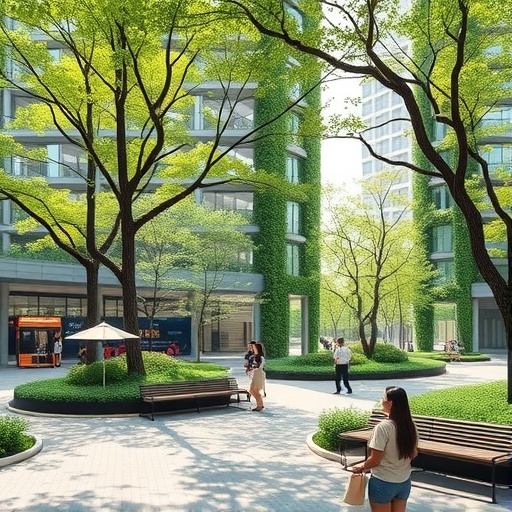
Green space attached to public buildings is often presented as an uncomplicated climate solution: add vegetation to roofs, terraces, façades, courtyards or other building-connected areas, and cities gain shade, biodiversity and carbon storage. But a new China case study argues that the climate value of such projects cannot be judged by counting plants or estimating how much carbon vegetation may absorb. The construction itself has a carbon cost, and that cost can arise long before the first leaf begins photosynthesis. In a study published in npj Urban Sustainability, Peng, Lv, Zeng and colleagues introduce a process-based carbon accounting framework designed to trace those emissions across the construction of public building-attached green space. The work addresses a question increasingly central to urban climate policy: when a city builds nature into its architecture, does the intervention deliver a genuine carbon benefit after every stage of the project is included?
The distinction matters because urban greening is not carbon-neutral by default. A planted roof or vertical garden may require concrete, steel, waterproofing membranes, drainage layers, growing media, irrigation equipment, protective structures and specialized transport. Manufacturing these materials can consume energy and release greenhouse gases, while excavation, land preparation, machinery use and construction-site activity add further emissions. Even the soil or engineered substrate supporting vegetation may carry an embodied carbon burden. “Embodied carbon” refers to emissions associated with producing, transporting, installing, maintaining and eventually replacing materials, rather than emissions released during a building’s daily operation. If these emissions are ignored, a project may appear to be a climate win simply because its plants are visible, while the largest sources of construction-related pollution remain hidden inside the structure.
The framework described by the researchers is process-based, meaning it follows the physical activities and material flows that make a project possible. Instead of assigning a broad average emission value to an entire green-space category, process-based accounting breaks the intervention into operations and inputs. Analysts can examine the quantity of concrete used for support elements, the mass of steel or other structural materials, the volume and composition of planting media, the energy consumed by machinery, the distances materials travel and the maintenance required after completion. Each element can then be linked to an emissions factor, such as the greenhouse gases released per kilogram of cement or per tonne-kilometre of freight. The approach is technically demanding, but it offers a much clearer picture of where emissions originate and which design decisions have the greatest influence on the final carbon balance.
That carbon balance is more complicated than a single number. A green installation can generate emissions immediately through construction, while the biological benefits unfold over years. Plants remove carbon dioxide from the atmosphere through photosynthesis, but the carbon is not necessarily stored permanently. Some returns to the atmosphere as leaves, roots and other organic matter decompose; some may remain in soil or biomass for longer periods. Vegetation can also reduce building energy demand by providing shade, insulating surfaces or cooling surrounding air, potentially lowering emissions from heating and air-conditioning. At the same time, irrigation pumps, lighting systems, fertilizers and replacement plants may create additional operational emissions. A credible assessment therefore needs to distinguish between direct construction emissions, ongoing maintenance emissions, changes in building energy use and carbon retained in vegetation or soil.
The China focus gives the research an important real-world setting. Chinese cities have expanded rapidly, and public buildings are increasingly being designed alongside roofs, terraces, façades and other forms of attached greenery. These projects can serve multiple urban goals at once, from reducing heat exposure and managing stormwater to improving public space and supporting ecological connectivity. Yet the environmental performance of each project depends on local conditions. Climate affects plant survival and irrigation demand; urban density influences transport distances and cooling benefits; construction standards determine the amount of structural reinforcement required; and regional electricity and manufacturing systems shape the emissions intensity of materials and equipment. A framework developed around a China case study can help make those relationships visible rather than treating all green infrastructure as interchangeable.
One of the most consequential technical choices in carbon accounting is the definition of the system boundary. If an assessment begins only when plants are installed, it may miss the emissions from producing the materials beneath them. If it ends when construction is complete, it may overlook years of watering, pruning, fertilization and repairs. If it counts carbon absorbed by vegetation but ignores eventual removal or replacement, it may overstate long-term storage. A process-based framework can establish a life-cycle boundary that follows the project from material extraction and manufacturing through transport, construction, operation, maintenance and end-of-life treatment. Such accounting is especially valuable for building-attached landscapes because their environmental performance depends on the interaction between biological systems and engineered systems. The plants may be alive, but the infrastructure that keeps them alive is manufactured, installed and maintained.
The study also points toward a more precise way to compare design alternatives. Two projects may contain the same area of greenery while producing very different carbon outcomes. A lightweight planting system may require less structural material than a deep intensive roof garden. Locally sourced substrate may reduce transport emissions compared with imported materials. Durable waterproofing or modular components may extend service life and reduce replacement-related emissions. Plant selection can influence irrigation needs, maintenance frequency, biomass accumulation and resilience under heat or drought. By tracing emissions process by process, planners can test these alternatives before construction and identify opportunities to reduce the project’s carbon payback period—the time required for operational savings and biological sequestration to compensate for initial emissions. The framework thus shifts the conversation from “How much green space was added?” to “What carbon consequences followed from every decision that added it?”
That shift is increasingly urgent as cities race to meet net-zero targets while expanding climate adaptation infrastructure. Urban greening is highly visible and politically attractive, which can make it tempting to promote projects through headline figures such as planted area, estimated carbon absorption or the number of new trees. But climate accounting demands more than attractive metrics. A project that stores carbon yet relies on emissions-intensive materials may deliver a smaller benefit than expected; another that requires frequent irrigation or replacement may lose much of its advantage over time. The researchers’ framework offers a way to expose these trade-offs and could support more credible environmental declarations, procurement standards and public investment decisions. It also underscores that carbon reduction and other benefits—cooling, habitat, recreation and stormwater control—should be evaluated together without allowing one benefit to conceal another project’s emissions.
The broader message is not that building-attached green space is ineffective, but that its climate promise depends on rigorous measurement and careful design. The China case study places carbon accounting at the center of an urban transformation that is often discussed primarily in visual or ecological terms. By connecting construction processes, material inventories, energy use and biological carbon dynamics, the framework can help researchers and planners distinguish genuine climate gains from carbon claims built on incomplete boundaries. As public buildings become laboratories for combining architecture and vegetation, that level of scrutiny may determine whether urban greening becomes a durable part of decarbonization strategy—or simply another form of infrastructure whose hidden emissions remain out of sight. The study’s significance lies in making those hidden processes count.
Cite Scienmag News
Courtney Benton. (August 17, 2026). China study unveils framework tracking construction carbon in public building green spaces. Scienmag. https://scienmag.com/china-study-unveils-framework-tracking-construction-carbon-in-public-building-green-spaces/
Courtney Benton. "China study unveils framework tracking construction carbon in public building green spaces." Scienmag, 17 August 2026, https://scienmag.com/china-study-unveils-framework-tracking-construction-carbon-in-public-building-green-spaces/. Accessed 3 September 2026.
Courtney Benton. "China study unveils framework tracking construction carbon in public building green spaces." Scienmag. August 17, 2026. https://scienmag.com/china-study-unveils-framework-tracking-construction-carbon-in-public-building-green-spaces/


