


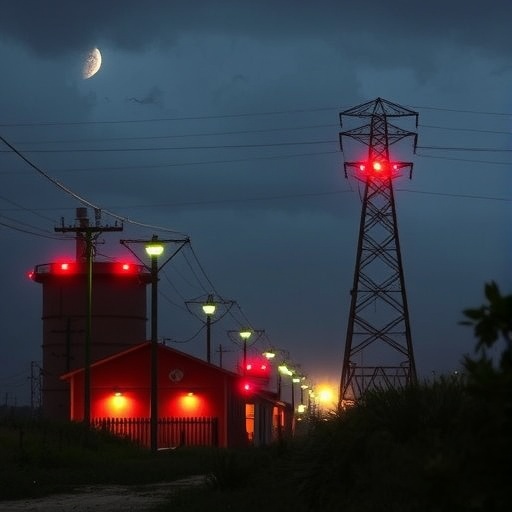
As climate change accelerates, a groundbreaking study led by the University of Michigan signals a troubling future for the Atlantic coast of the United States. The research projects a significant rise in hurricane-induced power outages particularly impacting Georgia and northern Florida. This is not just an environmental or engineering challenge; it also represents a stark social justice issue, disproportionately affecting Hispanic, non-white, low-income, and elderly communities. The intersection of increasing natural disasters and socio-economic vulnerability suggests the urgency for multi-layered intervention strategies.
The core scientific premise driving this projection hinges on the anticipated rise in global temperatures by an additional 1.5 degrees Celsius above pre-industrial levels—a threshold likely to be breached by the century’s end if comprehensive climate action remains elusive. This temperature increase accelerates the frequency and severity of tropical cyclones, which have already demonstrated a robust link to substantial power grid failures. Such storms’ intensification stems from warmer ocean temperatures fueling storm energy, slower storm forward speeds resulting in prolonged destructive impact, and increased moisture content leading to unprecedented rainfall amounts.
A critical finding of this study is the anticipation of power outages expanding into regions historically spared from frequent disruptions. The Northern Atlantic Coast, which has seen relatively few hurricane-induced blackout events, faces a looming escalation in vulnerability. Under scenarios of a roughly 3 degrees Celsius global temperature rise, the economic toll from outages is projected to nearly double. Presently, such events cost the U.S. economy approximately $6.2 billion annually; the forecasted figure soars to an estimated $11 billion in today’s dollars, underscoring the monumental scale of infrastructure challenge ahead.
The research team employed a sophisticated multi-disciplinary approach combining advanced climate modeling, extensive historical power outage datasets, and detailed socio-demographic analysis. Notably, they simulated 28,000 synthetic hurricanes based on extensive atmospheric and oceanic data, a method refined by Kerry Emmanuel, chief scientific officer at WindRisk Tech and formerly of MIT. These simulations provide unprecedented resolution in forecasting storm trajectories, intensities, and potential landfall zones critical for accurate risk modeling of power systems.
Beyond storm simulation, granular historic outage data at the Census tract level was analyzed. This enabled a nuanced understanding of outage patterns including micro-climatic factors such as local wind profiles, soil moisture, and tree root depth — all crucial variables influencing how storms translate into power infrastructure failure. Such detailed parameters enhance predictive accuracy and illuminate the complex physical interactions governing outage risks across diverse terrains.
Overlaying these data streams is a comprehensive socio-demographic assessment revealing that marginalized communities bear a disproportionately high outage burden. Hispanic and non-white populations, alongside economically disadvantaged and elderly residents, experience longer restoration times and more frequent service interruptions. These findings illuminate systemic inequities in infrastructure resilience, emergency response distribution, and adaptive capacity, raising urgent policy questions about fairness and targeted resource allocation.
The study further utilized the Interruption Cost Estimate Calculator, an innovative tool designed to quantify economic losses from outages as well as potential benefits of reliability improvements. This allows decision-makers to evaluate the cost-effectiveness of resilience investments systematically. For example, hardening power grids against extreme weather events could mitigate the exponential rise in outage-related costs, representing a critical leverage point to reduce future economic and social damages.
While certain regions such as northern Florida and the southern Atlantic seaboard (including North Carolina and South Carolina) are projected to face significant outage risk increases, areas like Texas show more variability and model uncertainty. This geographic heterogeneity highlights the necessity for region-specific adaptation strategies rather than a one-size-fits-all approach. It calls for precision engineering solutions focused on local vulnerabilities and climate projections to optimize resilience.
The consequences of these escalating storm-induced outages extend beyond inconvenience. Power failures disrupt transportation, healthcare, economic activity, and public safety, disproportionately impacting vulnerable populations. The estimated 78% of major power outages attributable to weather events—predominantly tropical cyclones—signal a systemic vulnerability in the nation’s critical infrastructure. As storms intensify with climate change, these risks magnify, threatening economic stability and social equity.
From a technical standpoint, the study emphasizes the interaction between atmospheric science, electrical engineering, and industrial operations research. Power systems must contend with increased physical stress from high winds, flooding, and debris impacts. Simultaneously, grid operators face challenges restoring services rapidly amid widespread damage. This necessitates innovations in grid hardening techniques, automated fault detection, and decentralized energy resources to bolster resilience.
The research team’s interdisciplinary framework—melding climate projections, infrastructure vulnerability assessments, and social equity analyses—represents a paradigm shift in disaster risk modeling. It moves beyond traditional hazard forecasting to integrate human dimensions of risk encapsulating who suffers most and why. This approach is vital to ensuring that future investments in adaptation do not merely protect infrastructure but also promote fairness and social justice.
Ultimately, this alarming forecast underscores an urgent call to action for policymakers, utility companies, and communities. Proactive system hardening and climate adaptation measures are necessary to avert escalating outage risks and associated costs. Moreover, equitably distributing these investments to protect the most vulnerable populations is paramount. The study’s insights provide a scientifically rigorous roadmap for navigating the increasingly turbulent intersection of climate change and critical infrastructure resilience.
Cite Scienmag News
Sloane Callahan. (October 17, 2025). Rising Hurricane Outages: A Detailed Analysis of Locations and Communities Facing Increased Future Power Cuts. Scienmag. https://scienmag.com/rising-hurricane-outages-a-detailed-analysis-of-locations-and-communities-facing-increased-future-power-cuts/
Sloane Callahan. "Rising Hurricane Outages: A Detailed Analysis of Locations and Communities Facing Increased Future Power Cuts." Scienmag, 17 October 2025, https://scienmag.com/rising-hurricane-outages-a-detailed-analysis-of-locations-and-communities-facing-increased-future-power-cuts/. Accessed 3 September 2026.
Sloane Callahan. "Rising Hurricane Outages: A Detailed Analysis of Locations and Communities Facing Increased Future Power Cuts." Scienmag. October 17, 2025. https://scienmag.com/rising-hurricane-outages-a-detailed-analysis-of-locations-and-communities-facing-increased-future-power-cuts/


