


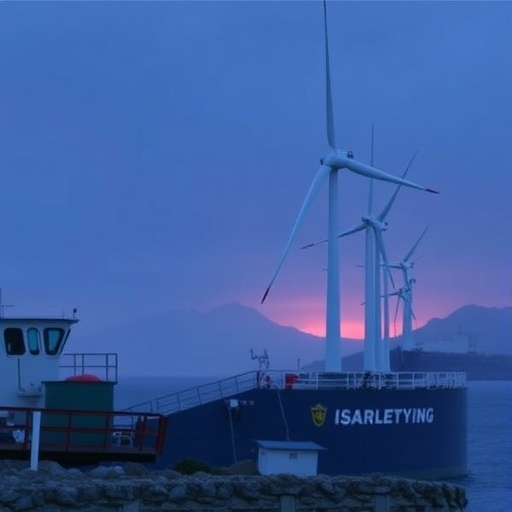
As the world accelerates its transition toward renewable energy, offshore wind farms have become a cornerstone of sustainable electricity generation. However, the resilience of these critical infrastructures increasingly comes under threat from intensifying extreme wind events, a challenge that demands urgent scientific attention and innovative engineering solutions. A recent study published in Nature Communications by Zhao, Tao, Chen, and colleagues provides a striking analysis of how extreme wind patterns are escalating and the significant implications this has for the future stability and efficiency of offshore wind energy systems.
Offshore wind energy has long been lauded for its capacity to harness powerful and consistent sea winds, delivering abundant clean energy with minimal land-use conflicts. Yet, this promising renewable resource is inherently vulnerable to the very forces it depends on. The researchers emphasize that extreme winds—characterized by sudden, intense gusts and high-velocity wind regimes—are not only becoming more frequent but also exhibit unprecedented magnitudes in various wind farm regions worldwide. These extreme conditions possess the potential to induce mechanical stress beyond design limits, accelerating wear or causing catastrophic failures in turbines.
The team employed sophisticated climate modeling combined with high-resolution wind data to scrutinize historical and projected patterns of extreme wind events over the next several decades. Unlike average wind speeds that might remain relatively stable or increase moderately, the simulations reveal a clearly upward trend in both the intensity and frequency of extreme wind gusts. This finding contradicts earlier assumptions that climate change might lead to the overall calming of certain wind regimes. Instead, it outlines a more complex scenario in global wind dynamics, driven by the interaction between evolving atmospheric circulation and regional weather phenomena.
Importantly, the study quantifies the projected increases in wind extremes using metrics tailored to turbine engineering standards, such as maximum gust speeds and extended duration high-wind episodes. These metrics are critical for understanding fatigue loads and the risk profile of turbine components such as blades, gearboxes, and foundations. The researchers warn that turbines currently installed or planned without adaptation measures might face a considerably elevated risk of mechanical failure, with direct consequences on maintenance costs, downtime, and energy yield.
One of the key contributions of this work lies in its integration of extreme wind assessments into resilience planning for offshore wind. The authors propose that current design regulations need to be revisited and updated to accommodate these newly identified risks. Incorporating probabilistic climate models into turbine certification processes could help the industry build more robust infrastructure capable of enduring the challenging environmental loads forecasted under climate scenarios. This task involves not only structural fortifications but also advancements in real-time monitoring technology and adaptive operational strategies.
Furthermore, the study highlights the spatial heterogeneity of extreme wind intensification, emphasizing that some offshore regions will experience more severe changes than others. For instance, areas with historically high wind variability or those close to storm tracks may become hotspots for extreme gusts. Understanding these geographic disparities is pivotal for policymakers and energy developers to prioritize investments and design location-specific mitigation measures. This tailored approach contrasts with traditional one-size-fits-all models, promising better allocation of resources and enhanced longevity of wind assets.
The implications of escalating extreme winds extend beyond physical infrastructure to the broader economics of offshore wind projects. As turbines suffer more frequent or intense mechanical stress, the cost of insurance, maintenance, and replacement components will inevitably rise. Such economic pressures might slow down the pace of offshore wind expansion unless mitigated by technological innovation and regulatory foresight. Hence, the research calls for a coordinated response involving climate scientists, engineers, insurers, and policymakers to ensure that the offshore wind sector remains sustainable and scalable.
An intriguing aspect of this research is its potential to influence future turbine technology development. Engineers may need to explore novel materials with higher fatigue resistance, adaptive blade designs capable of adjusting to fluctuating loads, and advanced control systems that optimize turbine operation in extreme weather conditions. These innovations could transform the industry’s capacity to cope with an uncertain climate landscape and enhance overall system resilience against other climate-related disturbances, such as waves and corrosion.
Significantly, the paper raises awareness about the interconnectedness of climate change impacts on different renewable energy infrastructures. While solar power faces challenges from extreme heat and drought, offshore wind is confronted with intensifying physical forces. This interconnected vulnerability underscores the need for integrated energy system planning that considers the full suite of environmental risks. Strategic diversification and redundancy within renewable portfolios could prevent costly disruptions and help maintain grid stability under extreme climatic stress.
Moreover, the findings have vital implications for global efforts to meet net-zero carbon emission targets. Offshore wind is positioned as a cornerstone technology for decarbonizing electricity grids, especially in coastal nations. Failure to adapt to rising extreme wind threats could undermine these ambitions, making long-term climate goals more elusive. The authors advocate for accelerated research and infrastructure upgrades as essential components of resilient clean energy transitions capable of withstanding the evolving climate reality.
Lastly, this research serves as a wake-up call for industry stakeholders to rethink risk assessment frameworks. Traditional methods often rely on historical weather records that may no longer represent future conditions accurately. The study demonstrates the critical role of climate-resilient design informed by forward-looking data, emphasizing that legacy practices might leave infrastructure dangerously underprepared. Industry-wide adoption of these insights could markedly improve reliability and confidence in offshore wind energy investments going forward.
In conclusion, Zhao, Tao, Chen, and colleagues provide a sobering yet essential perspective on the challenges posed by increasing extreme winds to offshore wind energy resilience. Their multi-disciplinary approach combining climatology, engineering, and risk management charts a path toward safeguarding one of the planet’s most promising renewable energy sources amid growing climatic volatility. As the offshore wind sector continues its rapid global expansion, integrating these findings into practice will be indispensable for securing a sustainable and robust clean energy future.
Cite Scienmag News
Faith Mcneil. (November 4, 2025). Rising Extreme Winds Threaten Offshore Wind Resilience. Scienmag. https://scienmag.com/rising-extreme-winds-threaten-offshore-wind-resilience/
Faith Mcneil. "Rising Extreme Winds Threaten Offshore Wind Resilience." Scienmag, 4 November 2025, https://scienmag.com/rising-extreme-winds-threaten-offshore-wind-resilience/. Accessed 3 September 2026.
Faith Mcneil. "Rising Extreme Winds Threaten Offshore Wind Resilience." Scienmag. November 4, 2025. https://scienmag.com/rising-extreme-winds-threaten-offshore-wind-resilience/


